Best App to Learn Chinese in 2026: 8 Apps Compared
By ToolNimba Editorial Team November 10, 2026 10 min read

- Top pick
 HelloChinese
Absolute beginners
Starting price$11.99 per monthCheck out HelloChineseRead our review - Runner-up
 Duolingo
Daily habit building
Starting priceFreeCheck out DuolingoRead our review - Also great
 LingoDeer
Structured grammar lessons
Starting priceSee websiteCheck out LingoDeerRead our review
How we researched this
We compared official pricing and feature pages, app store listings, privacy policies and public user reviews. Prices change, so check the provider's site before you pay.
Key takeaways
- HelloChinese is the strongest starting app for most beginners, because it teaches tones, pinyin, and characters in a clear order with speaking practice.
- No single app covers everything: pair a course app with a dictionary such as Pleco-style lookup, reading practice, and live speaking for faster progress.
- Pimsleur is best for speaking and listening on the move, while italki is best when you are ready for real conversation with a tutor.
- Prices vary by billing period, so check the monthly, quarterly, and annual rates in the app store before you commit to a year.
Quick comparison
| Name | Best for | Starting price | Free plan | |
|---|---|---|---|---|
| HelloChinese | Absolute beginners | $11.99 per month | Yes | Visit |
| Duolingo | Daily habit building | Free | Yes | Visit |
| LingoDeer | Structured grammar lessons | See website | Yes | Visit |
 Rosetta Stone | Immersive visual learning | $19.99 per month | Free trial | Visit |
 Pimsleur | Audio speaking practice | $19.95 per month | Free trial | Visit |
 ChineseSkill | Game-like beginner lessons | See website | Yes | Visit |
 Super Chinese | Short daily lessons | See website | Yes | Visit |
 italki | Live tutor lessons | See website | No | Visit |
The best app to learn Chinese
Learning Chinese means learning tones, characters, and listening skills at the same time, which is why the best app depends on your level and your routine. The apps below cover beginners, commuters, visual learners, and students ready for live conversation, and they can be combined as you progress.
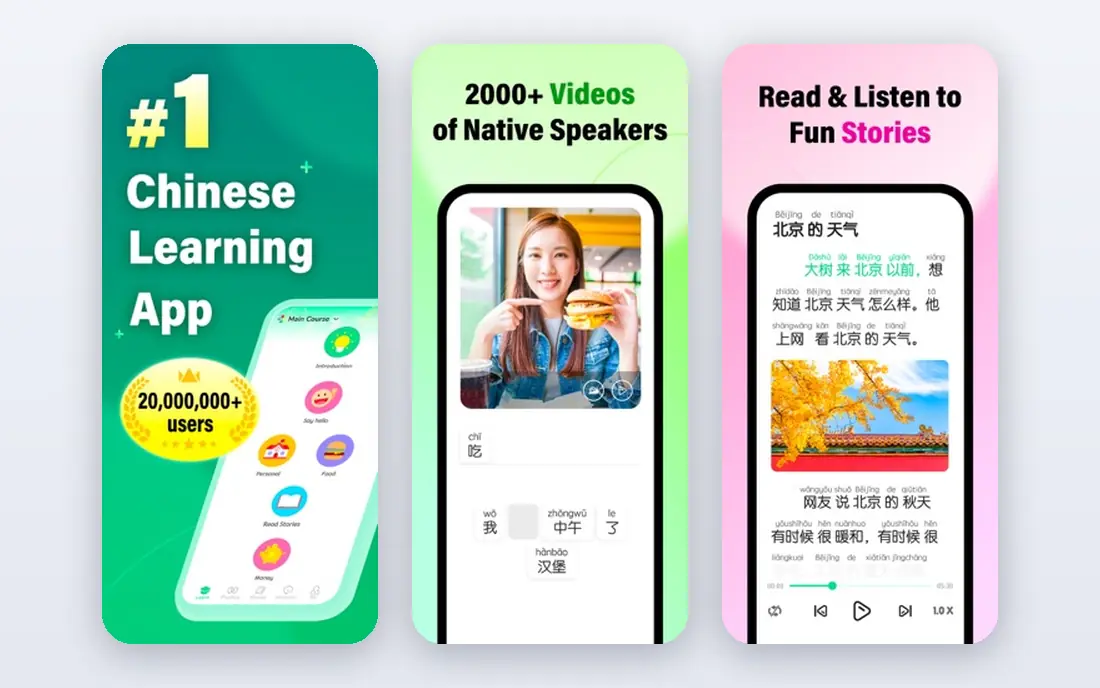
HelloChinese is the app we recommend first to most people starting Mandarin from zero. It teaches pinyin and tones step by step, then moves into characters, vocabulary, and short conversations in a logical order. Speech recognition from the first lesson means you practice saying words, not just tapping the right answer, which matters because tones change word meaning in Mandarin.
Lessons take only a few minutes, so a daily habit is easy to keep, and the app covers listening, speaking, reading, and writing in each unit. The main limit is depth: content thins out after the intermediate stages, so advanced learners will need reading material and tutor lessons next. For the first months, though, HelloChinese gives a stronger foundation than most rivals, at $11.99 per month or less on longer plans.
- Speaking-first lessons with tone feedback
- Clear path from pinyin to characters
- Bite-sized daily lessons
- Content thins out after intermediate levels
- Full access needs a paid subscription
- Immersive videos sit on higher tiers
Duolingo is the easiest app to start with, and that ease is its main strength. Its short, game-like lessons and streak system help many learners keep a daily habit, which is half the battle with Chinese. The free tier is genuinely usable for beginners, and the paid Super plan removes ads and adds offline lessons and unlimited hearts.
For serious progress, Duolingo alone is not enough. Grammar explanations are brief, character learning is less systematic than HelloChinese, and the course does not go as far for advanced learners. Use Duolingo as a daily warm-up or a second app alongside a structured course, rather than as your only method. If habit is your biggest problem, Duolingo is still a useful tool in the mix.
- Free to start
- Game-like streaks keep you returning
- Short lessons fit busy days
- Shallow grammar explanations
- Limited advanced Chinese content
- Speaking practice is thinner than HelloChinese
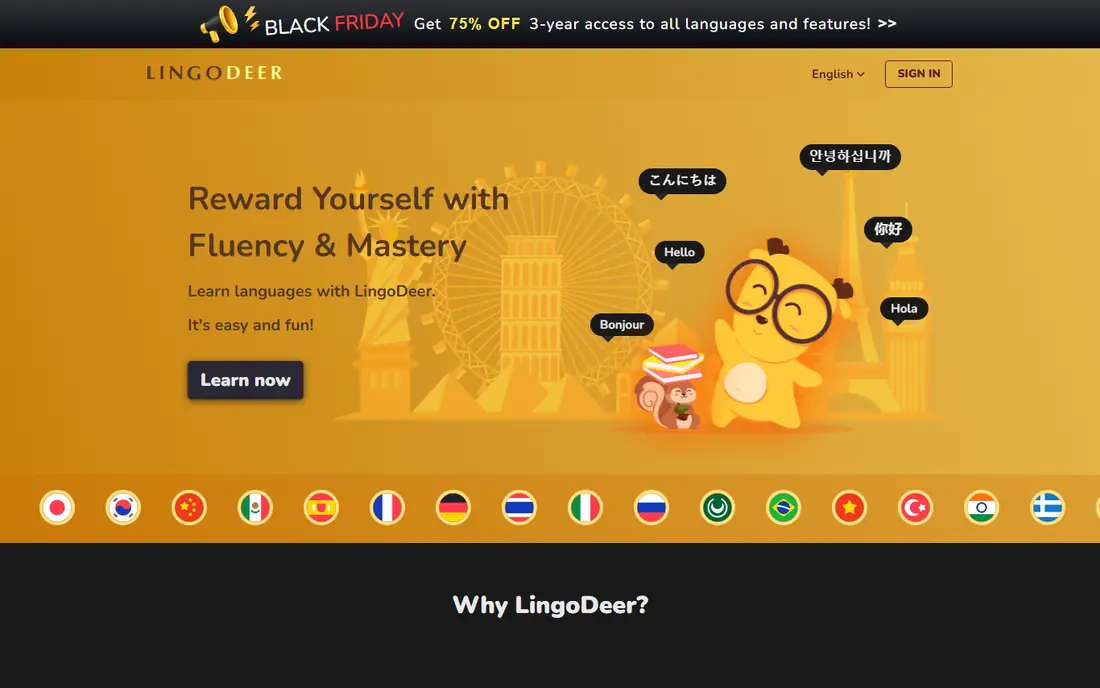
LingoDeer appeals to learners who want to understand why a sentence works, not just memorize it. Its lessons include grammar notes, sentence breakdowns, and structured review, which helps when Chinese word order and particles feel unfamiliar. The app was built with Asian languages in mind, so its Chinese course feels more considered than a generic language app add-on.
The course is not as long or as deep as a full textbook path, and pricing varies by app store and plan, so check the current rate before you subscribe. Speaking feedback is also thinner than HelloChinese. LingoDeer works best for learners who like structure and grammar, and who pair it with listening practice or tutor sessions for conversation.
- Clear grammar notes
- Structured path for Asian languages
- Offline lessons on paid plans
- Smaller Chinese course than some rivals
- Pricing varies by platform
- Less speaking feedback than HelloChinese
Rosetta Stone takes a different approach: it teaches through images and context, without translating into English. You learn words by seeing and hearing them used, which can build intuition for Chinese sounds and characters over time. Its speech recognition also gives feedback on pronunciation, and the course structure is steady and predictable.
That immersion has a cost. Learners who want clear grammar rules may feel lost, because Rosetta Stone does not explain grammar in the usual textbook way. The monthly price at $19.99 is also higher than HelloChinese or Duolingo, and the pace can feel slow if you already know some Chinese. Rosetta Stone suits visual learners who enjoy immersion and have time for a steady, long course.
- Immersive, image-based lessons
- Speech recognition
- Long-established course structure
- No explicit grammar explanations in the classic style
- Higher monthly price
- Slower pace for some learners
Pimsleur is the best pick for learners who study mainly by listening, such as during a commute or a walk. Each 30-minute audio lesson uses call-and-response: you hear a phrase, repeat it, and recall it later in the lesson, which builds speaking confidence and tone memory. That active recall is more useful for tones than tapping through multiple-choice drills.
Reading and writing are the weak points. Pimsleur focuses on speech, so you will need a separate app or book for characters and reading. Lessons are also longer than most app lessons, which suits commuters but not learners with only five minutes. At $19.95 per month for Premium, with a 7-day trial, Pimsleur is a strong second app for speaking, paired with HelloChinese or a reading tool.
- Excellent for speaking and listening
- Hands-free audio lessons
- Structured recall builds memory
- Limited reading and writing
- 30-minute lessons suit commutes more than short breaks
- Price is higher than app-only courses
ChineseSkill is a friendly, game-like option for absolute beginners who want a lighter alternative to HelloChinese. Its lessons cover pinyin, tones, vocabulary, and simple characters through short games and drills, and the free tier lets you test the style before paying. For a first taste of Mandarin, that low barrier helps.
Depth is the limit. ChineseSkill does not carry learners as far as HelloChinese or a tutor-based path, and its content beyond beginner levels is thinner. Treat it as a starter or a supplement for vocabulary games, not as a complete course to fluency. If you enjoy its style, use it alongside a structured app and move to reading and speaking practice as you progress.
- Fun, game-like lessons for beginners
- Covers pinyin, tones, and basic characters
- Free to start
- Less depth beyond beginner levels
- Fewer updates than larger rivals
- Limited advanced content
Super Chinese is built around short, daily lessons of about 10 minutes, which suits learners with a busy schedule. It uses AI review to repeat words you struggle with, and its beginner path moves from pinyin and tones into vocabulary and simple conversations in small steps. That bite-sized design makes it easier to study every day than a course that demands 30 minutes at a time.
Like other beginner apps, Super Chinese thins out at higher levels, and pricing can be confusing because it is shown in different currencies depending on your store. Check the price in your own currency before subscribing. Super Chinese is a good choice for slow-paced beginners who want a gentle daily routine, especially if HelloChinese feels too fast or too game-like.
- Bite-sized 10-minute lessons
- AI review of weak words
- Clear beginner path
- Less depth than HelloChinese for some learners
- Pricing is shown in different currencies
- Advanced content is limited
italki is not a course app, but it is the most effective step once you can hold a basic conversation. You choose a native tutor, book a one-on-one video lesson, and practice speaking, listening, and correction in real time. Lessons can focus on tones, job interviews, travel Chinese, or HSK exam preparation, depending on your goal, and prices vary by tutor, often from a few dollars to over $20 per lesson.
The cost adds up if you take several lessons a week, and tutor quality varies, so try trial lessons with two or three tutors before committing. italki also works best after a foundation from HelloChinese or Pimsleur, because a tutor can correct and extend what you already know faster than starting from zero. For speaking progress, no app replaces live conversation, and italki is the most flexible way to get it.
- One-on-one lessons with native tutors
- Flexible scheduling and tutor choice
- Lessons tailored to your goals
- Costs add up per lesson
- Quality varies by tutor
- Needs a basic foundation to get the most value
How we picked these
We compared apps that teach Mandarin Chinese specifically, using official pricing pages, app store listings, course descriptions, and public reviews. We favored apps with a clear beginner path, tone and pinyin teaching, and speaking or listening practice, and we included both self-study apps and live tutoring so readers at different levels have a next step. We did not rank apps on user counts or ratings alone, because those numbers change and say little about whether an app teaches tones well.
How to study Chinese with apps
Start with tones before characters. Spend your first weeks on pinyin and the four tones plus the neutral tone, because a wrong tone can change a word entirely. HelloChinese or Pimsleur will help here, but also listen to native speech daily, even for a few minutes, so your ear learns the pitch patterns. Do not rush past tones to learn more vocabulary: a small vocabulary said correctly beats a large one said with flat tones.
Then add reading and speaking in layers. Use a course app for daily lessons, a dictionary app for looking up words you meet, and graded reading material once you know basic characters. When you can introduce yourself and ask simple questions, add a weekly italki lesson for correction and real conversation. That mix of course, reading, and speaking covers the gaps that any single app leaves, and it keeps study varied enough to sustain for months.
Sources
Frequently asked questions
What is the best app to learn Chinese for beginners?
HelloChinese is the best starting app for most beginners, because it teaches tones, pinyin, and characters in order with speaking practice. Duolingo is a good free backup for habit building, and Pimsleur helps with speaking on the move. Combine a course app with listening and, later, tutor lessons for the fastest progress.
How long does it take to learn Chinese with an app?
It depends on your target. Basic conversation for travel can take several months of daily study, while reading newspapers or working in Chinese takes years. Apps help most in the first year, when tones, pinyin, and basic characters are the focus. Consistent daily study matters more than the app you choose.
Is Duolingo good for learning Chinese?
Duolingo is good for building a daily habit and learning basic vocabulary, and its free tier is useful for beginners. It is less strong on grammar, tones, and advanced content than HelloChinese or Pimsleur. Use Duolingo as a supplement, not as your only Chinese course, if you want solid progress.
Should I learn simplified or traditional characters?
Most learners start with simplified characters, which are used in mainland China and Singapore and taught by most apps. Traditional characters are used in Taiwan, Hong Kong, and Macau. Choose based on where you plan to travel, work, or read, and note that many apps default to simplified.
Do I need a tutor to learn Chinese?
You do not need a tutor at the start, when a course app covers tones and basics well. A tutor becomes very useful once you can speak in simple sentences, because live correction fixes tone and grammar errors that apps miss. A weekly italki lesson is a practical next step after a few months of app study.
What is HSK, and does it matter?
HSK is a standardized test of Chinese proficiency, with levels from beginner to advanced. It matters if you plan to study, work, or apply for programs in China, or if you want a clear goal for your learning. Many apps align their courses to HSK levels, which helps you track progress and choose reading material at the right level.