Best Apps to Buy Cars in 2026: 9 Apps Compared
By ToolNimba Editorial Team November 10, 2026 10 min read

- Top pick
 CarGurus
Checking if a price is a good deal
Starting priceFreeCheck out CarGurusRead our review - Runner-up
 Cars.com
Comparing local dealer inventory
Starting priceFreeCheck out Cars.comRead our review - Also great
 Autotrader
Largest selection and detailed search
Starting priceFreeCheck out AutotraderRead our review
How we researched this
We compared official pricing and feature pages, app store listings, privacy policies and public user reviews. Prices change, so check the provider's site before you pay.
Key takeaways
- CarGurus is our pick for price checking, thanks to deal ratings that compare a listing against similar cars nearby.
- Carvana and CarMax suit buyers who want a fully online purchase with home delivery and a return window.
- Cars.com, Autotrader, and Edmunds are best for research and comparing dealer inventory before you visit or negotiate.
- All apps below are free to download; car prices vary by vehicle, so always check the total price, fees, and history report before you pay.
Quick comparison
| Name | Best for | Starting price | Free plan | |
|---|---|---|---|---|
| CarGurus | Checking if a price is a good deal | Free | Yes | Visit |
| Cars.com | Comparing local dealer inventory | Free | Yes | Visit |
| Autotrader | Largest selection and detailed search | Free | Yes | Visit |
 Carvana | Fully online buying with delivery | Free | Yes | Visit |
 CarMax | No-haggle buying with returns | Free | Yes | Visit |
 Edmunds | Research and true market pricing | Free | Yes | Visit |
 TrueCar | Transparent dealer pricing for new cars | Free | Yes | Visit |
 Facebook Marketplace | Local private-party deals | Free | Yes | Visit |
 eBay Motors | Rare finds and auctions | Free | Yes | Visit |
The best apps to buy cars
Buying a car is a large purchase, so the app matters less than the checks you run before you pay. The best car buying app helps you compare prices, read dealer reviews, check history, and understand total cost including fees, taxes, and delivery. This article covers app and service features, not financial advice, and car prices themselves vary by vehicle. Use at least two apps for any serious search, and get an independent inspection for a used car when you can.

CarGurus is our first stop for any used car search because its deal ratings give an instant sense of value. Listings are labeled from Great Deal to Overpriced based on market analysis, and dealer ratings help you avoid sellers with a pattern of complaints. Price history on many listings shows whether a car has been sitting or recently reduced.
The rating is a guide, not a promise. A Great Deal label does not mean the car is in great condition, and dealer fees can change the total. Always read the full listing, check the history report, and confirm the out-the-door price. For price-conscious buyers, CarGurus remains the best reality check on this list.
- Deal ratings compare listings to market value
- Dealer ratings
- Price history on many listings
- Deal ratings are guidance, not a guarantee
- Some dealers add fees after the listed price
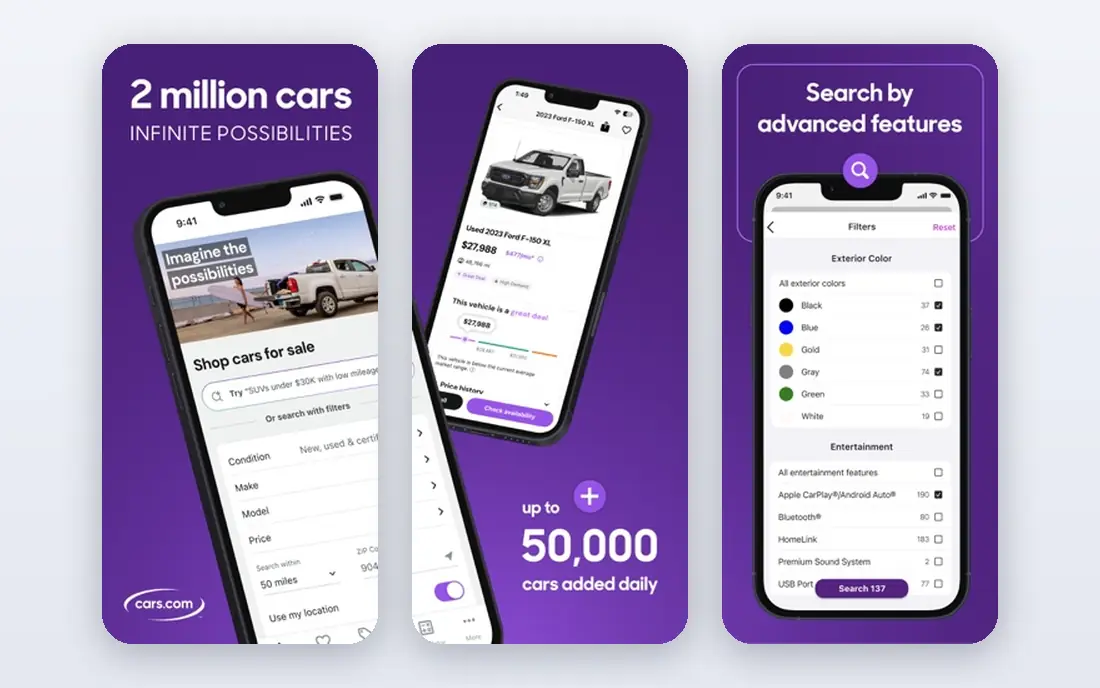
Cars.com is a strong all-round marketplace for comparing what local dealers actually have in stock. You can filter by make, model, price, mileage, and features, compare vehicles side by side, and read dealer reviews before you visit. Price alerts help you track a specific model while you decide.
The inventory leans toward dealers, so private-party bargains are less common here than on Facebook Marketplace. Listings can also go stale if a dealer does not update sold stock promptly. Use Cars.com to shortlist dealers and models, then confirm availability and total price directly before you travel to see a car.
- Large dealer inventory
- Dealer and salesperson reviews
- Market pricing and price alerts
- Private-party listings are thinner than dealer stock
- Some listings go stale
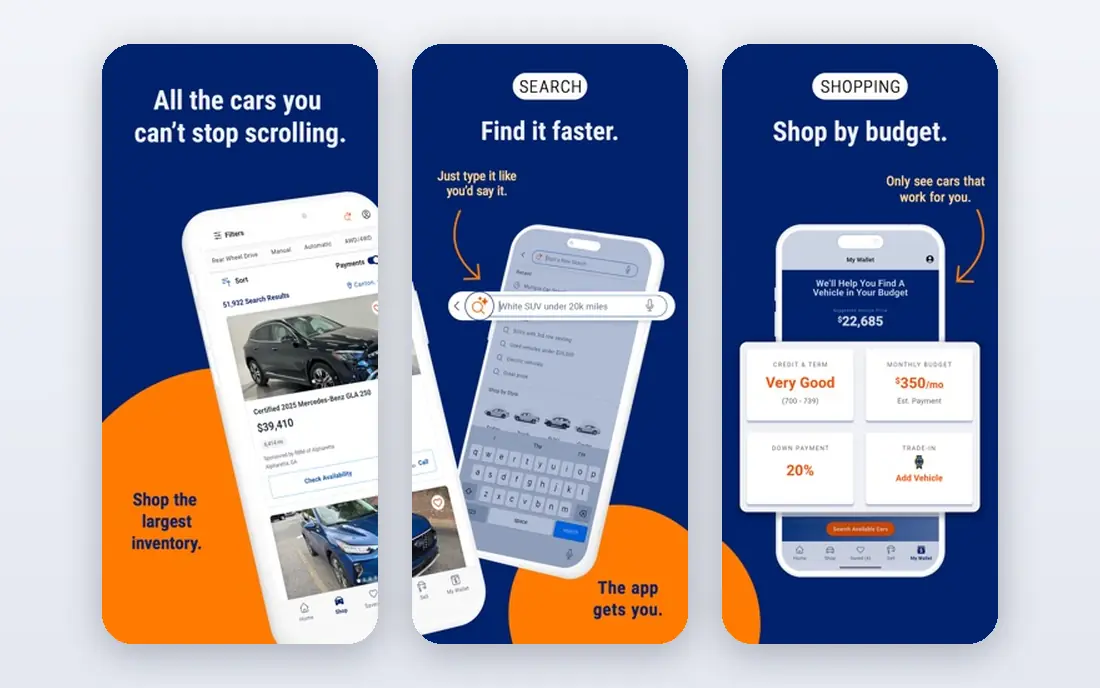
Autotrader offers one of the largest car selections in the US, with detailed filters for trim, drivetrain, fuel type, and features. That depth helps when you want a specific configuration rather than any car in a model range. Price analysis tools and dealer reviews add useful context to each listing.
As with any large marketplace, listing quality varies, and some dealers use low advertised prices with added fees. Treat Autotrader as a search and comparison tool first, and confirm the full price, history, and condition before you commit. For a hard-to-find trim or a wide search, its inventory is hard to beat.
- Very large inventory
- Detailed filters
- Price analysis and dealer reviews
- Listing quality varies by seller
- Dealer fees and add-ons need checking
Carvana suits buyers who want to skip the dealership entirely. You search, finance, and complete paperwork online, then get home delivery or pickup at a Carvana location. A 7-day return window, within mileage limits, gives you time to live with the car and get it inspected, which is a real advantage over a same-day dealer purchase.
The trade-off is price flexibility. Carvana prices are fixed, so you cannot negotiate a lower figure, and delivery fees may apply depending on location. Inspect the car promptly during the return window and check its history. For a low-pressure online purchase, Carvana is the leading pick.
- Fully online purchase
- Home delivery or pickup
- 7-day return window within mileage limits
- Prices are no-haggle, so negotiation is limited
- Delivery fees can apply in some areas
CarMax combines online shopping with a large physical store network. Prices are no-haggle, cars can be transferred between stores, and home delivery is available in many areas for a fee. Its 10-day return window is longer than Carvana, which gives more time for an inspection and a careful decision.
The cost of that convenience is price. CarMax prices often sit above a comparable private-party deal, since the company inspects, reconditions, and guarantees its cars. For buyers who value a return window and a simple process over the lowest possible price, CarMax is a strong choice.
- Large inventory
- No-haggle pricing
- 10-day return window
- Home delivery options
- Prices can sit above private-party deals
- Delivery fees may apply
Edmunds is best used before you buy, not as the place you buy. Its expert reviews, road tests, and True Market Value pricing help you judge what a car should cost and which trim and options are worth paying for. Comparison tools let you weigh rivals side by side on price, features, and ownership costs.
The limitation is that Edmunds does not sell cars directly, so you will still complete the purchase through a dealer or marketplace. Use it to set a target price and a shortlist, then search CarGurus, Cars.com, or Autotrader for matching listings. For research quality, Edmunds remains a top pick.
- Expert reviews and road tests
- True Market Value pricing
- Car comparison tools
- It is mainly a research tool, not a direct seller
- Inventory links out to dealers
TrueCar helps new-car buyers avoid the hardest part of dealership shopping: guessing a fair price. It shows market pricing based on what others paid, then connects you with dealers offering upfront prices for the car you configured. That transparency reduces haggling and gives you a clear target before you visit a dealer.
TrueCar does not ship cars or complete the sale itself, and its used inventory is thinner than the big used marketplaces. You still buy through a dealer, so confirm fees and add-ons in the final price. For a new car, especially a common model, TrueCar is a useful price check and dealer connector.
- Shows what others paid
- Connects buyers with dealers at upfront prices
- New-car focus
- Does not sell or deliver cars itself
- Used inventory is thinner than rivals
Facebook Marketplace is where many of the lowest private-party prices appear, especially for older or budget cars. You can message sellers directly, search locally, and find cars that never reach dealer sites. For a buyer with cash, patience, and mechanical knowledge, it can offer real bargains.
The risk is also highest here. Private sales usually carry no return policy or buyer guarantee, and scams are common, including fake listings and title problems. Never pay in advance, meet in a safe public place, check the title and history, and get an inspection. Marketplace rewards careful buyers and punishes rushed ones.
- Large local private-party inventory
- Direct seller messaging
- Often the lowest prices
- Higher scam risk
- No buyer guarantee on most private sales
- Listing quality varies widely
eBay Motors suits buyers looking for something unusual: a classic, a rare trim, a project car, or a specific older model that local dealers do not stock. Auctions and Buy It Now listings cover a wide range, and seller feedback gives some signal about reliability. It is also useful for price research on niche models.
Distance is the catch. You must arrange shipping or travel, inspections are harder, and return terms vary by seller. For a rare car, those hurdles may be worth it, but get a pre-purchase inspection from a local mechanic near the seller before you bid high. For everyday cars, a local marketplace is simpler.
- Huge range including rare and classic cars
- Auctions and Buy It Now
- Seller feedback history
- Shipping must be arranged separately
- Return terms vary by seller
- Inspection is harder at distance
How we picked these
We compared official app pages, app store listings, and marketplace features, focusing on apps that are actively offered to US car buyers in 2026. We checked inventory breadth, price tools, history and dealer information, delivery and return terms, and buyer protection. We did not claim hands-on testing, and car prices vary by vehicle, so confirm total price, fees, and history for the specific car before you buy.
How to buy a car through an app without costly mistakes
Start with research, not a listing. Use Edmunds and CarGurus to set a fair price range for the exact trim, mileage, and condition you want, then search two marketplaces for matches. Check the vehicle history report, confirm the title is clean, and ask for the out-the-door price including all dealer fees, taxes, and delivery charges. A low listed price means little until the total is in writing.
For used cars, get an independent pre-purchase inspection whenever the price justifies it, and test drive on varied roads, not just around the block. For online purchases, use the return window actively: inspect the car, check every feature, and drive it daily in the first days. Finally, arrange financing before you fall in love with a car, and never send payment to a private seller before you have seen the car and title in person.
Sources
Frequently asked questions
What is the best app to buy used cars?
CarGurus is our top pick for used cars because deal ratings help you judge price quickly, while Cars.com and Autotrader offer broad dealer inventory. Carvana and CarMax suit buyers who want delivery and a return window. Use two apps together for the best coverage.
What is the best app to buy a car for the lowest price?
Facebook Marketplace often has the lowest private-party prices, but it carries the highest scam risk and no return policy. CarGurus helps you spot fairly priced dealer cars, while TrueCar helps with new-car pricing. The lowest listed price is not always the lowest total cost, so check fees and condition.
Is it safe to buy a car fully online?
Buying from Carvana or CarMax is safer than a private online sale because both offer inspections, return windows, and established processes. Still, inspect the car during the return window and check its history. Avoid paying a private seller in advance or buying a car you have not seen or inspected.
Should I get a vehicle history report?
Yes, for any used car. A history report can reveal accidents, title brands, odometer issues, and prior ownership patterns. It does not replace a mechanical inspection, but it is a cheap check that can save you from a costly mistake. Ask the seller for the report or run one with the VIN yourself.
What fees should I check before buying a car?
Check dealer documentation fees, delivery or transfer fees, taxes, title and registration costs, and any add-ons such as warranties or protection packages. Ask for the out-the-door price in writing before you sign. For online purchases, confirm delivery fees and return terms, including mileage limits.