Best Baseball Card Scanner App in 2026: 9 Apps Compared
By ToolNimba Editorial Team November 9, 2026 9 min read

- Top pick
 CollX
Free scanning and marketplace
Starting priceFreeCheck out CollXRead our review - Runner-up
 Ludex
Accurate modern parallel pricing
Starting price$19.99 per monthCheck out LudexRead our review - Also great
 Card Ladder
Tracking collection value
Starting priceFreeCheck out Card LadderRead our review
How we researched this
We compared official pricing and feature pages, app store listings, privacy policies and public user reviews. Prices change, so check the provider's site before you pay.
Key takeaways
- CollX is the best free scanner for most collectors, with unlimited scans, a huge card database, and a built-in marketplace.
- Ludex is the most accurate on modern parallels and refractors, at $19.99 per month, which suits dealers and serious modern collectors.
- Card Ladder is the best tracker for watching a collection's value over time using real eBay sale data.
- For a true sale price, check eBay sold listings or 130 Point, because in-app values are estimates, not completed sale prices.
- Condition and grade move real prices more than any scan can show, so use a pre-grading tool before paying to grade a card.
Quick comparison
| Name | Best for | Starting price | Free plan | |
|---|---|---|---|---|
| CollX | Free scanning and marketplace | Free | Yes | Visit |
| Ludex | Accurate modern parallel pricing | $19.99 per month | Free trial | Visit |
| Card Ladder | Tracking collection value | Free | Yes | Visit |
 Sports Card Pro | Casual collection tracking | See website | Yes | Visit |
 eBay | Listing and sold-price checks | Free | Yes | Visit |
 130 Point | Real sold prices | Free | Yes | Visit |
 PreGradeCards | AI pre-grading before submission | See website | Free trial | Visit |
 TCGplayer | Trading card prices and marketplace | Free | Yes | Visit |
 Sports Card Investor | Market news and card values | See website | Yes | Visit |
The best baseball card scanner app
Scanning a card, tracking a collection, and finding what a card is really worth are three different jobs, and no single app does all three perfectly. The apps below cover each job, from free camera scanning to sold-price research. One warning applies to all of them: the value a scanner shows is an estimate, not what the card actually sold for. This is general information, not financial advice, and collectible prices can fall as well as rise.
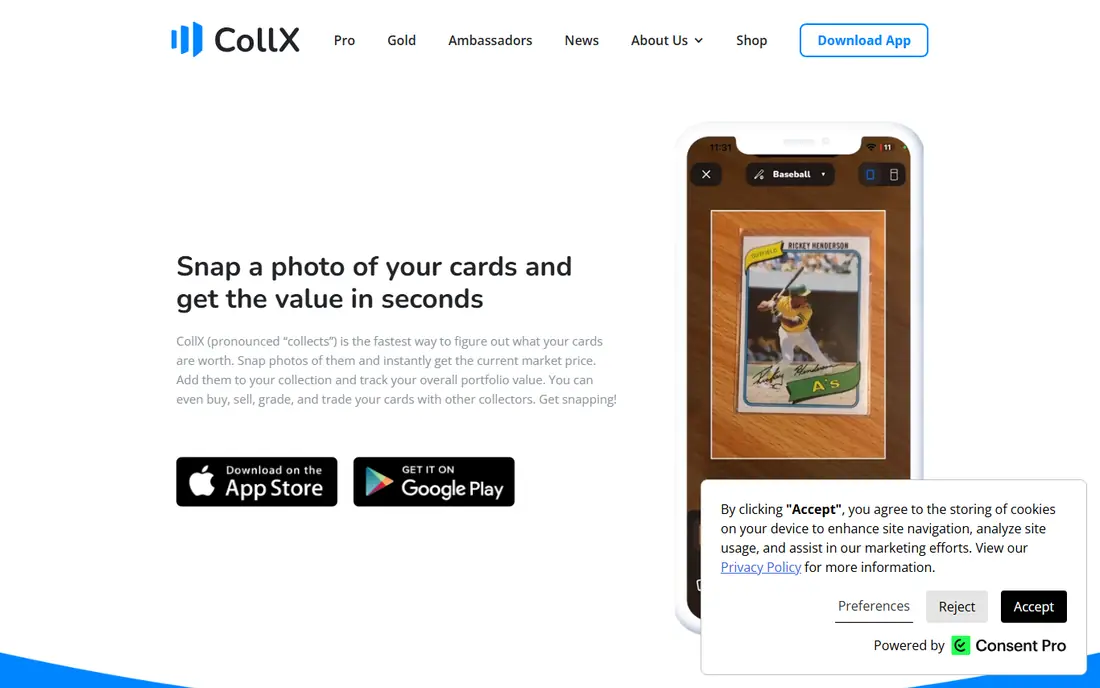
CollX is the best free scanner for most collectors. Point your phone camera at a card and it identifies the card, shows an estimated value based on historical auction prices, and adds it to your collection. The database covers sports and trading cards, and the built-in marketplace lets you buy and sell with a protection policy that holds payment until the card arrives.
The catch is accuracy on prices and tricky parallels. Independent testing puts CollX price estimates well above real eBay sold values, because the figures blend asking prices with sales, and parallel identification is less reliable than Ludex. Treat its number as a starting point, not a sale price. For free scanning and casual collecting, CollX is our top pick.
- Unlimited free scans
- Database of 17 million plus cards
- Built-in marketplace with buyer protection
- Price estimates run above real sold prices
- Parallel accuracy trails Ludex
- Pro needed for CSV export
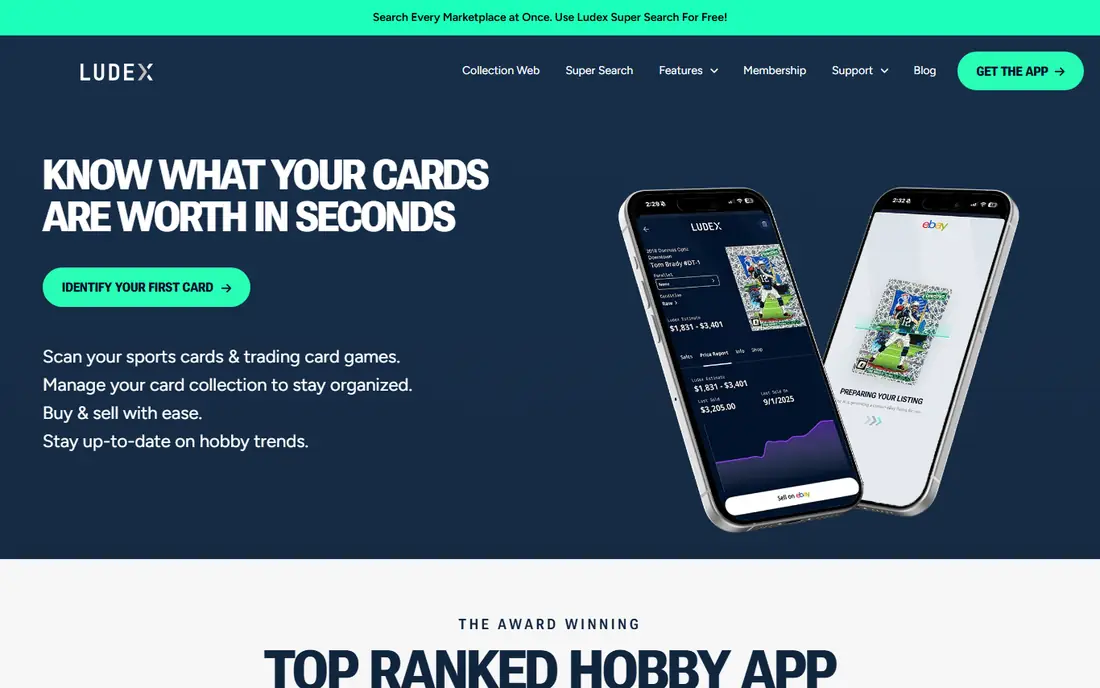
Ludex is the accuracy pick, especially for modern cards where parallels and refractors make identification hard. Independent testing puts its parallel accuracy near 85 percent, well ahead of CollX, and its price estimates run much closer to real eBay sold values. Dealers and modern-set collectors trust it for that reason.
The price is the barrier: real use needs the $19.99 per month Premium tier, since the free tier is effectively a trial. The database is also smaller than CollX at around 15 million cards. If you buy and sell modern cards regularly, the accuracy pays for itself. Casual collectors should stick with CollX.
- Best parallel and refractor accuracy
- Price error closer to real sold values
- Trusted by dealers
- Costs $19.99 per month
- Free tier is effectively a trial
- Smaller database than CollX
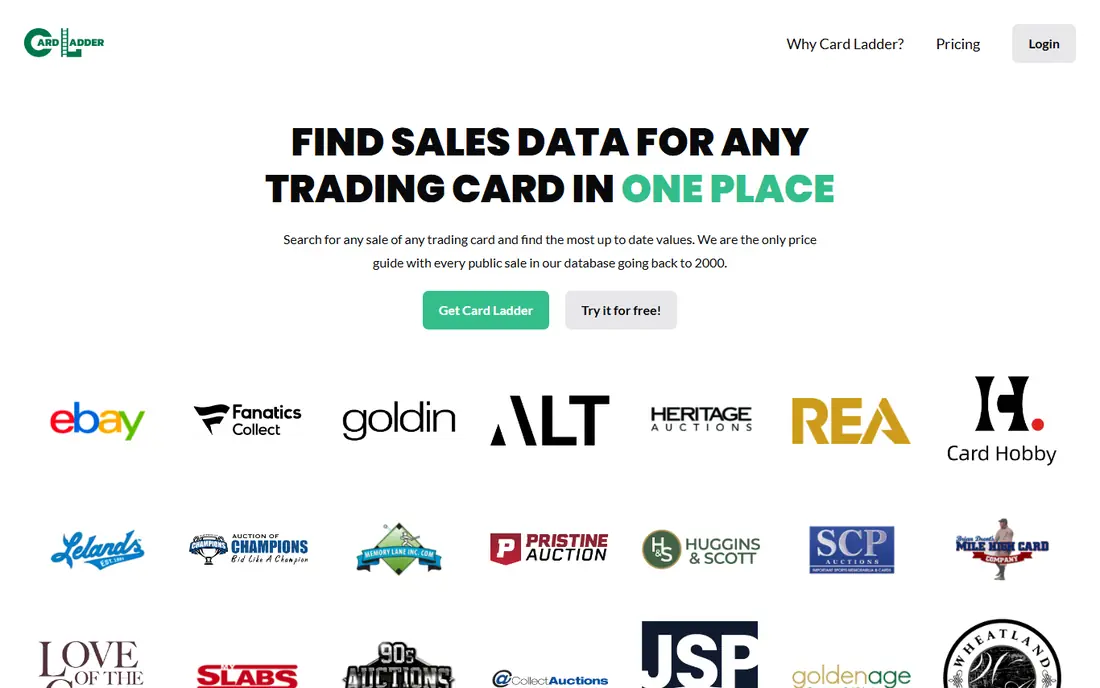
Card Ladder is the tracker, not the scanner. It pulls real eBay sale data to estimate what your collection is worth over time, with analytics, sales recaps, and index tracking for the wider hobby. That sale-based approach gives a more honest value picture than apps that blend in asking prices.
You will still want a scanner like CollX or Ludex to identify cards quickly before adding them. Card Ladder's strength is what happens after: watching your portfolio move with the market. For collectors who care about value over time, it is the best tracking companion here.
- Value tracking from real eBay sale data
- Detailed analytics
- Hobby news and indexes
- Not primarily a scanner
- Premium features cost extra
- Sports-focused, thinner on TCG
Sports Card Pro covers the casual middle ground: scan or add cards, track your collection, and see estimated values without paying for a pro tool. It suits collectors who want a tidy digital collection and a rough sense of value, without dealer-grade accuracy or marketplace features.
Depth is the limit. Analytics and pricing detail trail Card Ladder and Ludex, and estimates should be checked against sold listings before any sale. For a free, low-effort collection tracker, it does the job well.
- Simple collection tracking
- Price estimates for casual collectors
- Easy to use
- Less depth than Card Ladder
- Accuracy varies
- Smaller feature set
eBay belongs on this list for one reason: it is where real prices live. Its app scanner helps you list cards fast, and the sold-listings filter shows what identical cards actually sold for, which is the number that matters before you buy, sell, or grade. Every scanner estimate should be checked here.
It is not a collection tracker, and scanning is designed for listing rather than cataloging. But no serious collector should price a card without checking eBay sold listings first. Free to use, with selling fees only when you sell.
- In-app scanner for listings
- Sold-listings filter shows real sale prices
- Largest card marketplace
- Not a collection tracker
- Scanning is built for selling, not cataloging
- Fees on sales
130 Point is the research tool collectors use when they want the truth about a price. It surfaces eBay sold listings, including best-offer prices that eBay itself hides, for free. That makes it the best check against any scanner estimate, since it shows completed sales rather than asking prices.
It does not scan cards or track collections, and the interface is basic. Use it as the second step after scanning: identify the card in CollX or Ludex, then confirm the real market price on 130 Point before making a decision.
- Free access to eBay sold data
- Shows best-offer accepted prices
- No account games
- Research tool only, no scanning or tracking
- Interface is basic
- Sports-focused
PreGradeCards answers the question scanners cannot: what condition is your card actually in. Its AI analyzes a photo for centering, corners, edges, and surface, and returns a predicted grade with sub-scores, so you can run the real math on whether grading is worth the fee. A raw card that might grade a 10 is worth far more than the same card at a 9.
A prediction is not a promise, and the grading company makes the final call. But for deciding which cards deserve the grading fee, PreGradeCards saves real money by screening out cards that will not grade well. The first scan is free, which makes it easy to test.
- AI analysis of centering, corners, edges, and surface
- Predicted grade with sub-scores
- Free first scan
- Prediction is not a guarantee
- Grading companies decide the real grade
- Costs add up for many cards
TCGplayer is the marketplace and price guide for trading card games, and its app includes scanning for quick identification. Market prices reflect real marketplace activity across games, and the platform is the standard reference for many TCG collectors. The keyword set for this article includes trading card apps, and TCGplayer is the strongest TCG entry.
Sports coverage is thinner than the sports-first apps here, so baseball collectors should treat it as a complement, not a replacement. For collectors who hold both sports and trading cards, it rounds out the toolkit well.
- Huge trading card marketplace
- Market price data
- Scanner in the app
- Trading-card focused, thinner on sports
- Marketplace fees on sales
- Price data varies by game
Sports Card Investor helps collectors follow the market rather than just catalog it. It combines card value tracking with hobby news, analysis, and trend coverage, which helps you understand why prices move, not just what they are today. A free tier covers the basics.
It is not a scanner, so pair it with CollX or Ludex for identification. Values remain estimates, so confirm big decisions against sold listings. For collectors who treat the hobby as a market to follow, it is a useful daily read.
- Market news and analysis
- Card value tracking
- Good for following trends
- News and tracking focus, not a scanner
- Premium content costs extra
- Values are estimates
How we picked these
We compared official app store listings, pricing pages, and independent 2026 comparisons of sports card apps, favoring apps with current availability in October 2026, a real free tier or trial, and a clear job: scanning, tracking, pricing research, or pre-grading. We mixed free scanners with paid accuracy tools and research sites. Prices change, so confirm on each app store page before you pay. We did not test every app hands-on; our comparison rests on published features, pricing, and public reviews.
Using scanner values wisely
Treat every in-app value as an estimate. Scanners cannot see condition, and condition drives real prices: a card that looks mint in a photo can hide edge wear that drops its grade and value. Before buying, selling, or grading, check eBay sold listings and 130 Point for identical cards, and consider a pre-grade for anything valuable.
Set a simple workflow: scan with CollX or Ludex to identify the card, check sold prices for the real market, and pre-grade before paying a grading fee. That three-step routine costs little and prevents the most common collector mistake, which is trusting a single app number.
Sources
- https://theleaker.com/sports-card-apps/
- https://pregradecards.com/blog/scan-sports-cards-for-value-2026
- https://play.google.com/store/apps/details?id=app.collx.android&hl=en_CA
- https://apps.apple.com/us/app/collx-sports-card-scanner/id1581164444
- https://collx.app
- https://ludex.com
- https://cardladder.com
- https://sportscardpro.com
- https://www.ebay.com
- https://130point.com
- https://pregradecards.com
- https://www.tcgplayer.com
- https://sportscardinvestor.com
Frequently asked questions
What is the best app to scan baseball cards for value?
For most collectors, CollX is the best free scanner, with unlimited scans and a huge database. Ludex is more accurate on modern parallels and price estimates but costs $19.99 per month. For the real sale price, always check eBay sold listings or 130 Point afterward.
Are card scanner app values accurate?
Base card identification is highly reliable, but price estimates vary. Independent testing found Ludex estimates closer to real eBay sold values than CollX, which blends in asking prices. No scanner can judge condition, so treat every value as an estimate and verify with sold listings.
Can I scan a card to see if it is worth grading?
Partly. A scanner tells you the card's identity and raw price, which are the inputs to the decision. The actual decision needs condition, so use an AI pre-grading tool like PreGradeCards to estimate centering, corners, edges, and surface before paying a grading fee.
Is there a free app to scan sports cards?
Yes. CollX offers unlimited free scans and collection tracking, eBay's in-app scanner is free for listing, and 130 Point is free for sold-price research. Ludex offers a free tier, but real use needs its paid plan.
What is the difference between CollX and Ludex?
Ludex wins on accuracy for parallels and on price estimates closer to real sold values, while CollX wins on price, since it is free, and on database size and its built-in marketplace. Dealers and modern collectors tend to pick Ludex, while casual collectors pick CollX.