Best Cloud Security Companies in 2026: 9 Companies Compared
By ToolNimba Editorial Team November 11, 2026 10 min read

- Top pick
 Wiz
Multicloud risk visibility
Starting priceSee websiteCheck out WizRead our review - Runner-up
 Palo Alto Networks Cortex Cloud
Broadest security platform
Starting priceSee websiteCheck out Palo Alto Networks Cortex CloudRead our review - Also great
 CrowdStrike Falcon Cloud Security
Endpoint-led cloud protection
Starting priceSee websiteCheck out CrowdStrike Falcon Cloud SecurityRead our review
How we researched this
We compared official pricing and feature pages, app store listings, privacy policies and public user reviews. Prices change, so check the provider's site before you pay.
Key takeaways
- Wiz is our pick for multicloud visibility, with agentless scanning and risk prioritization based on toxic combinations of exposures.
- Palo Alto Networks offers the broadest platform, pairing cloud security with network security and security operations tools.
- CrowdStrike and SentinelOne suit companies that already use their endpoint platforms and want cloud workload protection in the same console.
- Zscaler is the zero trust pick for securing user and workload access without legacy VPNs.
- Nearly all leading cloud security vendors price by quote, so plan on a proof of concept and a sales conversation before budgeting.
Quick comparison
| Name | Best for | Starting price | Free plan | |
|---|---|---|---|---|
| Wiz | Multicloud risk visibility | See website | No | Visit |
| Palo Alto Networks Cortex Cloud | Broadest security platform | See website | No | Visit |
| CrowdStrike Falcon Cloud Security | Endpoint-led cloud protection | See website | No | Visit |
 Zscaler | Zero trust access | See website | No | Visit |
 Microsoft Defender for Cloud | Azure-first teams | See website | Yes | Visit |
 Orca Security | Agentless multicloud coverage | See website | No | Visit |
 Check Point CloudGuard | Prevention-focused cloud security | See website | No | Visit |
 Aqua Security | Container and Kubernetes security | See website | No | Visit |
 SentinelOne Singularity Cloud | Runtime cloud protection | See website | No | Visit |
The best cloud security companies
We compared vendor product pages, documentation, and public analyst and review coverage to find companies that protect real cloud workloads across AWS, Azure, and Google Cloud. The list covers CNAPP platforms, zero trust access, and workload protection, since different companies need different parts of the stack.
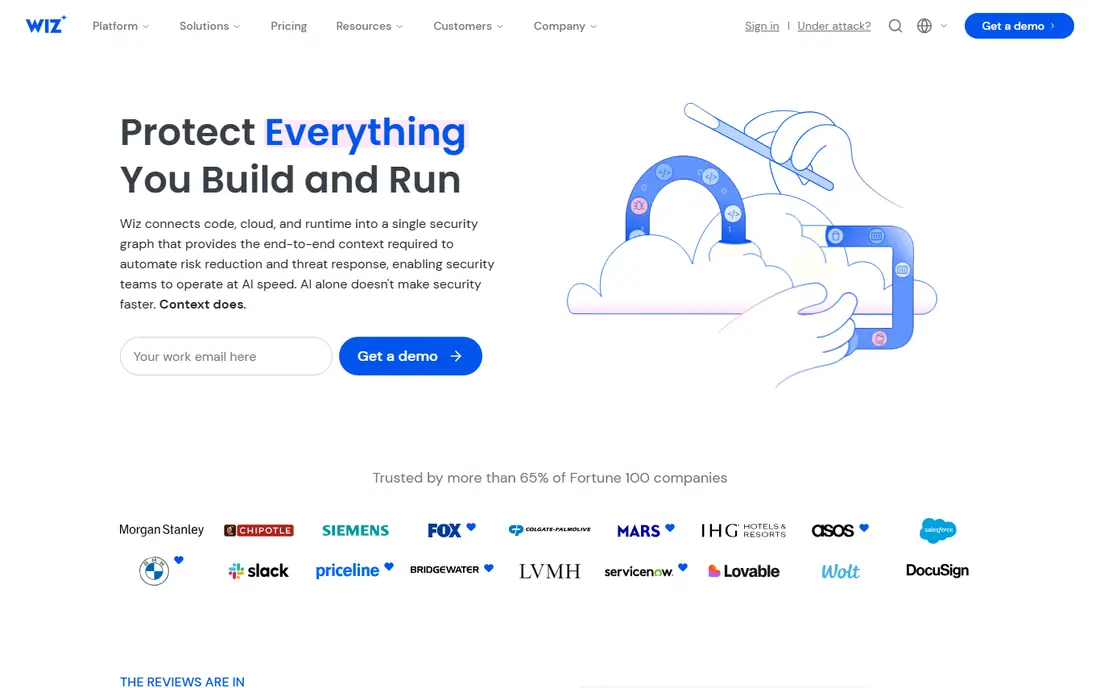
Wiz is our pick for teams that want to see their whole cloud risk picture quickly. Its agentless approach scans AWS, Azure, and Google Cloud without deploying agents everywhere, and its Security Graph connects misconfigurations, vulnerabilities, exposed workloads, and permissive identities into attack paths. That combination view helps teams fix the handful of issues that actually lead to breaches first.
The catch is pricing and prevention. Wiz is quote-based, and while it identifies risks well, real-time blocking often comes through integrations with partners like Check Point rather than built-in network controls. If visibility and prioritization are your main gaps, Wiz is hard to beat. If you need inline prevention, pair it with a network security tool.
- Agentless scanning gets visibility fast
- Security Graph highlights toxic combinations of risks
- Strong multicloud coverage
- Quote-based pricing
- Prevention features depend on partner integrations for blocking
Palo Alto Networks Cortex Cloud
Best for: Broadest security platform

Palo Alto Networks, through Cortex Cloud (formerly Prisma Cloud), offers the broadest cloud security platform on this list. It covers cloud posture management, workload protection, container and serverless security, and code security, with shift-left tools that scan infrastructure as code and container images during development. Its integration with Cortex security operations also appeals to teams that want cloud alerts in the same console as the rest of their SOC.
The trade-off is scale and effort. This is enterprise software with quote-based pricing, and getting full value from the platform takes deployment work and staff time. Companies already using Palo Alto firewalls or Cortex tools get the most from it, since consolidation is where the platform argument pays off.
- Full CNAPP covering posture, workloads, containers, and code
- Strong ties to Cortex security operations
- Code-to-cloud coverage
- Quote-based enterprise pricing
- Platform breadth takes time to deploy well
CrowdStrike Falcon Cloud Security
Best for: Endpoint-led cloud protection

CrowdStrike brings its endpoint strength into the cloud with Falcon Cloud Security. It provides cloud workload protection with deep runtime visibility into virtual machines and containers, plus posture management, and it runs on the same Falcon platform and agent that many enterprises already use for endpoints. That single-agent story simplifies deployment for existing customers.
The catch is that the value proposition is strongest inside the Falcon ecosystem. Companies without CrowdStrike elsewhere can still use it, but they will not get the same consolidation benefit, and pricing is quote-based. For Falcon shops expanding into cloud, it is a natural choice.
- Strong runtime visibility for VMs and containers
- Unified agent with Falcon endpoint protection
- Mature threat intelligence
- Quote-based pricing
- Best value for existing Falcon customers
Zscaler is the zero trust pick for cloud-first companies with distributed teams. Its Zero Trust Exchange brokers access between users, workloads, and applications based on identity, so neither users nor internal apps are exposed directly to the internet. That design replaces legacy VPNs and site-to-site links, which is a major win for remote and global workforces.
The honest limit is scope. Zscaler excels at access and network security, but it is not a full CNAPP replacement for posture management and workload scanning. Most buyers pair it with a CNAPP like Wiz or Cortex Cloud. If secure access is your main cloud problem, Zscaler is the category leader.
- Zero trust exchange removes legacy VPNs
- Identity-based access for users and workloads
- Global cloud architecture
- Quote-based pricing
- Solves access more than workload posture
Microsoft Defender for Cloud is the best value pick for Azure-centered organizations. Its free tier covers foundational cloud security posture management, and paid plans add workload protection across Azure, AWS, and Google Cloud, with findings surfaced in the Azure portal and Microsoft Defender XDR. Teams already running Microsoft 365 and Entra identity get a coherent stack without a new vendor.
The trade-off is that its depth tracks your Microsoft footprint. Multicloud teams that are not Azure-first may find rival CNAPP platforms more even-handed across clouds, and paid protection is priced per resource, so large estates need careful budgeting. For Azure shops, though, it is the obvious starting point.
- Free foundational posture tier
- Native Azure integration
- Covers AWS and Google Cloud too
- Deepest value inside Azure
- Advanced workload protection plans are paid per resource
Orca Security is the agentless specialist, and public comparisons rate its coverage breadth highly. Like Wiz, it scans cloud environments without agents, mapping assets, vulnerabilities, misconfigurations, and identity risks into attack paths. Teams that want quick visibility across many clouds without agent rollout projects tend to like it.
The catch is runtime depth. Agentless scanning is excellent for posture and risk prioritization, but agent-based rivals like CrowdStrike and SentinelOne offer deeper runtime detection inside workloads. If your priority is fast, broad visibility, Orca is a strong contender. If runtime protection matters most, weigh it against agent-based options.
- Agentless scanning across many clouds
- Fast time to value
- Strong attack path analysis
- Quote-based pricing
- Runtime protection is less deep than agent-based rivals
Check Point CloudGuard brings a prevention mindset to cloud security, pairing posture management with workload protection and network controls. Its strength is stopping threats inline rather than only reporting them, and its partnership with Wiz lets Wiz findings feed into CloudGuard blocking. Companies that already trust Check Point firewalls often extend that trust into cloud.
The downside is complexity for smaller teams. CloudGuard is enterprise software with quote-based pricing, and its breadth takes effort to configure well. For organizations that want prevention as well as visibility, it is a serious option. For teams that only need posture scanning, simpler tools cost less effort.
- Strong prevention heritage from network security
- Unified posture and workload protection
- Real-time blocking capabilities
- Quote-based pricing
- Platform can feel complex for small teams
Aqua Security is the specialist pick for container and Kubernetes-heavy environments. It secures the full container lifecycle, from image scanning in pipelines to runtime protection in Kubernetes clusters, and it is known for working in disconnected estates where cloud-only tools struggle. Teams running large container fleets get depth here that general CNAPP platforms may not match.
The trade-off is scope. Aqua is deep on cloud-native workloads but narrower than Wiz or Cortex Cloud on overall cloud posture, identity, and data security. Container-first companies often pair it with a broader CNAPP. If Kubernetes is the center of your cloud, Aqua deserves a shortlist spot.
- Deep container and Kubernetes focus
- Strong pipeline and runtime controls
- Works in disconnected and air-gapped estates
- Quote-based pricing
- Narrower scope than full CNAPP platforms
SentinelOne Singularity Cloud
Best for: Runtime cloud protection
SentinelOne Singularity Cloud extends the Singularity platform into cloud workloads, with runtime protection that validates whether findings are actually exploitable rather than only theoretically risky. That exploit validation cuts noise for security teams, and the AI-assisted operations tools help smaller teams triage faster. Existing SentinelOne endpoint customers get a unified console for endpoints and cloud.
The catch mirrors CrowdStrike: the strongest case is for existing customers, and pricing is quote-based. Teams without SentinelOne can still evaluate it, but they should compare its CNAPP breadth against Wiz and Orca before committing. For runtime-first buyers, it is a strong choice.
- Strong runtime detection with exploit validation
- Unified with Singularity endpoint platform
- AI-assisted security operations
- Quote-based pricing
- Best value for existing SentinelOne customers
How we picked these
We compared vendor product pages, documentation, and public analyst and review coverage from 2026, and we favored companies with real multicloud coverage, active development, and a clear role in the cloud security stack. We included CNAPP platforms, zero trust access, and workload specialists because no single product covers every cloud security job, and buyers usually combine two or three of these. Pricing is quote-based across nearly all of them, so we marked that honestly rather than inventing numbers.
What to check before you buy
Start with your cloud footprint. List which clouds you run, how many accounts and workloads you have, and whether containers, serverless, or VMs dominate, since that decides which vendors fit. Next, run a proof of concept with your real environment, not a vendor demo tenant, and measure how long it takes to get useful findings and how many of them are false positives.
Also ask about pricing mechanics in writing. Some vendors charge per workload, some per cloud account, and some by consumption, and those models produce very different bills at scale. Finally, check how findings flow into your existing workflow, whether that is a SIEM, a ticketing system, or a chat channel, since a tool your team never opens will not improve security no matter how good its scans are.
Sources
- https://www.getastra.com/blog/cloud/best-cloud-security-companies/
- https://www.techfinitive.com/product-guides/the-strongest-cloud-security-contenders-for-large-enterprises/
- https://www.icreativez.com/top-skills/top-10-cloud-based-cyber-security-companies-in-the-world.html
- https://www.unite.ai/top-10-cybersecurity-companies/
- https://cloudsecuritycompare.com/
Frequently asked questions
What is the best cloud security company?
Wiz is the best overall pick for multicloud visibility and risk prioritization, while Palo Alto Networks offers the broadest platform. The right answer depends on your stack: CrowdStrike and SentinelOne suit existing endpoint customers, Zscaler leads for zero trust access, and Microsoft Defender for Cloud is the best value for Azure-first teams.
What is CNAPP in cloud security?
CNAPP stands for Cloud-Native Application Protection Platform, which combines posture management, workload protection, and often code security in one product. Wiz, Palo Alto Cortex Cloud, Orca Security, and Check Point CloudGuard are CNAPP platforms. The idea is to replace several point tools with one system that connects risks across the cloud.
How much does cloud security software cost?
Nearly all leading vendors price by quote, based on workload count, cloud accounts, or consumption, so there is no useful public starting price for most of them. Microsoft Defender for Cloud offers a free foundational posture tier, with paid workload protection priced per resource. Budget for a proof of concept and a sales conversation to get a real number.
Do I need agentless or agent-based cloud security?
Agentless tools like Wiz and Orca give fast, broad visibility without deploying software to every workload, which suits posture management and risk prioritization. Agent-based tools like CrowdStrike and SentinelOne give deeper runtime detection inside workloads. Many companies use both: agentless for coverage, agent-based for runtime protection on critical systems.
Is Zscaler a cloud security company?
Yes. Zscaler secures access to cloud applications and workloads through its Zero Trust Exchange, replacing VPNs with identity-based access. It focuses on access and network security rather than full workload posture, so it is usually paired with a CNAPP platform rather than replacing one.
Can small businesses use these cloud security companies?
Small teams can use Microsoft Defender for Cloud, which has a free posture tier, and some vendors offer smaller packages on request. Most vendors on this list target mid-size and enterprise companies, so small businesses with a single cloud account may find simpler posture tools or their cloud provider's native security tools a better fit.