Best Corporate Travel Management Tool in 2026: 9 Tools Compared
By ToolNimba Editorial Team November 9, 2026 11 min read

- Top pick
 Navan
Small and mid-size companies
Starting priceFreeCheck out NavanRead our review - Runner-up
 TravelPerk
European travel and flexible changes
Starting priceFreeCheck out TravelPerkRead our review - Also great
 SAP Concur
Large SAP enterprises
Starting price$7 per expense reportCheck out SAP ConcurRead our review
How we researched this
We compared official pricing and feature pages, app store listings, privacy policies and public user reviews. Prices change, so check the provider's site before you pay.
Key takeaways
- Navan is our pick for most small and mid-size companies, because travel, expense, and cards live in one traveler-friendly app.
- TravelPerk suits companies with heavy European travel and frequent changes, thanks to its large inventory and flexible cancellation add-on.
- SAP Concur remains the strongest choice for large enterprises already running SAP, where audit depth and ERP integration matter most.
- Most enterprise tools here are priced by quote, so the real comparison is the fee model: per booking, per report, per user, or per trip.
- A tool that travelers actually use will beat a stricter tool they work around, so weigh adoption and support alongside policy controls.
Quick comparison
| Name | Best for | Starting price | Free plan | |
|---|---|---|---|---|
| Navan | Small and mid-size companies | Free | Yes | Visit |
| TravelPerk | European travel and flexible changes | Free | Yes | Visit |
| SAP Concur | Large SAP enterprises | $7 per expense report | No | Visit |
 Egencia by Amex GBT | Global enterprise programs | See website | No | Visit |
 Ramp Travel | Finance-led travel and spend | Free | Yes | Visit |
 Brex Travel | Startups with cards and travel | Free | Yes | Visit |
 Spotnana | API-first travel infrastructure | See website | No | Visit |
 BCD Travel | Large global managed programs | See website | No | Visit |
 Engine | Small teams booking hotels fast | Free | Yes | Visit |
The best corporate travel management tools
Corporate travel tools have split into two camps: modern platforms that travelers book in themselves, and full-service agencies with deep policy and duty-of-care support. The right pick depends on company size, travel volume, and who owns the program, finance or operations. We compared official pricing pages, published plan details, and feature documentation for the tools below.
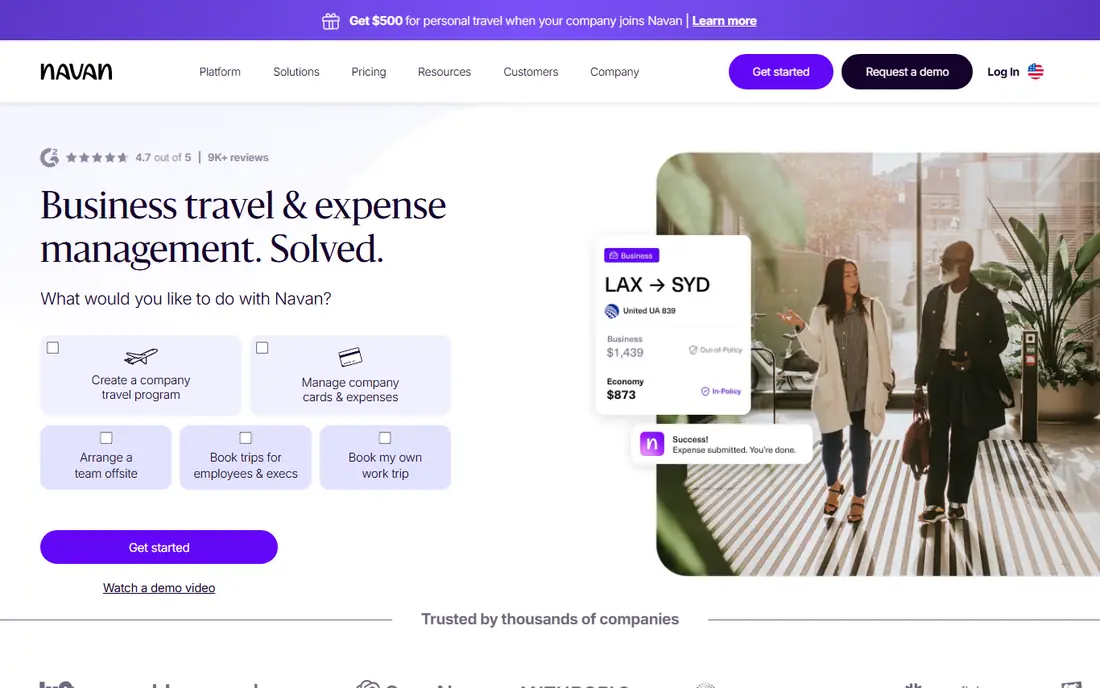
Navan, formerly TripActions, built its name on an app that employees do not dread opening. Travelers book flights, hotels, and cars, snap receipts, and track expenses in one place, while finance sees spend against policy in near real time. That combination explains why it is our pick for most companies under a few hundred employees, where adoption matters as much as control.
Travel booking is free for companies with 300 employees or fewer, funded by supplier commissions, while expense is free for five monthly active users and then $15 per user per month. Larger companies move to custom enterprise pricing, so get a quote before assuming the free tier scales with you. The honest catch is that very large, complex global programs may still need agency services that Navan sells separately.
- Travel, expense, and cards in one app
- Traveler-friendly booking
- 24/7 travel support
- Enterprise pricing above 300 employees is by quote
- Expense free tier covers only five monthly users

TravelPerk, which now brands some material as Perk, is strongest for companies with heavy travel in Europe and the United Kingdom. Its inventory covers flights, hotels, cars, and rail, and its invoicing handles VAT in a way that US-only tools often fumble. For teams whose plans change often, the FlexiPerk add-on, charged as a flat percentage per trip, refunds a large share of cancelled bookings.
Pricing starts with a free Starter plan that charges 5 percent per booking, with minimum and maximum thresholds, while Premium at $99 per month and Pro at $299 per month drop the booking fee to 3 percent. That per-booking model can suit low-volume teams, but high-volume companies should model total fees, not just the monthly plan price. Travel and spend bundles start at $11 per user per month on Premium and $13 on Pro, with booking fees still applying.
- Large global inventory across flights, hotels, and rail
- FlexiPerk cancellation cover
- VAT-ready invoicing
- Booking fees apply on every plan
- Paid tiers add up for larger teams

SAP Concur is the enterprise workhorse of this list, and it shows in both depth and complexity. Expense Base starts at about $7 per expense report and Plus at about $11 per report, both with unlimited users, while Premium, which includes Concur Travel, is priced by quote. That per-report model favors companies with fewer, larger expense claims and punishes high-volume, low-value reporting unless you negotiate well.
Where Concur earns its keep is audit and integration. It can audit expense reports for policy and fraud, handle multi-currency and tax rules across many countries, and connect with SAP, NetSuite, QuickBooks, Xero, and hundreds of other systems. The trade-off is implementation time and a learning curve that smaller teams may find heavy. If your company already runs SAP, that integration depth is hard to match elsewhere.
- Deep audit, tax, and multi-currency handling
- Huge integration library
- Strong SAP ERP fit
- Travel sits in the quoted Premium tier
- Interface feels dated next to newer rivals
Egencia, now part of American Express Global Business Travel, pairs an online booking platform with human travel agents around the world. That matters when flights cancel, borders close, or a traveler needs help at midnight in another time zone. Policy controls, traveler tracking, and reporting are built for large programs with complex approval chains and negotiated rates.
Pricing is by quote and typically transaction-based, with published benchmarks suggesting per-booking fees in the low tens of dollars plus platform fees that vary by company size. Amex GBT has been consolidating its platforms, and some mid-market Egencia accounts are moving to other Amex GBT products, so ask about roadmap and migration plans during procurement. For a large global program that needs live support, Egencia remains a serious contender.
- Global agency support in many countries
- Mature policy and duty-of-care tools
- Online-first booking
- Pricing is opaque and transaction-based
- Mid-market accounts are migrating within Amex GBT
Ramp Travel suits finance teams that want travel spend visible next to card and expense spend, without running three separate tools. Travelers book in the Ramp platform, policies apply at booking, and finance can see trip costs against budgets and card transactions. The free basic tier covers cards and expenses, with Ramp Plus at $15 per user per month adding deeper controls.
Travel itself is bundled on both tiers but takes a percentage of hotel and air spend, so model that charge against your volume before comparing it with a flat-fee tool. Companies that already issue Ramp cards will get the most value, since the card, expense, and travel data line up. Companies that want a standalone travel agency may prefer a dedicated travel platform instead.
- Cards, expenses, and travel in one finance platform
- Savings recommendations
- Free basic tier
- Travel takes a percentage of hotel and air spend
- Best fit is companies already using Ramp cards
Brex combines corporate cards, expenses, and travel booking in one platform aimed at startups and fast-growing companies. The Essentials tier is free per user per month and includes travel booking, which makes it easy to start without a procurement cycle. Premium, at $12 per user per month, adds deeper spend controls and reporting that finance teams usually want as headcount grows.
The catch is that Premium and Enterprise travel use a flat trip fee that Brex does not publish, and Enterprise pricing is custom, so the headline seat price is not the whole bill. Brex is at its best for venture-backed startups and mid-size companies that already use Brex cards and want travel inside the same spend system. Larger enterprises with complex travel policy may need a dedicated travel management company.
- Corporate cards and travel booking together
- Essentials tier is free
- Simple setup for startups
- Premium travel uses a flat trip fee that is not published
- Enterprise pricing is custom
Spotnana takes a different approach from the rest of this list. It sells travel infrastructure, a cloud-native booking platform with open APIs, that other travel management companies and large enterprises build on. That makes it attractive to technology companies that want to customize booking, policy, and data flows rather than accept a fixed vendor workflow.
Pricing is API-based and by custom quote, and implementation timelines vary with scope, so this is not a quick sign-up for a ten-person team. The upside is flexibility and a modern traveler experience without legacy code underneath. If your company has engineering resources and a clear travel technology plan, Spotnana is worth evaluating. If you want an agency to run the program for you, look at Egencia or BCD Travel instead.
- Cloud-native platform with open APIs
- Supports multiple travel management companies
- Modern booking experience
- Priced by custom quote
- More of a platform layer than a ready-made agency for small teams
BCD Travel is a large, privately held travel management company with a reputation for long client tenures, especially in pharmaceuticals, financial services, and energy. Its DecisionSource analytics platform is a standout for program managers who need detailed spend, policy, and traveler data. For global enterprises with meetings, groups, and complex duty-of-care needs, that service depth still matters.
Pricing is negotiated per program, so there is no public starting price to compare, and the experience can feel more traditional than Navan or TravelPerk. BCD suits companies that want a managed partner, not just software, and that value human expertise during disruptions. Smaller companies will likely find faster setup and clearer pricing elsewhere on this list.
- Long client relationships and global coverage
- Strong analytics platform
- Strength in regulated industries
- Pricing is relationship-driven and opaque
- Slower to adopt than product-led rivals
Engine is the simplest tool here, built for small businesses that mainly need to book hotels and manage group travel without a heavy platform. There are no membership fees, minimums, or contracts, and teams can start booking quickly. That low friction makes it a good fit for companies that travel occasionally and do not need full expense, card, and policy machinery.
The trade-off is scope. Engine does not replace a full travel and expense platform for companies with strict approval chains, negotiated air programs, or global duty-of-care requirements. Use it when hotel booking speed and simplicity are the main problem. Move to Navan, TravelPerk, or a managed agency when policy control and expense integration become the bigger need.
- Free to join with no membership fees or contracts
- Fast hotel booking
- Useful for small businesses
- Narrower focus than full travel and expense platforms
- Less suited to complex global policy
How we picked these
We compared official pricing pages, vendor feature documentation, and published 2026 pricing benchmarks for corporate travel platforms, and we kept only tools that are live and serve United States companies. We weighed booking inventory, policy controls, expense and card integration, duty-of-care support, and the fee model, since a per-booking, per-report, and per-user price cannot be compared on headline figures alone. We did not claim hands-on testing; our comparison rests on public pricing, feature pages, and procurement reporting.
Choosing the right fee model for your company
Start by counting how your team actually travels: trips per month, average trip cost, and how often plans change. A free plan with a per-booking fee can beat a flat monthly plan for a team that travels rarely, while a high-volume team will usually save with a lower booking fee or a seat-based plan. Ask each vendor for a total-cost estimate on your last twelve months of travel, including booking fees, trip fees, card fees, and implementation charges, and get the duty-of-care and support terms in writing. Run a pilot with one department first, and check traveler satisfaction, not just finance reports, before rolling the tool out company-wide.
Sources
- https://navan.com
- https://travelperk.com
- https://www.concur.com
- https://www.egencia.com
- https://ramp.com
- https://brex.com
- https://spotnana.com
- https://www.bcdtravel.com
- https://engine.com
- https://www.getmonetizely.com/articles/procurement-guide-how-are-corporate-travel-management-platforms-priced-for-enterprises
- https://travel-code.com/news/egencia-alternatives-corporate-travel-2026
- https://engine.com/blog/egencia-review
Frequently asked questions
What is the best corporate travel management tool for a small business?
Navan is our pick for most small businesses, because travel booking is free for companies with 300 employees or fewer and the app is easy for travelers to adopt. Engine is a simpler alternative if hotel booking is your main need, while TravelPerk suits small teams with heavy European travel.
Which is the best corporate travel management software for large enterprises?
SAP Concur is strongest for large enterprises already running SAP, thanks to audit depth and ERP integration. Egencia by Amex GBT and BCD Travel are better fits when you want a managed agency with global live support, while Spotnana suits technology-led enterprises that want to build on open APIs.
How much does corporate travel management software cost?
It depends on the fee model. Navan expense starts at $15 per user per month after five free users, TravelPerk Premium is $99 per month plus 3 percent per booking, SAP Concur starts at about $7 per expense report, and several enterprise tools are priced by quote only.
What is the best corporate travel management app for travelers?
Navan and TravelPerk both offer traveler-friendly mobile booking, expense capture, and trip tracking in one app. The best test is a short pilot with your own travelers, since an app they enjoy using will produce cleaner data and better policy compliance than one they avoid.
Do these tools handle travel policy and duty of care?
Yes, with different depth. Modern platforms apply policy at booking and track travelers, while managed agencies such as Egencia and BCD Travel add live agent support and deeper duty-of-care services. Ask each vendor how traveler location, disruption alerts, and emergency support work before you sign.
Should finance or operations own the travel program?
Finance usually owns spend and policy, while operations or office management owns traveler experience and day-to-day support. The best programs share ownership, with finance setting policy and budgets and a travel owner handling vendors, traveler feedback, and disruption support.