Best Customer Success Software in 2026: 9 Platforms Compared
By ToolNimba Editorial Team November 8, 2026 11 min read

- Top pick
 Gainsight
Enterprise CS teams
Starting priceSee websiteCheck out GainsightRead our review - Runner-up
 Totango
Templated journeys and playbooks
Starting priceSee websiteCheck out TotangoRead our review - Also great
 ChurnZero
Mid-market retention
Starting priceSee websiteCheck out ChurnZeroRead our review
How we researched this
We compared official pricing and feature pages, app store listings, privacy policies and public user reviews. Prices change, so check the provider's site before you pay.
Key takeaways
- Gainsight remains the enterprise benchmark for health scoring and complex account work, but it needs dedicated admin time and a large budget.
- ChurnZero and Vitally suit mid-market SaaS teams that want strong health scoring without enterprise complexity.
- Totango suits teams that want templated customer journeys and playbooks they can standardize across segments.
- Small teams should start with HubSpot Service Hub or a lighter tool, because a large platform bought too early often goes underused.
Quick comparison
| Name | Best for | Starting price | Free plan | |
|---|---|---|---|---|
| Gainsight | Enterprise CS teams | See website | No | Visit |
| Totango | Templated journeys and playbooks | See website | Yes | Visit |
| ChurnZero | Mid-market retention | See website | No | Visit |
 Vitally | Customizable mid-market CS | See website | Free trial | Visit |
 HubSpot Service Hub | Teams already on HubSpot | $90 per month | Yes | Visit |
 Planhat | Data-driven CS teams | See website | No | Visit |
 Custify | Budget SMB SaaS | See website | No | Visit |
 ClientSuccess | Affordable small to mid-market CS | See website | No | Visit |
 Velaris | Modern Gainsight-lite for mid-market | See website | No | Visit |
The best customer success software
We compared official product pages and recent customer success summaries for platforms that help SaaS and subscription businesses retain customers today. The best customer success software for you depends on how many accounts you manage, how many CSMs you employ, and whether you need deep health scoring, journey automation, or simple renewal tracking. The list below covers enterprise, mid-market, and smaller-team options, because a platform that fits a 20-person CS team rarely fits a 2-person team.
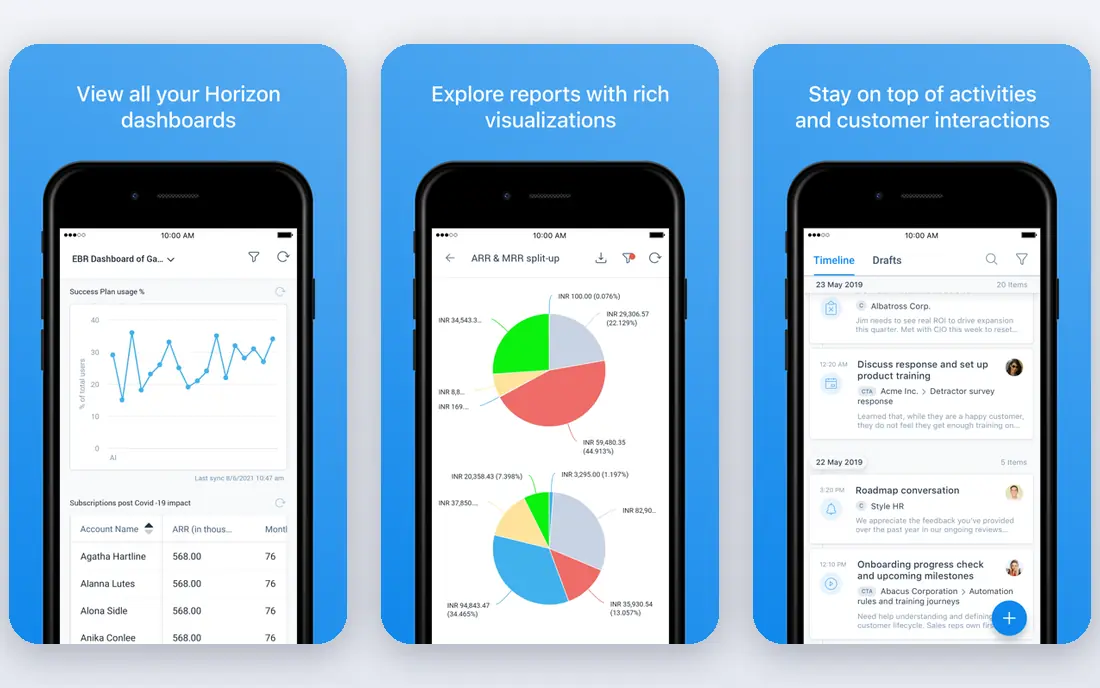
Gainsight is the platform most enterprise CS teams benchmark against. Its health scoring engine lets you weight product usage, support sentiment, financial data, and relationship signals into a single score, and its journey tools trigger multi-step playbooks based on real behavior rather than just renewal dates. Executive reporting and QBR tools are built for board-level conversations, which matters when CS must prove its impact on revenue.
The trade-off is cost and complexity. Pricing is quote-based, implementation often needs a dedicated CS operations person, and smaller teams frequently buy more platform than they can use in year one. Gainsight suits large CS orgs with complex, multi-product accounts and a team to run it. For smaller teams, a mid-market platform will deliver value faster.
- Highly configurable health scoring
- Journey orchestration and playbooks
- Strong executive and QBR reporting
- Quote-based pricing
- Implementation can take weeks to months
Totango, now combined with Catalyst in recent summaries, focuses on standardizing customer success work through templated journeys called SuccessBLOCs. Those templates cover onboarding, adoption, renewal, and expansion, which helps growing teams run the same playbook consistently across segments. Its health scoring and engagement tools support both high-touch and tech-touch models.
Paid pricing is quote-based and tiered by account volume, so you will need a sales conversation to get a firm number. Implementation still requires clean product and CRM data, even with templates. Totango suits mid-market and enterprise SaaS teams that want structured, repeatable CS processes without building every workflow from scratch.
- SuccessBLOC templates for standard workflows
- Customer journey automation
- Free tier for small teams
- Quote-based pricing on paid plans
- Implementation still needs planning and data work
ChurnZero is built for mid-market subscription businesses that need to spot churn risk early and act on it. Its health scores combine product usage, support, and billing signals, and its engagement tools let CSMs send in-app messages, emails, and playbook tasks from one place. That combination suits teams managing 100 to 2,000 accounts who need both insight and action in the same platform.
Pricing is quote-based, with third-party benchmarks citing entry contracts around $12,000 per year and higher for larger account counts, so budget for more than a small monthly fee. ChurnZero also depends on good data integration, so plan time to connect your product, CRM, and billing systems. For mid-market retention work, it is one of the strongest, most focused options.
- Strong health scoring tuned for mid-market
- In-app engagement and journey tools
- Good for subscription businesses
- Quote-based pricing
- Needs clean usage and billing data to score well
Vitally suits mid-market B2B SaaS teams that want a customizable platform without enterprise weight. Its health scoring, project tracking, and automation cover onboarding, adoption, renewals, and expansion, and its interface is often praised for usability compared with larger platforms. Teams with 50 to 500 accounts and a handful of CSMs can get value without a large admin team.
Pricing is quote-based across tech-touch, hybrid-touch, and high-touch tiers, so get a quote tied to your account count and CSM seats. Heavy customization can also create maintenance work, so keep health scores and playbooks as simple as they can be while still useful. For product-led and hybrid SaaS teams, Vitally is a strong mid-market pick.
- Flexible health scoring and dashboards
- Onboarding, adoption, and renewal workflows
- Usable for lean CS teams
- Quote-based pricing
- Customization needs CS ops time to maintain
HubSpot Service Hub is the best starting point for teams already using HubSpot CRM. It combines tickets, customer feedback, knowledge base, and basic success tools in one system, with a free plan and paid tiers from $90 per seat per month for Professional. That speed matters for small teams that need renewal tracking and support visibility without buying a separate CS platform.
Its health scoring and journey tools are more basic than Gainsight, ChurnZero, or Vitally, and advanced features sit on higher tiers. HubSpot suits teams that want one CRM for sales, support, and success, and that do not yet need deep CS automation. If you outgrow it, you can move to a dedicated platform later with cleaner data, because your customer records already live in HubSpot.
- Free plan and low entry price
- Unified CRM, support, and CS data
- Fast time to value
- Health scoring is more basic than dedicated CS platforms
- Advanced CS features need higher tiers
Planhat prices by customer account rather than by seat, which helps large CS teams managing a smaller book of accounts. Its data tools, health scoring, and QBR automation suit teams that already track product usage and revenue signals closely. That data-first approach appeals to CS ops leaders who want a single source of truth for account health and expansion.
Planhat needs data and ops capacity to shine, and its pricing is quote-based, with third-party benchmarks citing entry plans around $1,150 per month and higher for professional tiers. Small teams without a data pipeline may find it heavier than Vitally or Custify. For data-driven mid-market and enterprise teams, Planhat is a credible alternative to Gainsight.
- Account-based pricing with unlimited seats
- Strong data and QBR automation
- Good for data-rich teams
- Quote-based pricing
- Needs CS ops capacity to get full value
Custify targets early-stage and SMB B2B SaaS teams that need health scoring, lifecycle automation, and NPS tracking without enterprise pricing or a long implementation. Third-party estimates place entry pricing in the hundreds of dollars per month, which is far below Gainsight or Totango entry contracts. Implementation can happen in days or weeks rather than months, which helps lean teams show results quickly.
The trade-off is depth. Analytics and reporting are thinner than larger platforms, and some users find the interface less intuitive. Custify suits teams with under a few hundred accounts that need a real CS platform at a manageable price. If you need deep enterprise reporting, a larger platform will serve you better, but for SMB retention work, Custify is a practical starting point.
- Lower entry cost than enterprise platforms
- Health scoring and lifecycle automation
- Fast implementation for small teams
- Analytics depth is thinner than Gainsight or ChurnZero
- Support model varies by plan
ClientSuccess offers a focused customer success platform for small to mid-market SaaS teams that want health scoring, playbooks, and renewal visibility without enterprise complexity. Its workflows cover the core CS jobs: onboarding, adoption, health monitoring, and renewal management, in an interface built for CSMs rather than administrators. That focus helps small teams adopt it quickly.
Pricing is quote-based, with directories citing entry contracts around $15,000 per year, so it is not a low-cost tool, but it is more accessible than enterprise platforms. Its integration ecosystem is smaller than Gainsight, so check that your CRM, product, and billing tools connect cleanly. For teams that want a real CS platform at a mid-market price, ClientSuccess is worth a demo.
- Focused CS workflows for small teams
- Health scoring and renewal tracking
- Simpler than enterprise platforms
- Quote-based pricing
- Smaller integration ecosystem than Gainsight
Velaris positions itself as a modern, lighter alternative to Gainsight for mid-market SaaS teams. It covers health scoring, customer journeys, playbooks, and renewal tracking in a cleaner interface, with setup that aims to be faster than enterprise platforms. That appeals to teams that want Gainsight-style workflows without the enterprise implementation burden.
Because Velaris is newer and smaller, its ecosystem and third-party resources are less extensive than Gainsight or Totango. Pricing is also quote-based, with directories citing entry points around $10,000 per year. For mid-market teams that want a modern CS platform and are willing to work with a growing vendor, Velaris is a promising option to demo alongside Vitally and ChurnZero.
- Modern interface
- Health scoring and playbooks for mid-market
- Faster setup than enterprise platforms
- Newer and smaller than Gainsight
- Pricing details require a sales conversation
How we picked these
We compared official product pages and recent customer success summaries for platforms that serve SaaS and subscription businesses today. We favored platforms with clear health scoring, journey or playbook tools, and a realistic fit for a specific team size, from SMB to enterprise. We did not claim hands-on testing, and where pricing is quote-based or could not be confirmed from a vendor page in our research, we wrote See website. CS pricing often depends on account count, seats, and modules, so get a quote tied to your actual numbers.
How to choose a customer success platform without overbuying
Start with account count and team size, not feature lists. A team with 50 accounts and 2 CSMs needs simple health scores, renewal dates, and task lists. A team with 2,000 accounts and 20 CSMs needs segmentation, automation, and executive reporting. Match the platform to your current size plus one year of growth, not to a future size you may never reach. Overbuying is the most common CS software mistake, and it shows up as a platform nobody opens.
Next, audit your data before you buy. List where product usage, billing, support tickets, and CRM notes live, and check whether the platform connects to each source without custom work. A health score built on incomplete data will mislead CSMs, no matter how good the platform looks in a demo. Run a trial with your real accounts, not demo data, and ask CSMs to use it for two weeks on real renewal and risk work.
Health scores that actually help
A useful health score uses three to five signals you trust, such as product usage, support volume, payment status, and engagement with onboarding. Avoid scores with twenty inputs that nobody can explain to a customer or manager. Review scores monthly, compare them with actual churn and expansion, and adjust weights when the score misses. A simple score that CSMs trust beats a complex score they ignore.
Implementation and total cost
Budget for implementation, training, and admin time, not just the license. Enterprise platforms can add $10,000 to $50,000 in implementation costs, according to third-party summaries, plus ongoing admin time. Mid-market platforms usually cost less to implement, but still need data connections and playbook setup. Ask vendors for total first-year cost, including implementation, training, and any required modules, before you compare headline prices.
Sources
Frequently asked questions
What is the best customer success software for small teams?
HubSpot Service Hub is the best starting point for small teams, especially those already on HubSpot, because it offers a free plan and fast setup. Custify and ClientSuccess offer dedicated CS platforms at lower entry points than enterprise tools. The best tools for customer success managers on a small team are usually the simplest ones they will actually use daily for health checks and renewals.
What is the best customer success platform for mid-market SaaS?
ChurnZero, Vitally, and Totango are the strongest mid-market customer success platforms in this list. ChurnZero suits retention-focused teams, Vitally suits customizable workflows, and Totango suits templated journeys. The best customer success software platforms for mid-market teams depend on account count, data maturity, and whether you need deep automation or simple, reliable health scoring.
How much does customer success software cost?
Customer success software costs vary widely, from free or $90 per seat per month for HubSpot, to quote-based enterprise contracts that third-party benchmarks place at $30,000 to $50,000 per year and higher for Gainsight and Totango. Mid-market platforms often fall between those ranges, depending on account count and modules. Always ask for total first-year cost, including implementation, before signing.
What is the best customer success software with the best reviews?
Review scores vary by team size and use case, so the best-reviewed platform for a large enterprise team may not suit a small team. ChurnZero and Vitally frequently receive strong reviews from mid-market users for usability and retention tools, while Gainsight receives strong reviews for enterprise depth despite higher complexity. Read reviews from teams with a similar account count and CSM team size to yours.
Do I need a dedicated CS platform, or can I use a CRM?
A CRM such as HubSpot can cover basic CS needs, including tickets, renewal dates, and customer records, especially for small teams. A dedicated CS platform adds health scoring, product usage data, journey automation, and renewal forecasting that a CRM alone does not handle well. Start with your CRM if your account count is low, and move to a dedicated platform when health scoring and automation become daily work.
How long does it take to implement customer success software?
Implementation ranges from days for HubSpot or Custify, to two to four weeks for Vitally and ChurnZero, to eight to fourteen weeks or more for Gainsight, according to vendor and third-party summaries. Time depends on data connections, health score design, and playbook setup. Plan for data cleanup and CSM training in that timeline, because a platform launched without clean data will not earn trust.