Best Data Lineage Tools in 2026: 10 Tools Compared
By ToolNimba Editorial Team November 19, 2026 8 min read
We did not test these tools hands-on. Picks are based on vendor documentation and public information. Read our editorial policy and disclosure.

- Top pick
 Atlan
Cloud data teams
Starting priceSee websiteCheck out AtlanRead our review - Runner-up
 Collibra
Regulated governance
Starting priceSee websiteCheck out CollibraRead our review - Also great
 Alation
Analyst adoption and search
Starting priceSee websiteCheck out AlationRead our review
How we researched this
We compared official pricing and feature pages, app store listings, privacy policies and public user reviews. Prices change, so check the provider's site before you pay.
Key takeaways
- Atlan, Collibra, and Alation lead enterprise lineage, with column-level tracing and governance depth.
- Secoda and Select Star offer published prices and fast setup for smaller data teams.
- Monte Carlo ties lineage to incident response, showing blast radius when pipelines break.
- DataHub and OpenMetadata give open-source control for engineering-led teams with platform capacity.
- Most enterprise tools are quote-based, so budget for implementation as well as licenses.
Quick comparison
| Name | Best for | Starting price | Free plan | |
|---|---|---|---|---|
| Atlan | Cloud data teams | See website | Free trial | Visit |
| Collibra | Regulated governance | See website | Free trial | Visit |
| Alation | Analyst adoption and search | See website | Free trial | Visit |
 Monte Carlo | Lineage plus incident response | See website | Free trial | Visit |
 Secoda | Small teams needing fast value | $99 per month | Yes | Visit |
 Select Star | Automated column lineage | $270 per month | Yes | Visit |
 Informatica | Large multi-cloud estates | See website | Free trial | Visit |
 Microsoft Purview | Microsoft ecosystem teams | See website | No | Visit |
 DataHub | Open-source control | Free | Yes | Visit |
 OpenMetadata | Engineering-led open source | Free | Yes | Visit |
The best data lineage tools
Data lineage shows where a number came from, which tables and pipelines touched it, and what breaks if a source changes. We compared official product pages, pricing pages, and 2026 comparisons, and we favored tools that trace lineage to column level, not just table level, and that cover modern warehouses and BI tools.
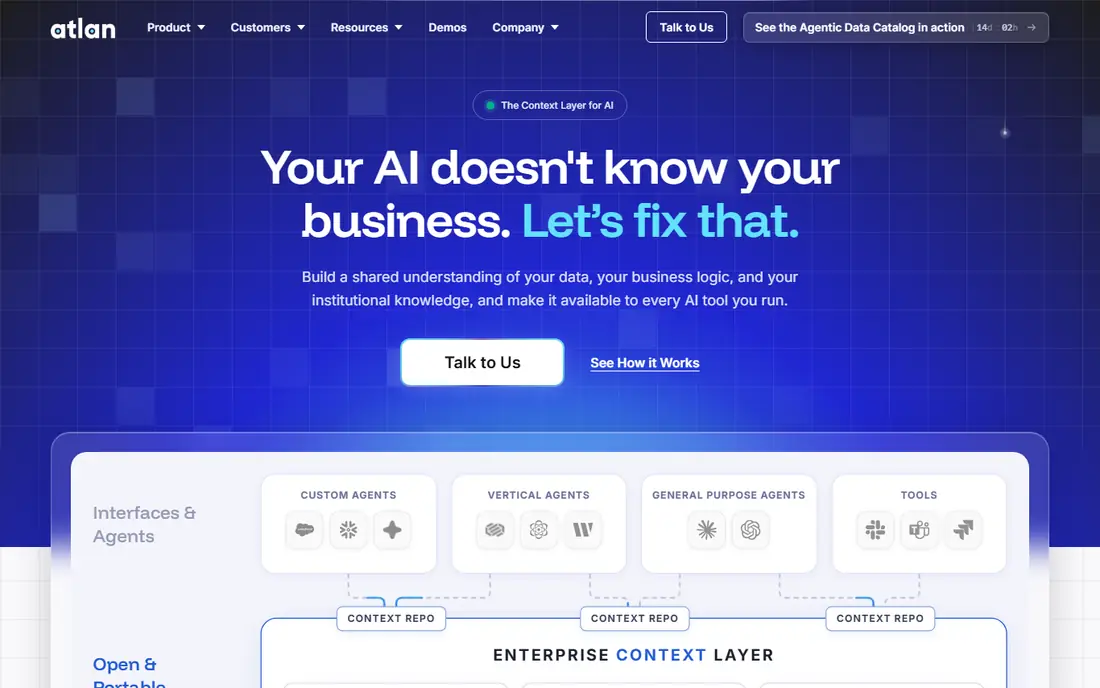
Atlan is the modern cloud-native pick, combining a data catalog, lineage, and governance with collaboration features that data teams actually use. Lineage traces data from sources through transformations to dashboards, and an enterprise data graph connects assets across the stack. AI governance features help teams manage AI-ready data.
Pricing is quote-based with a free trial, so budget depends on estate size. For cloud-first teams that want lineage plus collaboration, Atlan is a leading choice.
- Active metadata and collaboration
- Column-level lineage
- Modern cloud stack support
- Quote-based pricing
- Implementation effort grows with estate size
Collibra is the governance-first enterprise platform, with policy workflows, approval chains, and audit trails built for regulated industries. Lineage runs to column level through connectors, and data quality tools sit alongside the catalog. Banks, insurers, and healthcare firms choose it when formal accountability matters most.
It is expensive and implementation is a multi-month project, so smaller teams will find cheaper options. For regulated reporting where you must prove how a number was produced, Collibra is the safe pick.
- Deepest stewardship workflows
- Policy and audit trails
- Column-level lineage
- Quote-based and expensive
- Implementation takes months
Alation leads on analyst adoption, with search ranked by actual query behavior, trust signals, and a crowd-curated stewardship model. Lineage reaches column level through query-log parsing, which works well for warehouse-centric stacks. Agentic AI features add copilots and agent tooling for data teams.
Pricing is not published, and rollout takes planning and services. If getting analysts to use the catalog is the goal, Alation is hard to beat.
- Strong search and trust signals
- Stewardship model
- Column-level lineage for warehouses
- Quote-based pricing
- Implementation is a project
Monte Carlo earns its place because it ties lineage to incident response. When a pipeline breaks, you see which downstream dashboards and reports are affected, not just a static diagram. Anomaly detection and alerts help teams catch data quality issues before stakeholders do.
It is less of a pure governance suite than Collibra, so teams needing deep policy workflows may pair it with a catalog. For data reliability, Monte Carlo is the standout.
- Lineage tied to data observability
- Blast-radius analysis
- Anomaly alerts
- Quote-based pricing
- Observability focus over pure governance
Secoda is the fast-value pick for small data teams, with a published Starter price on annual billing and a free tier. Setup takes days rather than months, and AI-assisted search and documentation help small teams catalog assets without a dedicated governance staff. Lineage covers common warehouses and BI tools.
Large governance programs will outgrow it, and connector depth is smaller than on enterprise suites. For a first lineage tool, Secoda is the easiest start.
- Published pricing
- Fast setup
- AI-assisted search and documentation
- Less depth for large governance programs
- Smaller connector list than leaders
Select Star automates discovery and column-level lineage, so analytics teams see how tables, columns, and dashboards connect without manual documentation. Deployment is fast, and Snowflake cost intelligence helps teams spot expensive queries. A free tier lets teams try it before paying.
The entry price is higher than Secoda, and the focus is analytics teams rather than full governance offices. For automated lineage at mid-market scale, Select Star is a strong pick.
- Automated column-level lineage
- Fast deployment
- Snowflake cost insights
- Higher entry price than Secoda
- Analytics-team focus
Informatica, now part of Salesforce, serves large enterprises with complex multi-cloud data estates. Its lineage spans many sources, and the CLAIRE AI engine adds metadata intelligence across the platform. Integration depth suits firms already invested in Informatica tools.
Pricing is quote-based and the platform is complex, so it suits enterprises rather than small teams. For large estates with many source systems, Informatica is a credible leader.
- Broad multi-cloud lineage
- CLAIRE AI engine
- Deep integration catalog
- Quote-based pricing
- Complex enterprise platform
Microsoft Purview is the natural lineage choice for teams built on Azure and Microsoft 365. The unified catalog scans Azure sources natively, and lineage connects data assets to reports and AI workloads. Usage-based pricing options make entry costs variable rather than a fixed enterprise contract.
Outside the Microsoft stack, value drops, and governance depth varies by tier. For Azure-heavy teams, Purview is the obvious shortlist candidate.
- Azure-native integration
- Unified catalog
- Usage-based pricing options
- Best value inside Microsoft stack
- Governance depth varies by tier
DataHub is the serious open-source option, with a free core that covers catalog, lineage, and discovery. Engineering-led teams can self-host, customize, and avoid license fees, which suits platform teams with capacity. A managed cloud offering exists for teams that want support.
The license is free, but the engineering time is not, so total cost depends on your platform team. For control and flexibility, DataHub is the open-source pick.
- Free open-source core
- Full control over deployment
- Strong lineage and catalog
- Engineering time required
- Managed cloud pricing is quoted
OpenMetadata is the other credible open-source lineage tool, with a unified metadata graph, lineage, and data contracts for engineering teams. It covers many connectors and gives teams full control over deployment. Managed offerings exist for teams that want help running it.
Like DataHub, it needs platform capacity to run well, and support comes through managed plans. For engineering-led teams that prefer open source, OpenMetadata is a strong alternative.
- Free open-source core
- Unified metadata graph
- Data contracts
- Self-hosting and maintenance effort
- Managed offerings are quoted
How we picked these
We compared official product and pricing pages plus 2026 lineage and catalog comparisons, and we selected tools that exist and work now with real lineage features, not just a catalog label. Where vendors publish prices, we used them; where pricing is quoted, we wrote See website. We did not claim hands-on testing, and we treated third-party price ranges as estimates rather than list prices.
What to check before you buy
First, test lineage on your actual stack: connect your warehouse, transformation tool, and BI layer, and check whether lineage reaches column level on your most important reports. Second, ask about automated versus manual lineage, since manual diagrams go stale fast. Third, budget for implementation and stewardship, since even the best tool fails without owners who keep metadata current.
Also confirm how lineage handles change. A good tool updates when pipelines change, flags broken dependencies, and lets owners document business definitions beside technical assets. Without that upkeep, the lineage map becomes a snapshot that nobody trusts, so assign stewards for your most reported metrics from the start.
Sources
Frequently asked questions
What are data lineage tools?
Data lineage tools trace data from its source through pipelines and transformations to the reports and dashboards that use it. They show dependencies, so teams can find the cause of errors and the impact of changes.
What is the best data lineage tool?
For enterprises, Atlan, Collibra, and Alation lead, with different strengths in collaboration, governance, and analyst adoption. For smaller teams, Secoda and Select Star offer published prices and fast setup.
Is there a free data lineage tool?
Yes. DataHub and OpenMetadata offer free open-source cores, and Secoda and Select Star offer free tiers. Open-source tools cost engineering time instead of license fees.
What is column-level lineage?
Column-level lineage traces individual columns, not just tables, so you can see exactly which source column feeds a report metric. It matters when a single column change affects many downstream reports.
How much do data lineage tools cost?
Small-team tools start at $99 per month, while enterprise platforms are quote-based and often run into six figures per year. Open-source tools are free to license but need platform engineering time.
Do data lineage tools work with Snowflake and dbt?
Most modern tools connect to Snowflake, dbt, and major BI tools, but depth varies. Test lineage on your exact stack during a trial, especially for dbt models and BI dashboards.