Best Data Management Software in 2026: 9 Tools Compared
By ToolNimba Editorial Team November 5, 2026 10 min read

- Top pick
 Informatica
Enterprise integration and governance
Starting priceSee websiteCheck out InformaticaRead our review - Runner-up
 Talend
Data quality and integration
Starting priceSee websiteCheck out TalendRead our review - Also great
 Snowflake
Cloud data warehouse
Starting priceSee websiteCheck out SnowflakeRead our review
How we researched this
We compared official pricing and feature pages, app store listings, privacy policies and public user reviews. Prices change, so check the provider's site before you pay.
Key takeaways
- Data management covers several jobs: integration, quality, governance, catalog, and storage, so no single tool does everything equally well.
- Snowflake and Databricks suit analytics platforms, while Informatica and Talend suit enterprise integration and governance.
- Fivetran and Airbyte suit teams that want managed or open-source pipelines without building everything from scratch.
- Pricing is often usage-based or custom, so model costs on your data volume, not just the list price.
- Start with governance and ownership early, because a pipeline without owners and quality checks creates mistrust in reports.
Quick comparison
| Name | Best for | Starting price | Free plan | |
|---|---|---|---|---|
| Informatica | Enterprise integration and governance | See website | No | Visit |
| Talend | Data quality and integration | See website | No | Visit |
| Snowflake | Cloud data warehouse | See website | Free trial | Visit |
 Databricks | Lakehouse and AI workloads | See website | Free trial | Visit |
 Fivetran | Managed ELT pipelines | See website | Free trial | Visit |
 Airbyte | Open-source ELT | Free | Yes | Visit |
 Matillion | Cloud warehouse ELT | See website | Free trial | Visit |
 Collibra | Data governance and catalog | See website | No | Visit |
 Alation | Data catalog and discovery | See website | No | Visit |
The best data management software
We compared platforms on integration, transformation, data quality, governance, catalog, scalability, and pricing model. Enterprise platforms are usually quoted per project or by usage, so check the vendor's pricing page and get a quote based on your volume.
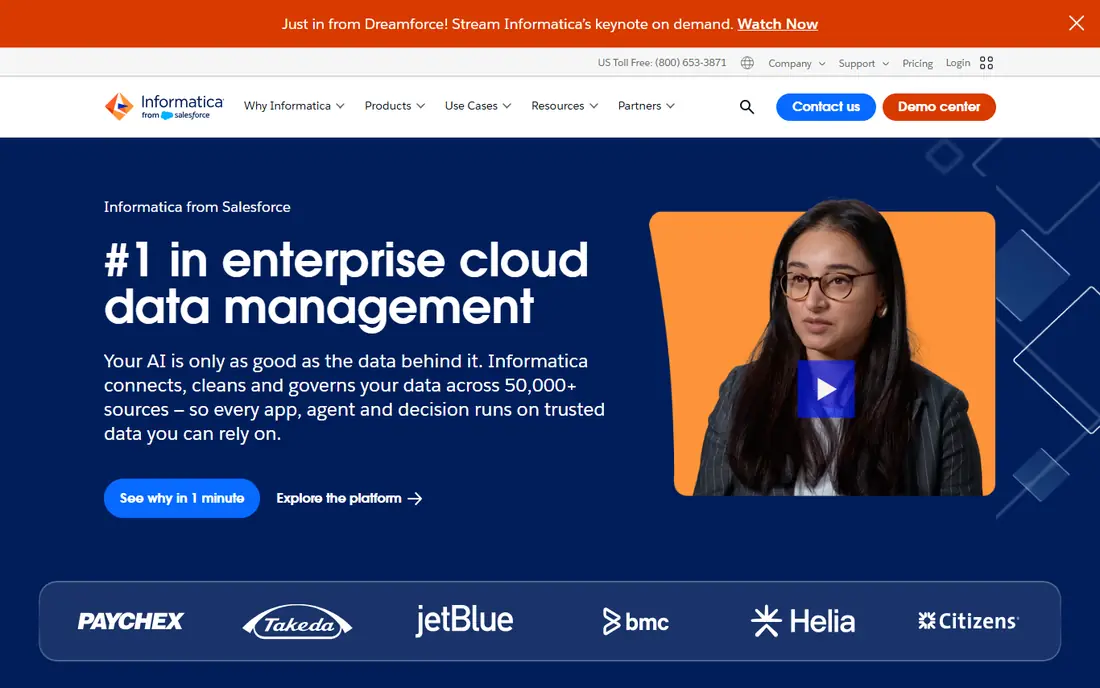
Informatica is a long-running enterprise data management platform, covering integration, quality, governance, master data, and catalog in one suite. Large firms in finance, healthcare, and telecom use it to move data between systems, clean it, and govern who can use it, with controls that suit regulated environments. Its breadth is the reason it appears in most enterprise shortlists.
That breadth brings cost and complexity, with pricing quoted per project and implementation that needs experienced data engineers. Informatica suits firms that need governance and scale together, not a small team that only needs a few pipelines. If you choose it, budget for training and for a phased rollout.
- Broad enterprise integration and governance
- Strong data quality
- Cloud and on-premises options
- Enterprise pricing and complexity
- Implementation takes skilled staff
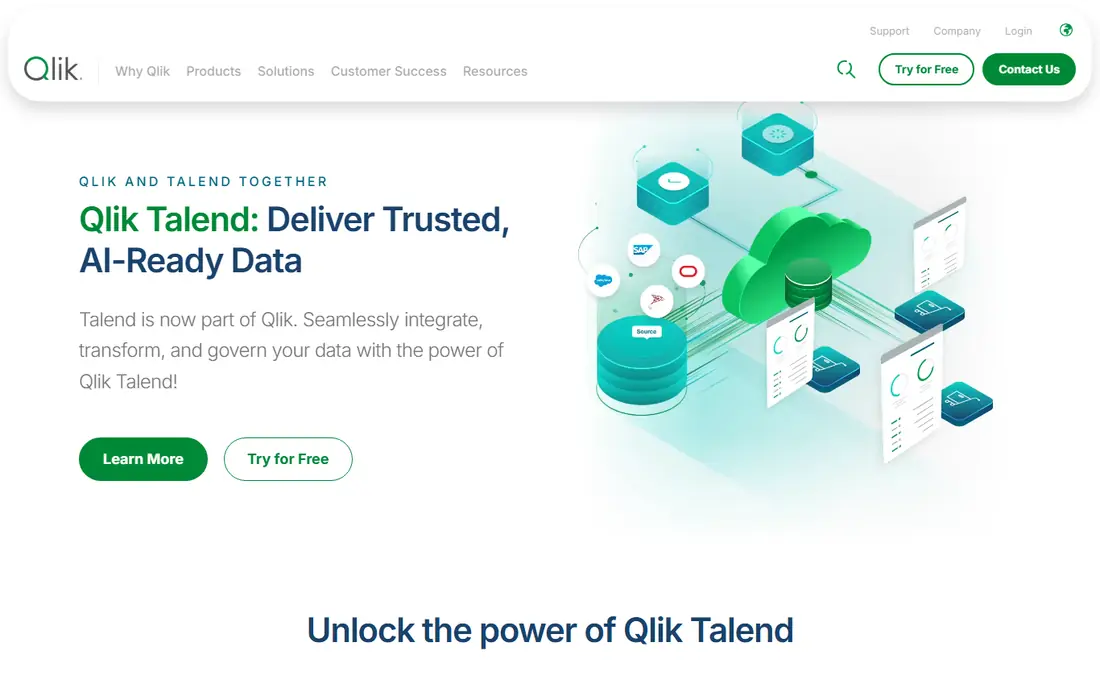
Talend, now Qlik Talend Cloud after the Qlik acquisition, combines integration, data quality, governance, and catalog tools for large enterprises. It offers hundreds of connectors across cloud, on-premises, and hybrid sources, with visual pipeline building and lineage tracking that shows where data came from. Qlik integration gives a path from ingestion to analytics in one vendor stack.
Pricing is tiered and enterprise-focused, with higher tiers quoted on request, and advanced work often needs Java skills. Talend suits firms with complex, mixed sources and strict governance needs, especially where data quality rules must be enforced in the pipeline, not cleaned up later.
- Many connectors
- Built-in data quality and lineage
- Qlik analytics integration
- Enterprise pricing is opaque
- Java-focused work needs specialized skills
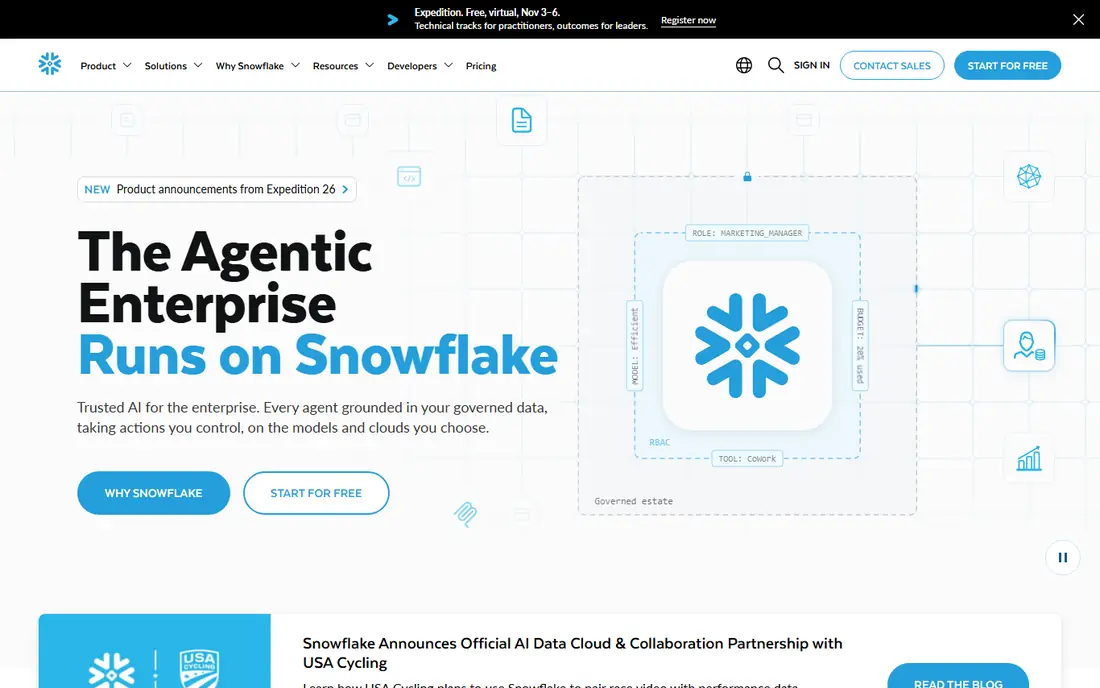
Snowflake is a cloud data warehouse that separates storage from compute, so teams can scale queries without scaling storage, and vice versa. It handles SQL analytics at high concurrency with little tuning, which suits business intelligence and governed reporting. Its marketplace and partner ecosystem make it easy to share and enrich data.
Pricing is usage-based, with compute credits and storage billed separately, and published credit rates vary by edition and region. That model is flexible, but idle or oversized compute is a common source of overspend. Snowflake fits analytics-first teams that want a managed warehouse and that will set cost alerts and warehouse sizing rules.
- Managed warehouse with separate storage and compute
- Strong SQL and concurrency
- Broad ecosystem
- Costs can spike if compute is not monitored
- Usage-based pricing needs cost controls
Databricks is a lakehouse platform built on open formats in your own cloud account, combining data engineering, SQL analytics, streaming, and machine learning. It rewards engineering teams that can build pipelines in SQL, Python, or Scala, and it handles unstructured data and model work that a pure warehouse handles less well. For AI and heavy pipeline work, Databricks is a strong choice.
The trade-off is skill and billing. Databricks bills for its platform, while your cloud provider bills for compute and storage underneath, so total cost needs both bills. It suits firms with data engineers and a roadmap for AI, not teams that only need simple reporting.
- Lakehouse over open formats
- Strong streaming, ML, and AI work
- Scalable engineering
- Needs engineering skill
- Split billing with cloud provider complicates cost tracking
Fivetran is a managed ELT service that moves data from SaaS apps, databases, and files into a warehouse with minimal setup. Connectors handle schema changes and incremental loads automatically, which saves engineering time compared with building pipelines by hand. For teams that want reliable ingestion without maintaining code, Fivetran is one of the simplest options.
Pricing is based on monthly active rows, so costs rise with data churn, and high-volume sources can become expensive. Fivetran suits analytics teams that value low maintenance over full control, and that can model costs on their actual row volume before committing.
- Managed connectors with little setup
- Automatic schema changes
- Reliable incremental loads
- Costs scale with data volume and churn
- Less control than open-source pipelines
Airbyte is an open-source ELT platform with a large connector library, available as a free self-managed version or as a managed cloud service with usage-based pricing. Teams that want control, custom connectors, and no vendor lock-in often choose Airbyte, because they can run it in their own infrastructure and extend it with its connector development kit.
Self-hosting means your team handles operations, upgrades, and monitoring, which is a real cost even when the software is free. Airbyte suits teams with engineering capacity that want flexible batch ELT, while real-time streaming teams may prefer a dedicated CDC tool. Start with Airbyte Cloud if you want managed operations without losing open-source flexibility.
- Open-source core
- Hundreds of connectors
- Cloud or self-managed deployment
- Self-hosting needs operations work
- Real-time CDC is more limited than streaming tools
Matillion is built specifically for cloud data warehouses, with visual ELT pipelines that push transformation into Snowflake, BigQuery, or Redshift. That warehouse-native approach keeps data in your tenant and can reduce egress costs, while Git integration supports good engineering practice. Analysts with SQL skills can build pipelines without deep coding.
Its focus is also its limit: Matillion is less suited to firms with many on-premises or legacy sources outside the major warehouses. Pricing is credit-based on compute usage, so complex queries can raise costs. Pick Matillion if your analytics stack is centered on one cloud warehouse.
- Warehouse-native ELT for Snowflake, BigQuery, and Redshift
- Visual pipelines
- Git integration
- Focused on cloud warehouses, so less suited to on-premises sources
- Usage-based costs can surprise
Collibra is a governance and catalog platform, not a pipeline tool, and it fills a different gap: knowing what data you have, who owns it, what it means, and whether it can be trusted. It offers a business glossary, data lineage, policy management, and workflows for approvals, which help regulated firms prove control over data. That governance layer is what makes reports trustworthy at scale.
Pricing is enterprise and quoted on request, and Collibra only works if business owners actually define terms and own datasets. It pairs well with Snowflake, Databricks, or Informatica for storage and movement, while Collibra governs meaning and access. Choose it when governance, not just movement, is the bottleneck.
- Strong governance, catalog, and lineage
- Policy and workflow tools
- Enterprise scale
- Enterprise pricing
- Implementation needs governance ownership
Alation is a data catalog that helps analysts find, understand, and trust data, with search, lineage, and collaboration tools. Its machine learning features suggest popular tables, flag trusted sources, and surface usage patterns, which helps new analysts avoid guessing which table to use. Stewardship tools let owners curate and document key datasets.
Like Collibra, Alation is enterprise-priced and quoted on request, and its value depends on analysts actually using the catalog instead of asking colleagues for table names. For firms where discovery is slow and reports conflict, Alation can cut wasted time, especially when paired with a warehouse such as Snowflake or Databricks.
- Strong data discovery and search
- Machine learning suggestions
- Collaboration and stewardship
- Enterprise pricing
- Catalog value depends on adoption by analysts
How we picked these
We compared vendor pages, platform comparisons, and data management guides from 2026, focusing on the same questions: what job does it do, how does it scale, how is it priced, and what skill does it need. We favored platforms that are active, that publish clear use cases, and that cover different jobs, from pipelines to warehouses to governance. We did not claim hands-on testing, and enterprise prices are quoted per customer, so we list See website where a fixed price would mislead.
How to choose and govern data well
Map your jobs first: ingestion, transformation, quality, catalog, governance, and analytics, then pick tools for the jobs you actually have, not for a complete suite you will not use. A small analytics team may need only Fivetran, Snowflake, and a simple catalog, while a regulated enterprise may need Informatica or Talend plus Collibra. Pilot with one data domain, such as sales or finance, and prove quality and ownership before you expand.
Quality, ownership, and cost control
Assign an owner to every key dataset, define quality rules such as completeness and freshness, and monitor them automatically. Set cost alerts for usage-based platforms, size warehouses for actual query patterns, and archive data you no longer need. Good data management is less about buying the largest platform and more about clear ownership, tested pipelines, and reports that people trust.
Sources
- https://www.informatica.com
- https://www.talend.com
- https://www.snowflake.com
- https://www.databricks.com
- https://www.fivetran.com
- https://www.airbyte.com
- https://www.matillion.com
- https://www.collibra.com
- https://www.alation.com
- https://estuary.dev/blog/snowflake-etl-tools/
- https://www.fivetran.com/learn/snowflake-etl-tools
Frequently asked questions
What is data management software?
Data management software helps organizations collect, store, clean, govern, and use data. It includes integration tools that move data, quality tools that fix errors, catalogs that document data, governance tools that control access, and warehouses that store data for analysis. Different tools cover different parts of that work.
What is the best data management software for small businesses?
Small teams often start with Fivetran or Airbyte for pipelines and Snowflake or a simpler warehouse for storage, because managed tools need less engineering. Enterprise suites such as Informatica and Collibra suit larger firms with governance needs. Start with the smallest tool that covers your actual data volume and skills.
Is Snowflake a data management platform?
Snowflake is primarily a cloud data warehouse, which is one part of data management: storage and analytics. It pairs with pipeline tools such as Fivetran or Airbyte for ingestion, and with catalog or governance tools for documentation and control. Calling it a full data management suite on its own would overstate its role.
How much does data management software cost?
Costs vary widely, from free open-source tools such as Airbyte self-managed, to usage-based warehouse and pipeline pricing, to enterprise suites quoted per customer. Model costs on data volume, query compute, and number of users, and ask vendors for a quote based on your actual usage, not a generic list price.
What is the difference between ETL and ELT?
ETL transforms data before loading it into a warehouse, while ELT loads raw data first and transforms it inside the warehouse. ELT is common with cloud warehouses such as Snowflake and BigQuery, because warehouse compute handles transformation well. The right choice depends on your warehouse, data volume, and governance needs.
Do I need a data catalog?
You need a catalog when analysts waste time finding data, when reports use different definitions, or when governance requires documentation of sources and owners. Small teams with a few tables may manage with documentation in a wiki, while larger firms benefit from a dedicated catalog such as Alation or Collibra.