Best EHS Software in 2026: 9 Tools Compared
By ToolNimba Editorial Team November 9, 2026 10 min read

- Top pick
 VelocityEHS
Enterprise EHS and chemical management
Starting priceSee websiteCheck out VelocityEHSRead our review - Runner-up
 Cority
Enterprise EHS and quality
Starting priceSee websiteCheck out CorityRead our review - Also great
 Intelex
Configurable EHS and quality
Starting priceSee websiteCheck out IntelexRead our review
How we researched this
We compared official pricing and feature pages, app store listings, privacy policies and public user reviews. Prices change, so check the provider's site before you pay.
Key takeaways
- EHS software covers environment, health and safety work such as incidents, audits, inspections, training and chemical management.
- Enterprise suites such as VelocityEHS, Cority, Intelex and Benchmark Gensuite use quote-based pricing and suit multi-site organisations.
- SafetyCulture and Safesite are the most accessible starting points for frontline teams, with free plans for small groups.
- EHS Insight publishes a starting price, which makes budgeting easier for mid-sized teams that want modular EHS tools.
Quick comparison
| Name | Best for | Starting price | Free plan | |
|---|---|---|---|---|
| VelocityEHS | Enterprise EHS and chemical management | See website | No | Visit |
| Cority | Enterprise EHS and quality | See website | No | Visit |
| Intelex | Configurable EHS and quality | See website | No | Visit |
 Benchmark Gensuite | AI-assisted EHS and compliance | See website | No | Visit |
 SafetyCulture | Frontline inspections and incidents | $24 per user per month | Yes | Visit |
 EHS Insight | Modular EHS for mid-sized teams | $5,000 per year | No | Visit |
 Safesite | Free safety management for small teams | Free | Yes | Visit |
 Evotix | Workforce safety engagement | See website | No | Visit |
 KPA | EHS and compliance for mid-market teams | See website | No | Visit |
The best EHS software
EHS stands for environment, health and safety, and the software in this guide helps organisations record incidents, run inspections and audits, track corrective actions, manage training and stay ready for regulators and insurers. We compared official product pages, pricing pages and public documentation, and we focused on mobile use for frontline staff, reporting for managers, and the breadth of modules. No software alone guarantees compliance, since procedures, training and timely reporting still matter.
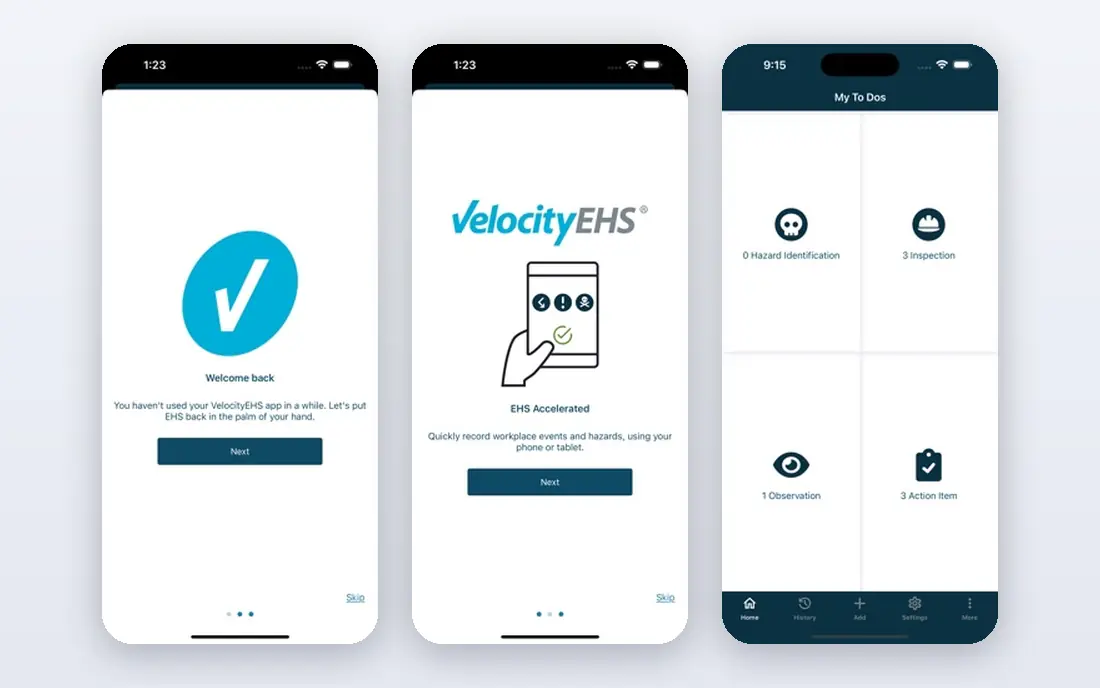
VelocityEHS is one of the broadest enterprise EHS platforms here, covering incident management, audits, inspections, ergonomics, industrial hygiene, chemical management and sustainability in related modules. That breadth suits large organisations that want one system across sites rather than a patchwork of spreadsheets and point tools. Chemical management is a particular strength, given its long history in safety data sheets.
Pricing is by quote, and a full multi-module rollout needs planning, configuration and training. Smaller teams will find simpler tools faster and cheaper. For a multi-site organisation that needs depth across safety and chemical programmes, VelocityEHS is a strong enterprise starting point for a formal evaluation.
- Broad EHS coverage across safety, health and environment
- Strong chemical management through its MSDSonline history
- Mobile tools for field staff
- Quote-based pricing
- Full rollout can take months for large organisations
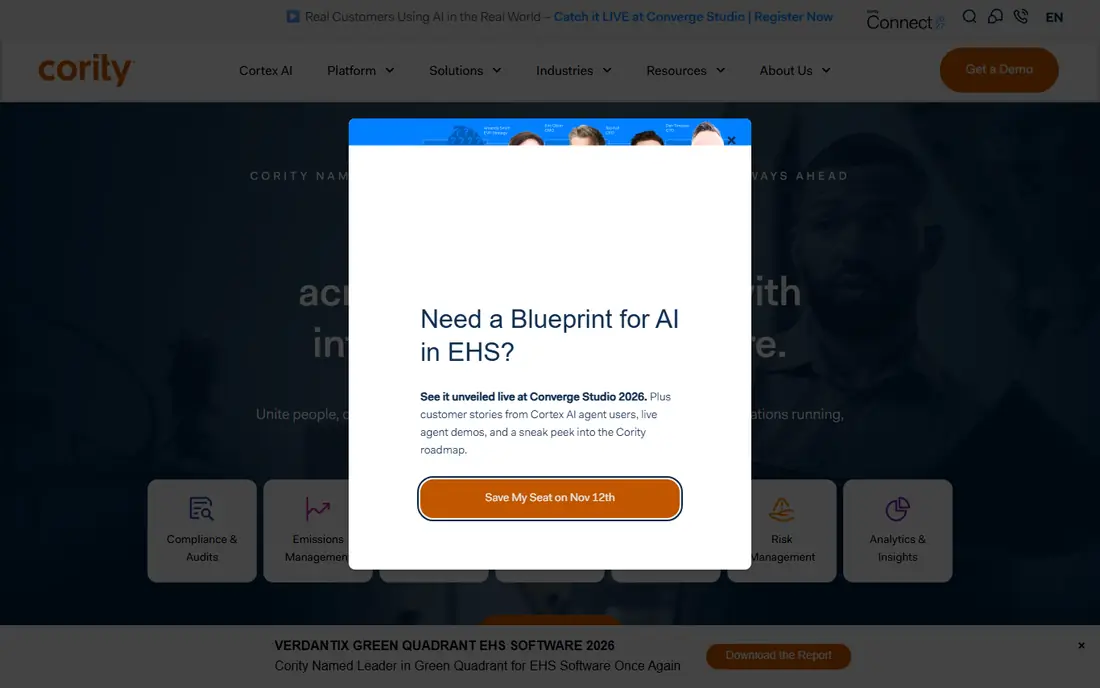
Cority, often described as EHSQ software because it adds quality, suits large organisations in regulated industries that need consistent processes across sites and countries. It covers incidents, audits, risk, occupational health, environmental management and related quality workflows, with reporting that helps leaders spot trends rather than just count events. That consistency is valuable when an audit or regulator asks for a clear trail.
As with other enterprise suites, Cority needs a committed owner, clean data and time to configure. A team without that ownership will struggle to get value from any enterprise platform. If your organisation is large, regulated and ready to standardise, Cority belongs on the shortlist alongside VelocityEHS and Intelex.
- Wide EHS and quality coverage
- Strong reporting and analytics
- Built for large, regulated organisations
- Quote-based pricing
- Implementation needs dedicated ownership
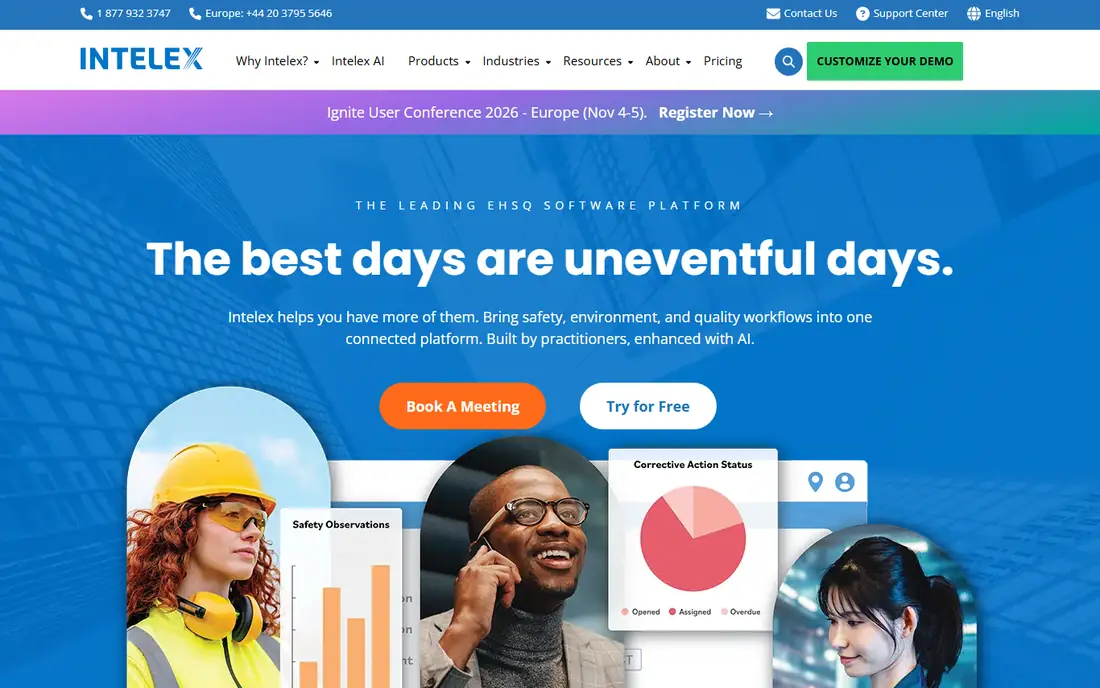
Intelex appeals to organisations that want to shape EHS workflows around their own processes rather than adopt a fixed template. Forms, workflows, approvals and dashboards can be configured for incidents, audits, observations, permits and quality events, which helps companies with specific regulatory or internal requirements. The platform also supports mobile reporting, so frontline staff can raise issues from the field.
Flexibility is also the risk. Without clear governance, a configurable system can grow into many overlapping forms that confuse users. Start with a small set of core workflows, agree naming and ownership, and expand only where reporting shows a gap. Done that way, Intelex is one of the most adaptable enterprise EHS platforms available.
- Highly configurable workflows and forms
- Broad EHS and quality modules
- Strong analytics and dashboards
- Quote-based pricing
- Configuration can become complex without governance
Benchmark Gensuite, formerly Gensuite, covers a wide EHS and compliance footprint, including incidents, audits, inspections, risk, environmental and sustainability-related workflows. It suits global organisations that need consistent reporting across regions and want to link safety performance with broader compliance and sustainability reporting. Its scale and module breadth make it a credible enterprise alternative to Cority and VelocityEHS.
Smaller organisations will find the platform and its pricing heavier than needed. Benchmark Gensuite makes most sense when you have multiple sites, complex reporting duties and a team that can own the system. In that setting, its breadth can replace several smaller tools and give leaders one view of risk.
- Broad EHS, sustainability and product stewardship coverage
- Tools to support reporting and risk workflows
- Used by large global organisations
- Quote-based pricing
- Best value at enterprise scale
SafetyCulture, now also known in some contexts as Mitti, is the most accessible tool here for frontline teams. Staff can complete inspections from a phone, raise incidents, assign corrective tasks and track follow-up without a long training course. The free plan suits very small teams, and paid plans start at $24 per user per month billed annually in recent listings.
It does not replace an enterprise suite for complex occupational health, chemical or sustainability programmes. For a team that needs to move inspections and incident reporting off paper and spreadsheets quickly, SafetyCulture is our pick for most people starting out, and it can run in days rather than months.
- Easy mobile inspections and checklists
- Free plan for small teams
- Incident reporting and task follow-up
- Less depth than enterprise EHS suites
- Higher tiers needed for advanced analytics
EHS Insight stands out in this market by publishing a starting price. Its site lists pricing from $5,000 per year for small and mid-sized businesses, with costs scaling by contacts, modules and implementation needs. That transparency helps mid-sized teams budget without a long sales process just to learn the entry point. Modules cover incidents, audits, inspections, risk, training and compliance tracking.
The platform is less broad than the largest enterprise suites, but for a mid-sized organisation that wants a structured EHS system without enterprise complexity, that focus is a strength. Check which modules your starting price includes, since the final cost depends on the set you choose and the number of contacts you need.
- Published starting price for small and mid-sized businesses
- Modular choice across many EHS areas
- Clear incident, audit and training tools
- Enterprise plans are quoted
- Costs rise with contacts and modules
Safesite gives small teams a free route into structured safety management. You can run inspections, log incidents and hazards, assign actions and keep basic records from a phone, without paying for an enterprise suite. That makes it a practical step up from paper forms and spreadsheets for construction, field service and small manufacturing teams.
Larger organisations with multi-site reporting, occupational health or chemical duties will outgrow Safesite and need a broader platform. For a small team that needs to prove a safety habit first, Safesite is a low-risk place to start, and you can move to a larger system once reporting needs grow.
- Free plan for core safety management
- Mobile inspections and incident reporting
- Simple setup for small teams
- Less enterprise depth
- Advanced features need paid plans
Evotix focuses on getting workers involved in safety, not just recording events after they happen. Observation reporting, engagement tools and trend dashboards help safety teams see near misses and positive behaviours, and act before a serious incident occurs. That people-first angle suits organisations trying to improve safety culture rather than only improve record-keeping.
Evotix is not the broadest EHS suite here, so check module coverage for audits, training, chemical or environmental needs before you choose it as a single system. As a complement to a broader platform, or as a focused tool for engagement and observations, it fills a gap that many larger suites treat as secondary.
- Focus on worker engagement and observations
- Mobile-first reporting
- Dashboards for safety trends
- Quote-based pricing
- Less broad than the largest EHS suites
KPA suits mid-market organisations that want EHS software plus practical compliance support, rather than software alone. Its offerings combine safety and compliance tools with training and related services, which can help teams without a large in-house EHS staff. Audit, incident and training workflows give managers a clearer view of gaps across sites.
Pricing is by quote and packages vary, so ask for a written scope that lists modules, users and support. KPA is a good fit when you want a partner as well as a platform, especially in industries with frequent training and audit duties. If you only need a simple inspection app, SafetyCulture or Safesite will be faster to start.
- Combines EHS software with compliance content and support
- Practical for mid-market and multi-site teams
- Training and audit tools included in related offerings
- Quote-based pricing
- Scope varies by package, so check module details
How we picked these
We compared official product pages, pricing pages and public documentation for tools that cover core EHS work, not just a single checklist app. We weighed incident and audit coverage, mobile use, corrective action tracking, reporting and price transparency, and we mixed enterprise suites with accessible frontline tools. We did not claim hands-on testing, and prices are starting prices or quote-based descriptions from vendor pages at the time of writing. Software supports compliance work but does not by itself guarantee it.
What to check before you buy
Start with the workflows that cause the most pain today. If inspections and incident follow-up are the problem, a frontline tool may solve most of it. If audits, occupational health, chemical management and multi-site reporting are all in scope, an enterprise suite is more honest, even though it costs more and takes longer to roll out.
Next, test mobile use with real field staff, including offline or low-signal conditions if your sites need it. Check corrective action tracking, because a system that records incidents but does not chase actions will not change safety outcomes. Ask for implementation time, data migration help and training in writing, and confirm who owns the system after go-live. Finally, price your real user mix and modules, and confirm what happens to your data if you leave.
Sources
Frequently asked questions
What is EHS software?
EHS software manages environment, health and safety work, including incident reporting, inspections, audits, corrective actions, training records and compliance tracking. It replaces spreadsheets and paper forms with one system that managers and frontline staff can both use.
How much does EHS software cost?
It varies widely. Frontline tools such as SafetyCulture start around $24 per user per month, EHS Insight lists a starting price of $5,000 per year, and enterprise suites such as VelocityEHS, Cority and Intelex use quote-based pricing that can run much higher depending on modules and users.
Will EHS software keep us OSHA compliant?
It helps a lot, but it does not guarantee compliance. Good software gives you incident logs, OSHA 300 records, audits, training tracking and an audit trail in one place. You still need correct procedures, trained people and timely reporting to meet your duties.
How long does EHS software take to set up?
Simple frontline tools can run in days. Mid-market platforms often take four to twelve weeks including configuration, migration and training. Enterprise suites can take three to nine months for a full multi-module rollout, so ask for a written timeline before you sign.
Do small teams need EHS software?
Not always, but spreadsheets break down as sites and staff grow. If you have more than one location, more than about 50 employees, or frequent audits, a dedicated tool usually saves admin time and reduces the risk of missed actions. Small teams can start free with Safesite or SafetyCulture.