Best Encrypted Messaging Apps in 2026: 9 Apps Compared
By ToolNimba Editorial Team November 9, 2026 11 min read

- Top pick
 Signal
Overall privacy
Starting priceFreeCheck out SignalRead our review - Runner-up
 WhatsApp
Reaching everyone
Starting priceFreeCheck out WhatsAppRead our review - Also great
 Telegram
Large groups and channels
Starting priceFreeCheck out TelegramRead our review
How we researched this
We compared official pricing and feature pages, app store listings, privacy policies and public user reviews. Prices change, so check the provider's site before you pay.
Key takeaways
- Signal is the best encrypted messaging app for most people, with end-to-end encryption by default, open-source code and minimal metadata.
- WhatsApp is the best choice for reach, since it uses the Signal protocol and nearly everyone already has it, though Meta holds more metadata.
- Telegram is best for large groups and channels, but end-to-end encryption applies only to Secret Chats, not to regular chats.
- Threema and Session suit users who want to message without a phone number, with Threema using a random ID and Session using a routing network.
- For business teams, Wire and Element offer encrypted collaboration, admin controls and self-hosting options that consumer apps lack.
Quick comparison
| Name | Best for | Starting price | Free plan | |
|---|---|---|---|---|
| Signal | Overall privacy | Free | Yes | Visit |
| WhatsApp | Reaching everyone | Free | Yes | Visit |
| Telegram | Large groups and channels | Free | Yes | Visit |
 Threema | No phone number needed | $5 one-time | No | Visit |
 Session | Anonymous messaging | Free | Yes | Visit |
 Wire | Business collaboration | Free | Yes | Visit |
 Element | Self-hosted team chat | Free | Yes | Visit |
 Apple iMessage | Apple-to-Apple chats | Free | Yes | Visit |
 Google Messages | Android RCS chats | Free | Yes | Visit |
The best encrypted messaging apps
An encrypted messaging app should protect message content with end-to-end encryption, so only the sender and receiver can read it. Privacy also depends on metadata, such as who you message and when, on whether the code is open source, and on what identifier you must share to sign up. We compared official privacy pages, feature pages and recent secure messaging comparisons for the apps below, focusing on encryption by default, metadata, sign-up requirements and team features.
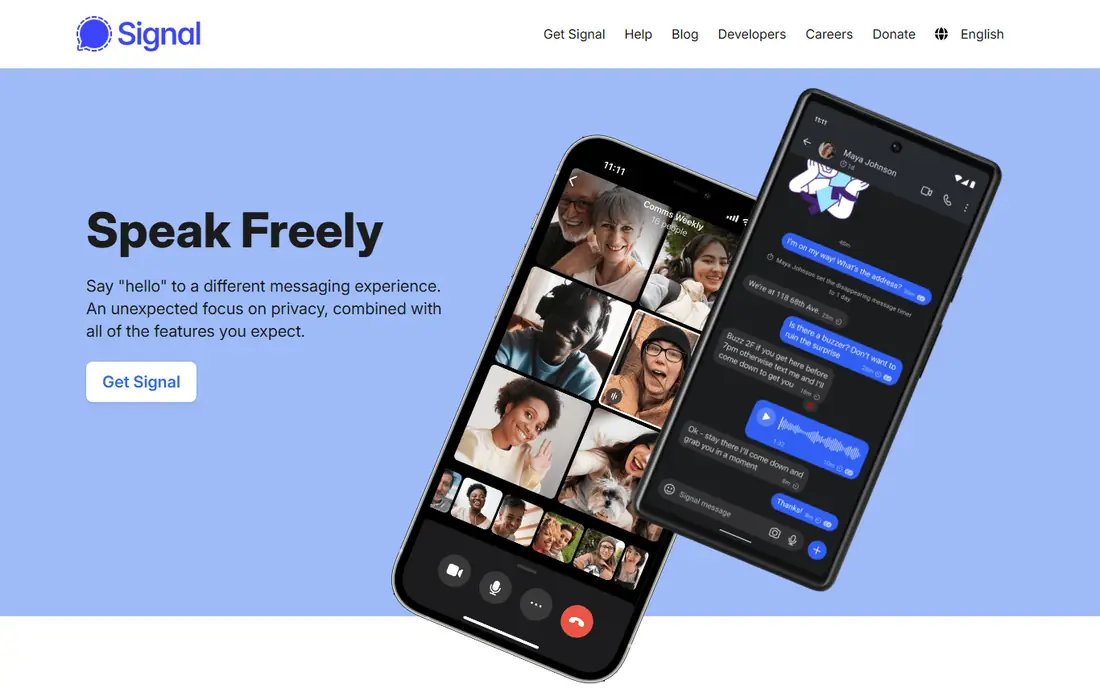
Signal is the standard other private messengers are measured against. Every message and call is end-to-end encrypted by default, the code is open source, and the non-profit structure means the app does not profit from user data or advertising. Signal has also shown in legal responses that it holds very little metadata, which is a stronger privacy position than encryption alone.
The main limits are reach and sign-up. Signal needs a phone number, and fewer contacts use it than WhatsApp, so you may need to invite people for a private thread. Group features have improved, but Telegram still leads for very large groups and channels. For one-to-one and small group chats where privacy matters most, Signal is the clear first choice.
- End-to-end encryption by default for all chats
- Open-source and audited code
- Minimal metadata collection
- Non-profit model
- Needs a phone number to sign up
- Smaller user base than WhatsApp
- Large group features are thinner than Telegram
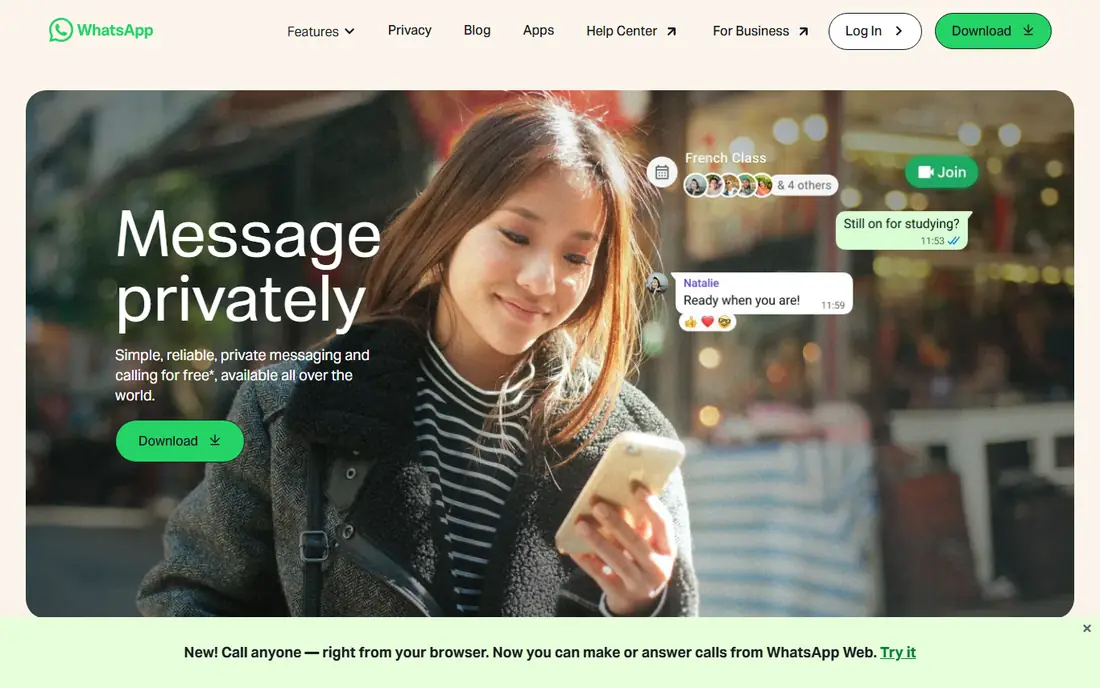
WhatsApp is the pragmatic private messenger, because the people you need to reach are already there. Message content uses the Signal protocol for end-to-end encryption, and the app covers voice, video, groups and file sharing at no cost. For everyday chats with family, friends and colleagues, that combination of encryption and reach is hard to beat.
The privacy trade-off is metadata. Meta, which owns WhatsApp, can hold data on who you message, when and how often, linked to other Meta accounts, even though it cannot read encrypted message content. The client is also not open source, so independent review is thinner than Signal. Use WhatsApp for reach, and Signal for threads where metadata privacy matters most.
- End-to-end encryption using the Signal protocol
- Nearly universal adoption
- Voice, video and group chats included
- Meta holds substantial metadata
- Client code is not open source
- Business chats may have different handling
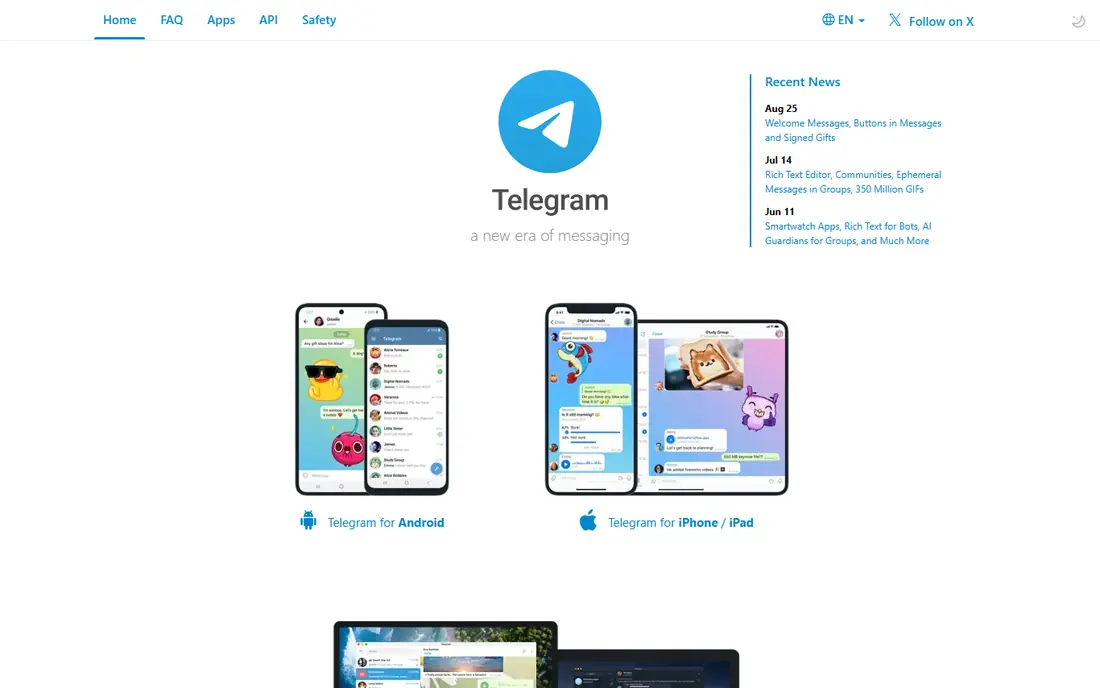
Telegram is best understood as a social and broadcast app with a private mode, rather than a fully encrypted messenger. Regular chats use cloud encryption, which protects data in transit and at rest on Telegram servers but does not give end-to-end encryption. Secret Chats do offer end-to-end encryption, with self-destruct timers and device-only storage, but you must start them explicitly for each contact.
That distinction matters for a privacy shortlist. Telegram excels for large groups, channels, bots and large files, and its sync across phone, desktop and web is fast. For sensitive one-to-one chats, start a Secret Chat or use Signal instead. Do not assume a regular Telegram chat has the same protection as a Signal chat, because it does not.
- Huge groups and channels
- Fast cloud sync across devices
- Large file sharing and bots
- End-to-end encryption only in Secret Chats
- Regular chats are cloud-encrypted, not end-to-end
- Phone number needed to sign up
Threema suits users who do not want to share a phone number to message privately. You get a random Threema ID, the company is based in Switzerland, and the app is a one-time purchase rather than a free, ad-supported product. That paid model aligns the business with the user, not with advertisers, and the app declares no data collection for its core messaging in store listings reviewed in 2026.
The cost is adoption. At around $5 one-time, Threema is cheap for one person but can slow a group move, since every contact must buy it too. Features are also simpler than WhatsApp for calls and large groups. For a small circle that values a phone-number-free identity, Threema is a strong and principled choice.
- Random Threema ID instead of a phone number
- Swiss-based company
- One-time purchase, no ads or tracking model
- Small user base
- One-time cost can slow adoption
- Group and call features are simpler than WhatsApp
Session is built for anonymity above convenience. You sign up with a random Session ID, no phone number or email is required, and messages route through an onion network that hides who is talking to whom. That design protects metadata as well as content, which suits journalists, activists and anyone with a high need for anonymity.
The trade-off is speed and polish. Onion routing can slow delivery compared with a direct server model, and the user base is smaller, so finding contacts takes effort. Features are also thinner than WhatsApp for calls and large groups. For everyday chats, Signal is easier. For a thread where identity itself must stay hidden, Session is the stronger tool.
- No phone number or email needed
- Onion routing hides metadata
- Open-source and free
- Slower message delivery at times
- Smaller user base
- Fewer mainstream features than WhatsApp or Signal
Wire is the business pick for teams that need encrypted collaboration without consumer-app compromises. Messages, calls and files are end-to-end encrypted, business plans add admin controls, guest rooms and compliance features, and the company offers EU hosting. That combination suits law firms, clinics, finance teams and other groups that must show how client data is handled.
A personal user will find fewer contacts on Wire than on WhatsApp or Signal, and business pricing, from around 6 euros per user per month on some plans, adds up for a large team. Wire is not the app to message family on, but for a work team that needs encrypted rooms, file sharing and admin control, it is a credible and well-documented choice.
- End-to-end encryption for messages, calls and files
- Business plans with admin controls
- EU-based hosting options
- Personal user base is small
- Business plans cost per user
- Interface is more work-focused than social
Element runs on Matrix, an open, federated protocol, which gives organizations a choice consumer apps do not offer: run your own server, control your data, and still communicate with other Matrix servers. End-to-end encryption is available, hosted plans start at around $5 per user per month, and the free tier covers basic use. Public sector and large organizations use Matrix for that control.
The cost is complexity. Self-hosting needs technical skill, encryption setup has edge cases in large rooms, and the interface feels rougher than Signal or WhatsApp. For a small team that just needs private chats, Signal or Wire will be faster. For an organization that must own its server and data, Element is the most flexible encrypted option on this list.
- Open Matrix protocol
- End-to-end encryption
- Self-hosting and federation for organizations
- Used by public sector teams
- Setup is more complex for self-hosting
- Encryption setup has edge cases
- Interface is rougher than consumer apps
Apple iMessage is a strong private option inside the Apple system. Messages between Apple devices are end-to-end encrypted, contact key verification helps confirm a contact identity, and the service is built into iOS and macOS at no extra cost. For a household or team that all use Apple devices, iMessage gives private chats without installing anything new.
The limit is the other side of the conversation. Chats with Android devices do not get the same iMessage encryption, and fall back to SMS or carrier RCS handling depending on setup. There is also no Android app, so a mixed-device group cannot rely on iMessage alone. Use iMessage for Apple-to-Apple threads, and Signal for mixed-device private chats.
- End-to-end encryption between Apple devices
- Contact key verification
- Built into iPhone, iPad and Mac at no cost
- Apple devices only for full encryption
- Chats with Android fall back to less protected SMS or RCS handling
- No Android app
Google Messages is the default messaging app on many Android phones, and its RCS chats offer end-to-end encryption between Google Messages users. That gives Android users a private option without installing a new app, with typing indicators, high-quality media and group RCS features where supported. For a casual Android user, it is a useful step up from plain SMS.
The scope limit is important. Google states that end-to-end encryption is not available for SMS or MMS messages, so protection disappears when a thread falls back to plain texting. Both sides also need RCS enabled, and carrier support varies. For guaranteed private chats across devices, Signal remains the safer choice, while Google Messages is a good default for Android-to-Android RCS threads.
- End-to-end encryption for RCS chats between Google Messages users
- Built into many Android phones
- No extra cost
- Encryption does not apply to SMS or MMS fallback
- Needs RCS enabled on both sides
- Google account and carrier support vary
How we picked these
We compared official privacy pages, feature pages and recent secure messaging comparisons, and kept only apps that offer end-to-end encryption for at least some chats and still work in October 2026. We favored a mix of consumer apps, phone-number-free apps and business tools, and we noted where encryption is by default, optional or limited to certain chat types. Encryption protects content, but metadata, sign-up identity and code openness also shape privacy, so we weighed those factors beside encryption alone.
How to choose an encrypted messenger
Start with who you need to talk to, then with what you need to protect. An app no one else uses will not help, however strong its encryption, and an app everyone uses may still collect metadata you would rather avoid. The steps below balance reach and privacy.
Check encryption by default, not just encryption on offer
Ask whether end-to-end encryption applies to all chats by default, or only to a special mode such as Telegram Secret Chats. Default encryption removes the risk of forgetting to enable it, and it protects group chats as well as one-to-one chats. For sensitive threads, default encryption should be a requirement, not a bonus.
Check metadata and sign-up identity
Ask what the app collects beyond message content, such as contact lists, timing and device data, and what you must share to sign up. Signal holds minimal metadata but needs a phone number, Threema and Session avoid a phone number, and WhatsApp holds more metadata through Meta. Choose the trade-off that fits your threat level, from everyday privacy to full anonymity.
Keep a mainstream app and a private app
For most people, the practical setup is two apps: WhatsApp or iMessage for everyday reach, and Signal for private threads. That split avoids forcing every contact onto a niche app, while keeping sensitive conversations in a stronger privacy model. For work, add Wire or Element where team controls or self-hosting are required.
Sources
- https://www.flozic.ai/blog/best-secure-messaging-app
- https://beebom.com/best-secure-messaging-apps/
- https://appshelm.com/secure-messaging-apps-2026/
- https://signal.org
- https://www.whatsapp.com
- https://telegram.org
- https://threema.ch
- https://getsession.org
- https://wire.com
- https://element.io
- https://www.apple.com
- https://messages.google.com
Frequently asked questions
What is the best encrypted messaging app?
Signal is our pick for most people, because it offers end-to-end encryption by default, open-source code and minimal metadata, all for free. WhatsApp is better for reach, Threema and Session are better for phone-number-free use, and Wire and Element are better for business teams. The best app for you depends on reach, metadata and team needs.
What is the best private messaging app?
Signal is the best private messaging app for most users, since it combines default encryption with low metadata collection and a non-profit model. Threema is a strong alternative if you do not want to share a phone number, while Session suits users who need anonymity through onion routing. Privacy and encryption are related but not identical, so check metadata as well as encryption.
Is Telegram encrypted?
Telegram offers end-to-end encryption only in Secret Chats, which must be started explicitly and are device-specific. Regular Telegram chats use cloud encryption, which protects data in transit and on Telegram servers but is not end-to-end. For sensitive chats, use a Secret Chat or switch to Signal.
Is WhatsApp really private?
WhatsApp message content is end-to-end encrypted using the Signal protocol, so Meta cannot read the content of those messages. Meta can still hold metadata, such as who you message and when, linked to other Meta accounts. That metadata distinction is why Signal is a stronger privacy choice for sensitive threads, even though WhatsApp encryption itself is strong.
What is the best encrypted messaging app for business?
Wire and Element are the strongest business picks on this list. Wire offers encrypted collaboration with admin controls and EU hosting, while Element offers self-hosting and federation through Matrix. Signal also works for small business teams, but it lacks the admin controls and compliance features larger organizations often need.
Do encrypted messaging apps work without a phone number?
Some do. Threema uses a random ID, Session uses a random Session ID, and Element and Wire can use an email rather than a phone number. Signal, WhatsApp and Telegram generally need a phone number to sign up, though Telegram allows a username for contact after sign-up. Choose a phone-number-free app if sharing your number is itself a privacy concern.