Best ETF App in 2026: 9 Apps Compared
By ToolNimba Editorial Team November 9, 2026 10 min read

- Top pick
 Fidelity
Best all-round ETF investing
Starting priceFreeCheck out FidelityRead our review - Runner-up
 Charles Schwab
Research and education
Starting priceFreeCheck out Charles SchwabRead our review - Also great
 Vanguard
Long-term index ETF investing
Starting priceFreeCheck out VanguardRead our review
How we researched this
We compared official pricing and feature pages, app store listings, privacy policies and public user reviews. Prices change, so check the provider's site before you pay.
Key takeaways
- Most major US brokers now offer $0 online commission on ETF trades, so the choice turns on research, fractional shares, automation and account types.
- Fidelity is our pick for most ETF investors, with broad ETF choice, fractional shares and strong research in one app.
- Vanguard suits long-term index investors, Schwab suits research-led investors, and M1 Finance suits hands-off portfolio automation.
- ETF fund fees still apply even when trading is commission-free, so compare expense ratios as well as app features. This is not financial advice, and investing carries risk, including loss.
Quick comparison
| Name | Best for | Starting price | Free plan | |
|---|---|---|---|---|
| Fidelity | Best all-round ETF investing | Free | Yes | Visit |
| Charles Schwab | Research and education | Free | Yes | Visit |
| Vanguard | Long-term index ETF investing | Free | Yes | Visit |
 Robinhood | Mobile-first ETF trading | Free | Yes | Visit |
 M1 Finance | Automated ETF portfolios | Free | Yes | Visit |
 Interactive Brokers | Broad market access | Free | Yes | Visit |
 E*TRADE | Active ETF traders | Free | Yes | Visit |
 SoFi Invest | Simple ETF investing for beginners | Free | Yes | Visit |
 Public | Social and educational ETF investing | Free | Yes | Visit |
The best ETF apps
An ETF app is usually a brokerage app that lets you buy and hold exchange-traded funds, which track an index, sector or theme in a single fund. We compared official broker pages, fee schedules and app listings, and we focused on ETF choice, trading commissions, fractional shares, recurring investing, retirement accounts and research. Trading commissions for online US stock and ETF trades are $0 at most brokers here, but fund expense ratios, spreads and other fees still apply, so read the fund and broker fee pages before you invest.
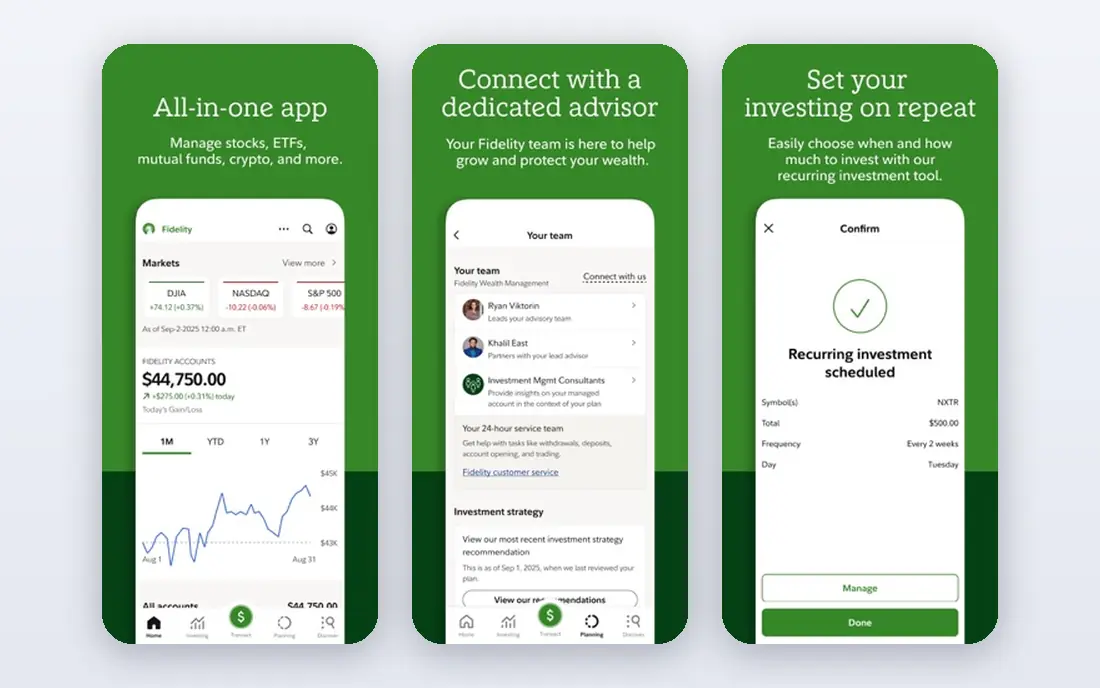
Fidelity is our pick for most ETF investors because it combines low cost with breadth. Online US stock and ETF trades are $0, there is no account minimum in the usual model, and the app offers ETF screening, research and fractional shares on eligible assets. That mix suits both a first-time index investor and a more active ETF holder who wants sector, bond and international funds in one account.
The app is powerful rather than minimal, so a complete beginner may need a short time to find the right screens and settings. Once set up, recurring investments and fractional shares make regular ETF buying simple, even with small amounts. For an all-round ETF app that does not force a trade-off between cost, choice and tools, Fidelity is the safest starting point.
- $0 online ETF commissions
- Broad ETF choice and research tools
- Fractional shares and recurring investing
- App depth can feel busy for absolute beginners
- Some advanced features take time to learn
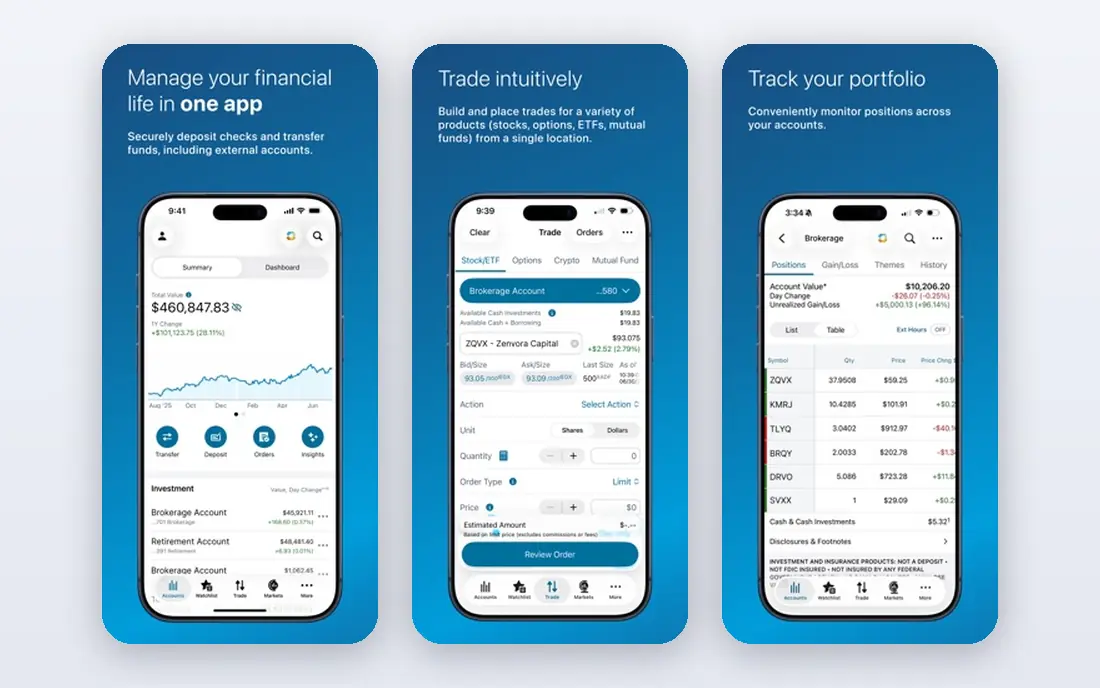
Charles Schwab suits investors who want research and education alongside low-cost ETF trading. Online US stock and ETF trades are $0, retirement accounts are well supported, and research, screeners and learning content help you compare funds before you buy. Support, including phone help, is a practical plus for investors who want a human answer to a question.
Fractional investing is more limited for ETFs than at Fidelity or Robinhood in some cases, so check the current rules for the ETFs you plan to buy in small amounts. If you invest larger sums or use retirement accounts and value research depth, Schwab is a strong, steady choice that will not push you toward frequent trading.
- $0 online ETF commissions
- Strong research and education
- Wide ETF choice and retirement accounts
- Fractional ETF shares are more limited than some rivals
- App can feel formal for casual traders
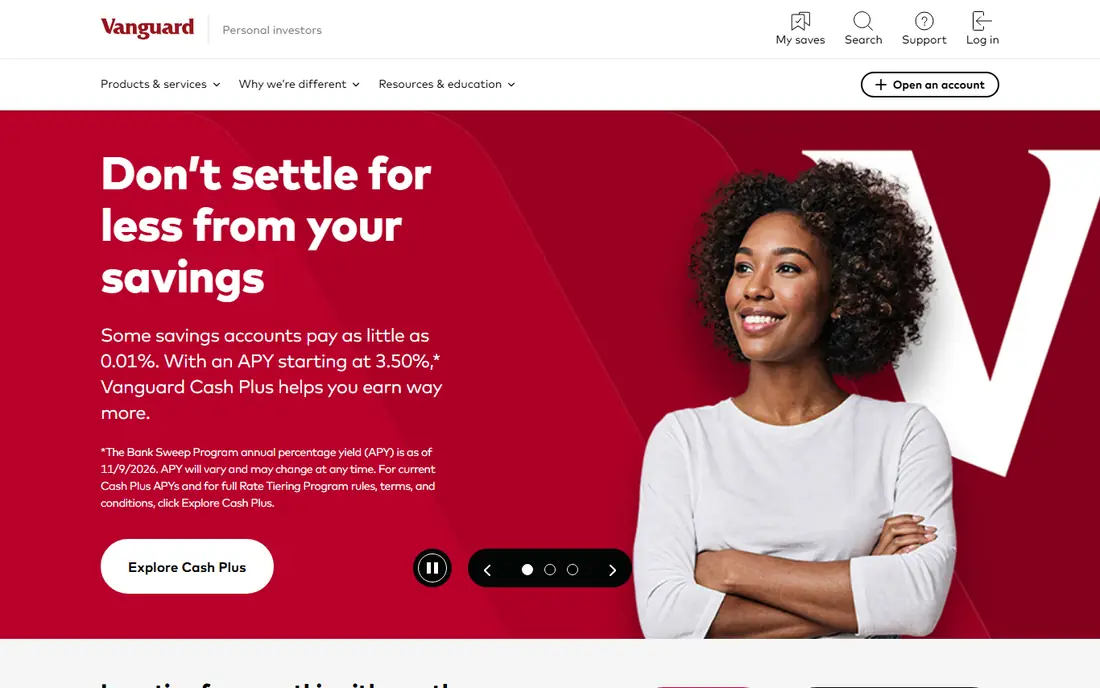
Vanguard remains the natural home for long-term index investors. Its own ETFs are known for low expense ratios, online US stock and ETF trades are generally $0, and automatic investing and retirement accounts support a buy-and-hold plan. If your strategy is to hold broad index ETFs for years and add money regularly, Vanguard keeps costs and complexity low.
The app is less polished than Fidelity or Robinhood, and fractional ETF buying is more limited in some cases, so small, frequent purchases of third-party ETFs need checking. Choose Vanguard when low fund costs and a long-term index approach matter more than a slick trading app, and pair it with a research app if you want deeper screening.
- Low-cost index ETF heritage
- $0 online ETF trades
- Automatic investing and retirement accounts
- App experience feels more functional than modern rivals
- Fractional ETF buying is more limited
Robinhood is the simplest mobile route into ETF investing. The app is clean and fast, online stock and ETF trades are $0, and fractional shares let you start with small amounts. Recurring investments help beginners build a habit without watching the market every day, and IRA accounts are available with terms that change by plan.
Research depth is the main limit. Investors who want detailed fund analysis, screening and portfolio tools will find Fidelity or Schwab stronger. Robinhood suits a mobile-first investor who knows which ETFs to buy and wants a low-friction way to buy them, rather than someone who needs research to choose a fund.
- $0 ETF commissions
- Simple mobile app
- Fractional shares from small amounts and recurring investments
- Research tools are thinner than Fidelity or Schwab
- Retirement match features depend on plan terms
M1 Finance suits hands-off ETF investors who want a portfolio, not a series of trades. You build a pie of ETFs and stocks with target weights, add money, and M1 invests it to keep the pie balanced, with automatic rebalancing on the platform. That structure helps long-term investors avoid drift and emotional trading, and it works well for a core ETF portfolio.
M1 is less convenient for frequent, single-ETF trading, since the pie model is built around portfolio-level investing. If you want to trade ETFs tactically every week, a broker such as Fidelity or E*TRADE will feel more direct. If you want to set a diversified ETF portfolio and add money regularly, M1 is one of the best automation picks here.
- $0 ETF trades in the usual model
- Portfolio pies for automated ETF investing
- Automatic rebalancing and recurring deposits
- Less suited to frequent single-ETF trading
- Some features need a paid tier
Interactive Brokers suits experienced investors who want broad access to ETFs and markets beyond a basic US broker app. Its platforms offer deep research, screening and trading tools, and account types include retirement accounts for US investors. For a global or advanced ETF investor, that breadth is hard to match in a single app.
Beginners should be cautious. The platforms are powerful but complex, and pricing varies by plan, product and market, so read the fee schedule for your trading pattern. Choose Interactive Brokers when you have outgrown a simple app and need wider access, and choose Fidelity or Schwab when simplicity and guidance matter more.
- Very broad ETF and market access
- Advanced tools for experienced investors
- Competitive pricing on many products
- Platform complexity for beginners
- Pricing varies by plan and product
E*TRADE, from Morgan Stanley, suits investors who trade ETFs more actively but still want a full broker account. Online US stock and ETF trades are $0, screeners and charting support ETF selection, and the mobile and desktop apps handle orders, watchlists and account management well. Retirement accounts and education content add value for longer-term holders too.
ETRADE does not lead on every research feature, and some advanced tools depend on plan or balance, so compare the current offering for your needs. For an active ETF investor who wants solid tools without moving to a professional terminal, ETRADE is a balanced and well-established choice.
- $0 online ETF commissions
- Strong trading tools and screeners
- Good mobile and desktop apps
- Research depth varies by fund
- Some premium features need higher balances or plans
SoFi Invest suits beginners who want ETF investing inside a simple financial app. The interface is clear, online ETF trades are $0 in the usual model, and an automated investing option can build and manage a diversified portfolio for you. That simplicity helps new investors start without learning a complex trading platform first.
Research and screening are lighter than at Fidelity, Schwab or Interactive Brokers, so investors who want to compare many funds in depth may need a second tool. If you want a straightforward start, especially alongside other SoFi accounts, SoFi Invest is an easy and low-cost entry point into ETF investing.
- Simple app for new investors
- $0 ETF commissions in the usual model
- Automated investing option available
- Research tools are lighter than Fidelity or Schwab
- ETF choice is broad but less research-led
Public suits investors who learn by reading, following themes and discussing ideas, as well as by trading. The app offers $0 commissions on US stocks and ETFs in the usual model, fractional shares, recurring investments and IRA accounts, alongside education and community features that help new investors understand what they own. That social layer can make ETF investing feel less lonely for a beginner.
Public is not a research terminal, and some premium features cost extra, so compare it with Fidelity or Schwab if deep fund research is your priority. As a simple, educational ETF app for a new investor who wants to start small and learn as they go, Public is a friendly and credible option.
- $0 ETF commissions in the usual model
- Fractional shares and recurring investments
- Education and community features
- Research tools are lighter than large brokers
- Some premium features cost extra
How we picked these
We compared official broker pages, fee schedules and app listings for US apps that let ordinary investors buy ETFs, not just track them. We weighed ETF choice, online commissions, fractional shares, recurring investing, retirement accounts, research and app ease. We did not claim hands-on testing, and we did not recommend any single ETF, since fund choice depends on goals, risk tolerance and time horizon. Prices shown as Free refer to app and account access and $0 online ETF commissions in the usual model, while fund expense ratios and other fees still apply.
What to check before you choose
Start with your investing plan. A long-term index investor needs low fund costs, recurring investing and retirement accounts, while an active ETF trader needs screeners, charts and fast orders. Check fractional share rules for the ETFs you plan to buy, since limits vary, and confirm whether your chosen ETFs are available commission-free.
Next, compare fund costs, not just broker costs. Two similar index ETFs can have different expense ratios, and that difference compounds over years. Check spreads and trading hours for less liquid ETFs, and read the fund prospectus for what the ETF actually holds. Finally, keep the app count low: one broker app for trading and one research tool is usually enough, and a simple recurring plan beats a complex app you rarely open.
Sources
Frequently asked questions
What is the best app for ETF investing?
Fidelity is the best all-round pick for most ETF investors, with $0 online ETF trades, broad choice, fractional shares and strong research. Vanguard suits long-term index holders, Schwab suits research-led investors, and M1 Finance suits hands-off portfolio automation.
Can I buy ETFs with no commission?
Yes, at most major US brokers, online US stock and ETF trades are $0. Fund expense ratios still apply, and they are charged inside the fund, so compare expense ratios as well as trading commissions when you choose an ETF.
Can I buy fractional ETF shares?
Yes, at several brokers, including Fidelity, Robinhood, M1 Finance and Public, on eligible ETFs. Rules vary by broker and ETF, so check fractional availability for the specific funds you want before you rely on small, regular purchases.
Is an ETF app the same as a robo-advisor?
Not exactly. An ETF app lets you choose and buy ETFs yourself, while a robo-advisor builds and manages a portfolio for you, often using ETFs. Some apps, such as M1 Finance and SoFi Invest, offer automation that sits between the two models.
Do I need a lot of money to start ETF investing?
No. Many brokers have no account minimum and offer fractional shares, so you can start with a small amount and add money regularly. A recurring investment plan is often more useful than a large one-off sum, but all investing carries risk, including loss.