Best Grade of Tool Steel in 2026: 9 Grades Compared
By ToolNimba Editorial Team November 9, 2026 12 min read

- Top pick
 D2 Tool Steel
Long-run wear resistance
Starting priceSee websiteCheck out D2 Tool SteelRead our review - Runner-up
 A2 Tool Steel
General-purpose tooling
Starting priceSee websiteCheck out A2 Tool SteelRead our review - Also great
 O1 Tool Steel
Short runs and easy machining
Starting priceSee websiteCheck out O1 Tool SteelRead our review
How we researched this
We compared official pricing and feature pages, app store listings, privacy policies and public user reviews. Prices change, so check the provider's site before you pay.
Key takeaways
- There is no single best grade. The right grade depends on wear, toughness, heat, and how much machining you can do.
- D2 wins for long-run wear, S7 wins for shock, and H13 wins when heat is the main enemy.
- A2 is our pick for most general shop work, because it balances wear, toughness, and dimensional stability.
- O1 is the friendliest grade for small shops and short runs, thanks to simpler heat treatment and good machinability.
- Powder steels such as CPM S35VN and CPM 3V cost more, but they can pay off in edge tools where toughness and wear both matter.
Quick comparison
| Name | Best for | Starting price | Free plan | |
|---|---|---|---|---|
| D2 Tool Steel | Long-run wear resistance | See website | No | Visit |
| A2 Tool Steel | General-purpose tooling | See website | No | Visit |
| O1 Tool Steel | Short runs and easy machining | See website | No | Visit |
 S7 Tool Steel | Shock and impact tools | See website | No | Visit |
 M2 Tool Steel | High-speed cutting tools | See website | No | Visit |
 H13 Tool Steel | Hot work and molds | See website | No | Visit |
 P20 Tool Steel | Pre-hardened plastic molds | See website | No | Visit |
 CPM S35VN | Premium knife blades | See website | No | Visit |
 CPM 3V | Tough, high-wear blades | See website | No | Visit |
The best grade of tool steel
Tool steel grades are not ranked by one number. Hardness, wear resistance, toughness, and heat resistance pull in different directions, so the best grade is the one that fits the failure mode you most need to avoid.

D2 is the classic choice when a die or blade must survive many cycles against abrasive material. Its high chromium and carbon content forms hard carbides that resist wear, which is why it shows up in blanking dies, shear blades, and long-run stamping tools. If your current tool wears out before it chips, D2 is often the first grade to try.
That wear resistance comes with trade-offs. D2 is less forgiving under shock, needs careful heat treatment, and takes more machining time than O1. Buy D2 when run length and abrasion drive costs, not when impact is the main risk.
For knife makers, D2 offers good edge holding at a moderate price, but it is not stainless in the same way as a true stainless blade steel. It has some corrosion resistance from chromium, yet it still needs care in wet use. Keep that limit in mind before you pick D2 for a tool that will live outdoors without maintenance.
- Very high wear resistance
- Air hardening with good stability
- Holds an edge in abrasive work
- Lower toughness than A2 or S7
- Harder to machine and grind than O1

A2 is the grade we suggest first when you are unsure, because it does many jobs well without a sharp weakness. It air hardens, which helps dimensional stability, and it offers better toughness than D2 while still holding up in moderate wear work. Punches, dies, gauges, and general forming tools are common A2 uses, and suppliers stock it in a wide range of sizes.
A2 will not beat D2 in pure abrasion, nor S7 under repeated shock. That middle position is the point, and it avoids paying for an extreme grade on a normal job.
Heat treatment still matters. A2 needs the correct austenitizing and tempering cycle to reach the 58 to 62 HRC range often cited for the grade, and a rushed cycle can leave soft spots or excess distortion. If you do not heat treat in-house, use a shop that works with air-hardening grades regularly and can confirm hardness after treatment.
- Good balance of wear and toughness
- Air hardening limits distortion
- Widely stocked in bars and plates
- Less wear resistance than D2
- Less shock resistance than S7
O1 is the friendly grade in this list, and small shops love it for good reason. It machines well, it heat treats with a simpler oil-quench process, and it is well suited to gauges, cutters, short-run dies, and prototype tools. If you need a tool fast and you do not need extreme wear life, O1 often gets the job done with less fuss.
The limit is scale. For long production runs, O1 will wear faster than A2 or D2, and that extra tool change time can erase the savings on steel and machining. Oil hardening also brings more distortion risk than air hardening, so tight-tolerance parts need care in quenching and fixturing.
We like O1 for learning, prototyping, and low-volume work, and for tools where a sharp edge matters more than extreme life. It is also a sensible pick for hand tools and simple cutting tools where the maker will sharpen the edge regularly. Just do not expect it to match D2 in a high-volume abrasive job.
- Easy to machine in the annealed state
- Forgiving heat treatment
- Low cost for prototypes and short runs
- Oil hardening can distort more than air hardening
- Lower wear resistance than D2 or A2
S7 exists for jobs that break other steels. Heavy punches, shear blades, chisels, and other impact tools need toughness first, because a chipped edge stops work faster than gradual wear. S7 trades some wear resistance for that toughness, and in shock work that trade is worth it. Its typical working range around 54 to 58 HRC reflects that priority.
Do not pick S7 for a job that is mostly abrasion with little impact. In that case you pay for toughness you do not use, and you give up wear life you could have had with D2. The grade also needs correct heat treatment to keep its shock properties, so confirm the tempering cycle with your heat treater.
For shops that run both wear and impact tools, keeping S7 in stock for the impact jobs prevents a common mistake: using a hard, brittle grade where a punch takes a side load. A tougher grade that lasts through shocks is cheaper than a harder grade that chips on the first bad hit.
- Excellent shock resistance
- High toughness for punches and chisels
- Air or oil hardening options
- Lower wear resistance than D2
- Softer working hardness range than some cold work grades
M2 is a high-speed steel, which means it is built for cutting tools that get hot in use. Drills, taps, reamers, saw blades, and router bits benefit from its ability to hold hardness when friction heats the edge. In the 60 to 65 HRC range often cited for M2, it keeps cutting where a plain carbon steel would soften and dull.
That performance costs machining time. M2 is harder to shape and grind than O1 or A2, and it needs rigid setups and suitable abrasives. It is also not the right pick for a shock-loaded punch, where S7 would be safer. Use M2 where cutting speed and edge heat are the main limits, not where impact dominates.
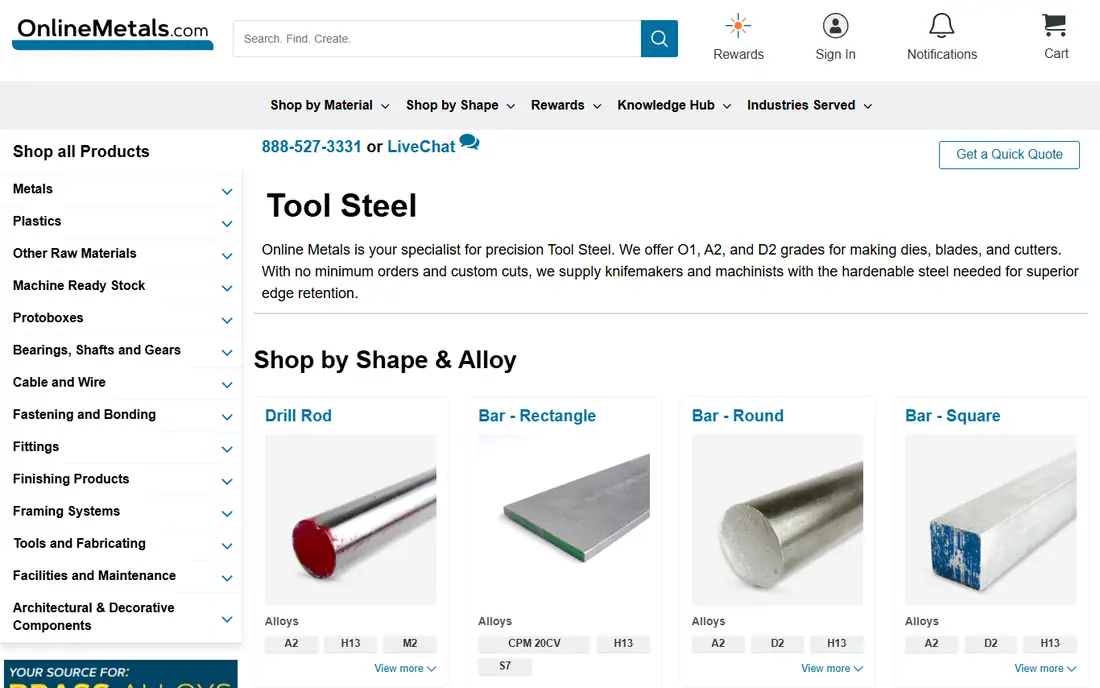
For buyers, M2 is widely available as drill rod and bar stock from tool steel suppliers. Check the form you need before you order, because cutting tool blanks, round bar, and flat stock are stocked differently. A grade that is perfect on paper does not help if it is not available in the size your tool needs.
- High hardness and wear resistance
- Holds strength at higher cutting temperatures
- Proven for drills, taps, and saw blades
- Hard to machine and grind
- Less tough than S7 under shock
H13 is the hot work grade on this list, and it earns that place by keeping strength and toughness when other grades soften. Forging dies, extrusion dies, hot shear blades, and die casting molds all face repeated heating and cooling, and H13 resists the cracking that thermal cycling causes. It also polishes to a good finish, which matters for mold surfaces.
Do not use H13 as a direct swap for D2 in cold work. Its working hardness range is lower, around 45 to 55 HRC in many uses, and its wear resistance in cold abrasive work will not match D2. The grade is optimized for heat, not for cold wear, and using it outside that role wastes its main strength.
- Strong at high temperature
- Good toughness and thermal fatigue resistance
- Polishes well for mold work
- Lower hardness than cold work grades
- Not the best pick for cold abrasive wear
P20 is a practical pick for plastic injection molds at moderate volumes. It is supplied pre-hardened, usually around 28 to 32 HRC, so you can machine the mold and put it into service without a separate hardening step. That saves time, avoids distortion from heat treatment, and keeps costs down for molds that do not face extreme wear or heat.
The trade-off is hardness. A pre-hardened mold steel will not match the wear life of a fully hardened cold work or hot work grade in demanding service. For high-volume molds, abrasive resins, or hot runner work that pushes temperatures up, a harder mold steel may be the better long-term buy.
- Supplied pre-hardened, so no post-machining heat treatment
- Good machinability for mold work
- Saves time on moderate-volume molds
- Lower hardness than tool steels hardened after machining
- Not suited to high-wear or hot work extremes
CPM S35VN is a powder metallurgy stainless steel made for blades that need toughness, edge retention, and corrosion resistance together. It was developed as a tougher follow-up to CPM S30V, with niobium carbides added to improve toughness without giving up wear resistance. That balance is why it remains popular for folding knives and fixed blades used in daily carry.
Powder metallurgy gives a finer, more uniform carbide structure than conventional melting, which helps grindability and edge stability. The cost reflects that process, and small pieces can still vary widely in price by size and supplier. New Jersey Steel Baron lists CPM S35VN stock in various sizes, so check the size you need rather than assuming a single price.
Heat treatment is critical for this grade. A generic cycle will not bring out its best toughness, so use a heat treater with CPM stainless experience or follow the mill guidance closely. For a user, the payoff is a blade that resists chipping better than many high-wear steels while still holding an edge well in normal use.
- Good toughness for a stainless blade steel
- Good edge retention and corrosion resistance
- Easier to sharpen than some higher-wear steels
- Higher steel cost than D2 or O1
- Needs a skilled heat treater for best results
CPM 3V is the hard-use grade for buyers who break or chip other blade steels. It combines high toughness with good wear resistance, which makes it a strong pick for large fixed blades, choppers, and tools that take lateral loads and impacts. Where a brittle high-wear steel would chip, CPM 3V is more likely to bend or dent first, and that failure mode is easier to live with in the field.
CPM 3V is not stainless. It will rust if left wet and unprotected, so users need to oil the blade and keep it dry, just as with D2 or carbon steels. That care is a real cost in time, and buyers who want a low-maintenance blade should look at CPM S35VN instead.
The grade also costs more than basic tool steels and takes more effort to grind, so it suits hard-use tools where toughness is worth paying for. For a light-duty kitchen or pocket knife, that toughness is overkill, and a simpler stainless or carbon steel will be easier to sharpen and maintain.
- Very high toughness for its wear resistance
- Good edge stability in hard-use blades
- Powder metallurgy structure
- Not stainless, so it needs care against rust
- Higher cost and harder to grind than simple carbon steels
How we picked these
We compared supplier grade guides, mill-type property summaries, and stock lists from tool steel suppliers, and we favored grades that are widely stocked in the United States and cover cold work, hot work, shock, high-speed cutting, mold, and blade uses. We did not claim hands-on testing in a shop. Instead, we weighed hardness ranges, wear and toughness trade-offs, heat treatment needs, machinability, and availability in common bar, plate, and drill rod forms. Prices vary by size and supplier, so we list See website where a single price would mislead.
How to choose the right grade
Start with the failure you want to avoid. If tools wear out slowly and predictably, favor wear resistance and look at D2 or M2. If tools chip or break suddenly, favor toughness and look at S7 or CPM 3V. If heat softens the edge or cracks the die, favor H13. If you need a mold fast without heat treatment, P20 is the practical answer. Write down that failure mode before you shop, because it keeps you from buying a famous grade for the wrong job.
Next, check machining and heat treatment. A grade that is hard to machine will cost more in shop time, and a grade that needs a precise cycle will cost more if you outsource heat treatment. Confirm stock form, size, and hardness testing with the supplier, and ask what tempering range they recommend for your use. A small test piece or a single tool run is cheaper than a full batch in the wrong grade, so prove the choice on one tool when the job allows it.
Sources
- https://www.onlinemetals.com/en/buy/tool-steel
- https://www.alro.com/divSteel/metals_comp.aspx?comp=TS&n=TOOL+STEEL
- https://aobosteel.com/selection-of-steels-for-cold-work-dies-and-punches/
- https://www.protolabs.com/en-gb/resources/blog/tool-steel-in-manufacturing/
- https://niftyalloys.com/blogs/tool-steel-d2-a2-o1-h13-p20-guide
- https://newjerseysteelbaron.com/product/cpm-s35-vn/
Frequently asked questions
What is the best grade of tool steel overall?
There is no one best grade for all uses. A2 is a good general pick, D2 is better for wear, S7 is better for shock, and H13 is better for heat. Match the grade to the failure mode, not to a popularity ranking.
Is D2 better than A2?
D2 is better for wear resistance and long runs, while A2 is tougher and more dimensionally stable in many general jobs. Pick D2 when abrasion drives tool life, and pick A2 when you need a balance of wear, toughness, and stability.
Is O1 good for beginners?
Yes, O1 is a good beginner grade because it machines well and heat treats with a simpler oil-quench process. It is best for short runs, prototypes, and simple tools, rather than high-volume abrasive work.
What tool steel is best for knives?
For a low-maintenance stainless blade, CPM S35VN is a strong pick. For a hard-use blade where toughness matters most, CPM 3V is strong but needs rust care. For a budget blade with good edge holding, D2 and O1 are both common and proven.
Does heat treatment matter more than the grade?
Heat treatment can make or break any grade on this list. The wrong cycle can leave a good steel soft, brittle, or distorted, so use a heat treater experienced with your grade and confirm hardness after treatment.
Where can I buy small amounts of tool steel?
Online Metals, Alro Steel, and knife steel suppliers such as New Jersey Steel Baron stock common grades in bar, plate, and drill rod forms. Check size, form, and current pricing on the supplier site before you order, because prices vary by size.