Best HCM Software in 2026: 9 Platforms Compared
By ToolNimba Editorial Team November 11, 2026 9 min read

- Top pick
 Workday HCM
Large enterprises
Starting priceSee websiteCheck out Workday HCMRead our review - Runner-up
 Oracle Fusion Cloud HCM
Oracle ERP enterprises
Starting priceSee websiteCheck out Oracle Fusion Cloud HCMRead our review - Also great
 SAP SuccessFactors
SAP enterprises
Starting priceSee websiteCheck out SAP SuccessFactorsRead our review
How we researched this
We compared official pricing and feature pages, app store listings, privacy policies and public user reviews. Prices change, so check the provider's site before you pay.
Key takeaways
- Workday HCM remains the enterprise default when HR and finance must live on one governed platform.
- BambooHR and Rippling are the only widely published-price options here, which makes budgeting far easier for smaller companies.
- UKG Pro and Dayforce stand out for large hourly and shift-based workforces where scheduling and labor cost matter most.
- Most enterprise HCM suites price by quote, so implementation cost and timeline matter as much as the software price itself.
Quick comparison
| Name | Best for | Starting price | Free plan | |
|---|---|---|---|---|
| Workday HCM | Large enterprises | See website | No | Visit |
| Oracle Fusion Cloud HCM | Oracle ERP enterprises | See website | No | Visit |
| SAP SuccessFactors | SAP enterprises | See website | No | Visit |
 UKG Pro | Large hourly workforces | See website | No | Visit |
 Dayforce | Payroll plus time on one database | See website | No | Visit |
 ADP Workforce Now | Mid-market compliance | See website | No | Visit |
 Paylocity | Mid-market payroll and engagement | See website | No | Visit |
 BambooHR | Small and mid-size HR simplicity | $10 per employee per month | Free trial | Visit |
 Rippling | HR plus IT plus finance | $40 per month base plus $8 per employee | Free trial | Visit |
The best HCM software
Human capital management software covers core HR records, payroll, benefits, time, talent, and workforce planning. The right choice depends heavily on company size: a 50-person company needs simplicity and clear pricing, while a 5,000-person global employer needs compliance, multi-country payroll, and deep reporting. We compared official product pages, pricing pages, and public documentation for the platforms below.
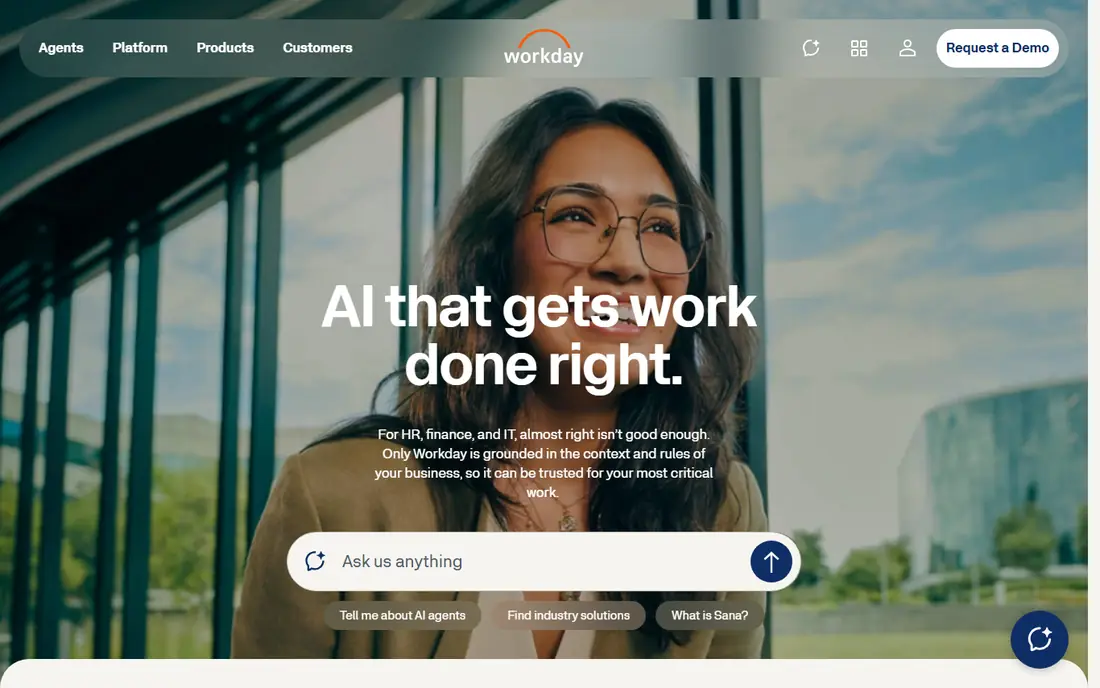
Workday HCM is the default shortlist entry for large organizations, and its signature strength is that HR and financial data live in one system. Headcount planning, actual hiring, and financial actuals stay consistent without reconciliation work across separate tools. That unified model matters most for public companies and multinationals with complex reporting needs.
The honest catch is cost and complexity. There is no published pricing, and total cost includes implementation, which typically involves consulting partners and months of work. Smaller companies regularly find Workday oversized. If you have fewer than a few hundred employees, you are paying for machinery you may never use.
- Unified HR and finance data model
- Strong global payroll coverage
- Deep workforce planning
- Quote-only pricing
- Implementations are long and consulting-heavy
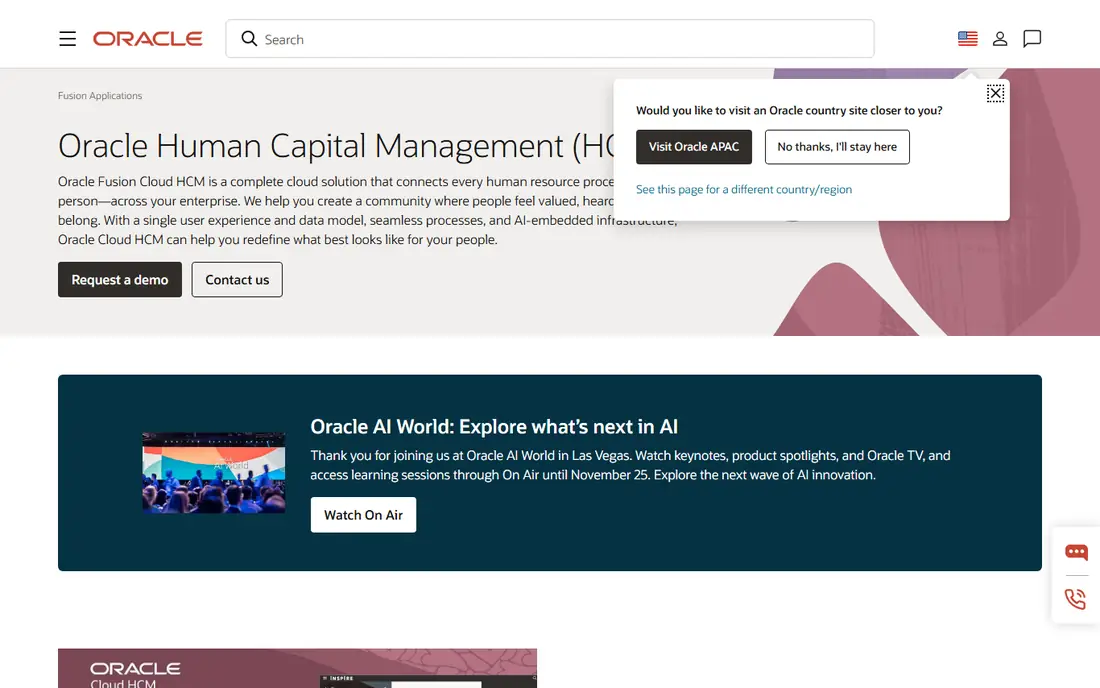
Oracle Fusion Cloud HCM fits companies already standardized on Oracle for finance or supply chain. HR, payroll, talent, and workforce planning share data with the wider Oracle suite, which reduces integration work for Oracle shops. Global payroll and compliance coverage is broad, which helps multinationals with many country rules to follow.
The trade-off is scale. Oracle HCM is an enterprise suite with enterprise implementation effort, and its value is clearest when the rest of the business already runs on Oracle. Companies without that Oracle footprint may get similar HR outcomes with less complexity from a mid-market platform.
- Deep Oracle ERP integration
- Global HR and payroll breadth
- Strong compliance tooling
- Quote-only pricing
- Complexity suits large enterprises best
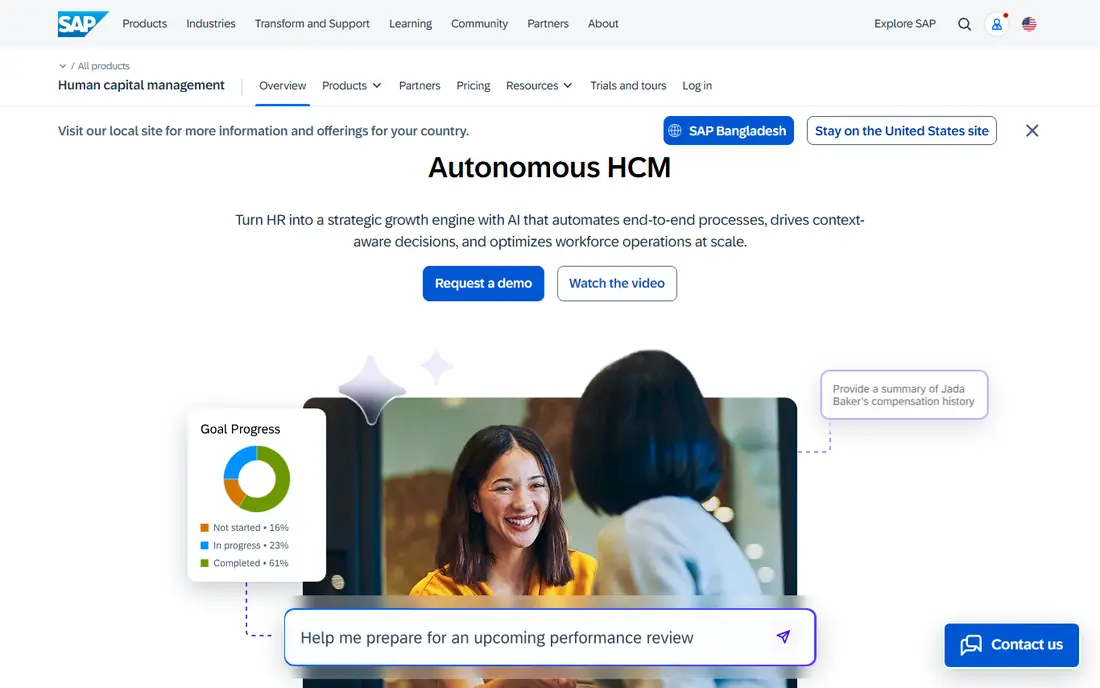
SAP SuccessFactors is the natural HCM choice for companies running SAP ERP. It covers core HR, payroll, recruiting, learning, performance, and succession in a suite designed to share data with SAP finance and operations. For global enterprises with complex HR processes, that completeness is a real advantage.
Buying can be complicated, since SuccessFactors is sold in modules and bundles that vary by need. Implementation also takes planning, especially for global payroll and talent processes. SAP customers will usually find the integration value outweighs that effort, while non-SAP companies should compare mid-market suites first.
- Complete HR suite for SAP customers
- Global talent and learning depth
- Strong ecosystem
- Quote-only pricing
- Module choices can complicate buying
UKG Pro, formed from the Kronos and Ultimate Software combination, is built for organizations with large hourly and shift-based workforces. Scheduling, time tracking, absence, and labor cost management sit alongside core HR and payroll, which helps retailers, healthcare providers, manufacturers, and hospitality employers manage labor as a real cost driver rather than an afterthought.
That depth is also the limit. UKG Pro is an enterprise platform with quote-only pricing and implementation work to match. Smaller salaried teams will find simpler tools faster to deploy. For large hourly workforces, UKG Pro is one of the strongest shortlist options.
- Strong workforce management for hourly staff
- Scheduling and labor cost controls
- Broad HR and payroll
- Quote-only pricing
- Depth can overwhelm smaller teams
Dayforce, from Ceridian, pitches a single database for HR, payroll, time, benefits, and talent, with continuous calculation so pay reflects time and schedule changes as they happen. That design reduces the end-of-period scramble to reconcile timesheets with payroll, which is a real pain point for mid-size and large employers with hourly staff.
The catch is enterprise buying again: pricing is by quote, and implementation requires planning around pay rules, benefits, and time policies. Dayforce fits mid-enterprise companies that want payroll, time, and talent together without stitching point tools. Smaller companies should weigh BambooHR or Rippling first.
- Continuous payroll calculation
- Time, pay, and HR on one database
- Strong compliance reporting
- Quote-only pricing
- Implementation needs careful planning
ADP Workforce Now serves mid-market companies that prioritize compliance certainty above all. Payroll tax filing, benefits administration, and HR records are backed by one of the largest payroll operations in the US, which matters when regulations change or audits arrive. The platform also scales from a few dozen employees to thousands.
Pricing is by quote, which makes early budgeting harder than with BambooHR or Rippling. Some users also find parts of the interface less modern than newer rivals. If compliance confidence and payroll depth are your top criteria, ADP Workforce Now is a safe and proven choice.
- Deep US payroll and tax compliance
- Broad HR and benefits
- Large support ecosystem
- Pricing by quote
- Interface can feel dated in places
Paylocity pairs mid-market payroll depth with a more modern experience than older enterprise suites. HR, payroll, time, benefits, and employee engagement tools sit in one platform, with communication features that help distributed teams stay connected. That blend suits growing US companies that want payroll reliability without an enterprise look and feel.
The limit is quote-only pricing and a US-centered payroll story. Global enterprises with complex multi-country payroll may prefer Workday, Oracle, or SAP. For a US mid-market company that wants modern usability with payroll depth, Paylocity is a strong contender.
- Modern user experience
- Strong payroll depth
- Engagement and communication tools
- Pricing by quote
- Global payroll less central than enterprise suites
BambooHR is the simplicity pick in this list. Core HR records, onboarding, time off, and employee self-service are easy to learn, and implementation is faster than any enterprise suite here. Published pricing from 10 dollars per employee per month for Core helps smaller companies budget without a sales call, though plan details and minimums should be confirmed on the vendor site.
The trade-off is depth. BambooHR is not built for global enterprise payroll complexity, and payroll sits as an add-on rather than a native core in every plan. For companies under a few hundred employees that want HR done well without enterprise overhead, BambooHR is often the right size.
- Simple and clear interface
- Strong onboarding and self-service
- Published pricing
- Payroll is an add-on in some plans
- Less depth for global enterprises
Rippling unifies HR, payroll, IT, and finance workflows, so onboarding can trigger payroll setup, app access, and device provisioning in one flow. Offboarding can revoke access and stop payroll in the same motion. That automation saves real admin time for scaling companies, especially remote and tech-forward teams.
The catch is module pricing. The base platform plus per-employee pricing is published, but adding IT, finance, and global payroll modules raises the total, so the headline price is not the full bill. Teams that will actually use the IT and workflow automation get the most value. Teams that only need core HR may find BambooHR simpler and cheaper.
- HR, IT, and payroll on one platform
- Strong workflow automation
- Device and app provisioning
- Costs rise as modules are added
- Best value for tech-forward teams
How we picked these
We compared official product pages, pricing pages, and public documentation, and we favored platforms that cover core HR, payroll, and talent at distinct company sizes. We checked that each product is offered in October 2026 and that its homepage loads and matches the product named. We did not claim hands-on testing. Enterprise platforms without published prices are marked as See website, and published prices are listed as found on vendor or recent pricing coverage.
How to choose an HCM platform
Start with headcount and payroll complexity, not feature lists. Under 100 employees, simplicity and published pricing usually win, which points to BambooHR or Rippling. From a few hundred to a few thousand employees, ADP, Paylocity, and Dayforce become stronger, especially with hourly staff. Above that, or with global payroll, Workday, Oracle, SAP, and UKG belong on the shortlist.
Next, map the processes that cause pain today. If onboarding and IT access eat HR time, Rippling automation matters. If scheduling and labor cost drive margins, UKG Pro or Dayforce matter more. If finance and HR reporting must reconcile, Workday unified data matters most. Rank those pains before you sit through demos, since every vendor demo looks complete.
Finally, budget for implementation, not just subscription. Data migration, pay rule setup, benefits configuration, and training often cost as much as the first year of software for enterprise suites. Ask for a written implementation timeline, a named project lead, and references from companies of similar size and industry before you sign.
Sources
- https://www.workday.com
- https://www.oracle.com/human-capital-management
- https://www.sap.com/products/hcm.html
- https://www.ukg.com
- https://www.dayforce.com
- https://www.adp.com
- https://www.paylocity.com
- https://www.bamboohr.com
- https://www.rippling.com
- https://rankite.com/blog/top-human-capital-management-software
- https://rankite.com/blog/top-10-hcm-software
Frequently asked questions
What is the best HCM software?
Workday HCM is the enterprise default, BambooHR is the best simplicity pick for smaller companies, and Rippling is best when HR, IT, and payroll must work as one system. The best HCM software depends on headcount, payroll complexity, and whether you already run Oracle or SAP.
What are the top HCM software platforms for large companies?
Workday HCM, Oracle Fusion Cloud HCM, SAP SuccessFactors, UKG Pro, and Dayforce lead for large employers. Workday suits finance-plus-HR unity, Oracle and SAP suit existing ERP customers, UKG Pro suits hourly workforces, and Dayforce suits continuous payroll with time tracking.
What is the best HCM platform for a small business?
BambooHR is a strong small-business pick for core HR simplicity with published pricing, while Rippling suits small teams that also want IT provisioning and workflow automation. Gusto and Zoho People are also worth comparing for very small teams, though they sit outside the enterprise HCM scope of this list.
How much does HCM software cost?
BambooHR starts around 10 dollars per employee per month and Rippling starts at a 40 dollar monthly base plus 8 dollars per employee, while most enterprise suites price by quote. Implementation, payroll add-ons, and extra modules can add substantially to the subscription price, so request a full quote.
What is the difference between HCM and HRIS software?
HRIS usually means core HR records and administration, while HCM is broader, covering talent, workforce planning, and often payroll and benefits strategy as well. In practice vendors use the terms loosely, so compare the actual modules included rather than the label on the product page.