Best Healthcare Software Development Companies in 2026: 9 Firms Compared
By ToolNimba Editorial Team November 11, 2026 8 min read

- Top pick
 ScienceSoft
Audit-heavy enterprise health systems
Starting priceSee websiteCheck out ScienceSoftRead our review - Runner-up
 Itransition
Enterprise hospital and care coordination systems
Starting priceSee websiteCheck out ItransitionRead our review - Also great
 Appinventiv
Growth-stage patient-facing apps
Starting priceSee websiteCheck out AppinventivRead our review
How we researched this
We compared official pricing and feature pages, app store listings, privacy policies and public user reviews. Prices change, so check the provider's site before you pay.
Key takeaways
- ScienceSoft and Itransition suit audit-heavy, enterprise-grade builds with deep compliance experience.
- Simform and Appinventiv are strong choices for mobile-first patient apps and growing health tech teams.
- Arkenea and HTD Health bring a healthcare-only focus that reduces the learning curve on clinical workflows.
- Hourly rates in this list run roughly from $25 to $99, but project totals depend on scope, team size and timeline.
- Always ask for a business associate agreement, security documentation and references from similar healthcare projects.
Quick comparison
| Name | Best for | Starting price | Free plan | |
|---|---|---|---|---|
| ScienceSoft | Audit-heavy enterprise health systems | See website | No | Visit |
| Itransition | Enterprise hospital and care coordination systems | See website | No | Visit |
| Appinventiv | Growth-stage patient-facing apps | See website | No | Visit |
 Simform | Mid-market teams with clear specs | See website | No | Visit |
 OSP Labs | EHR integration and patient apps | See website | No | Visit |
 Arkenea | Healthcare-exclusive product builds | See website | No | Visit |
 HTD Health | Digital health transformation projects | See website | No | Visit |
 TATEEDA | Diagnostics, compliance and connected devices | See website | No | Visit |
 Boston Technology Corporation | Enterprise EHR, telemedicine and revenue cycle platforms | See website | No | Visit |
The best healthcare software development companies
Building healthcare software is different from building ordinary apps, because patient data, clinical workflows and regulators are involved from day one. The firms below cover telehealth, EHR integration, patient portals, remote monitoring and AI-assisted workflows. We compared their healthcare focus, compliance posture and published rate ranges, and we note where a firm is healthcare-only versus a general firm with a healthcare practice. Rates and minimums vary widely by firm.
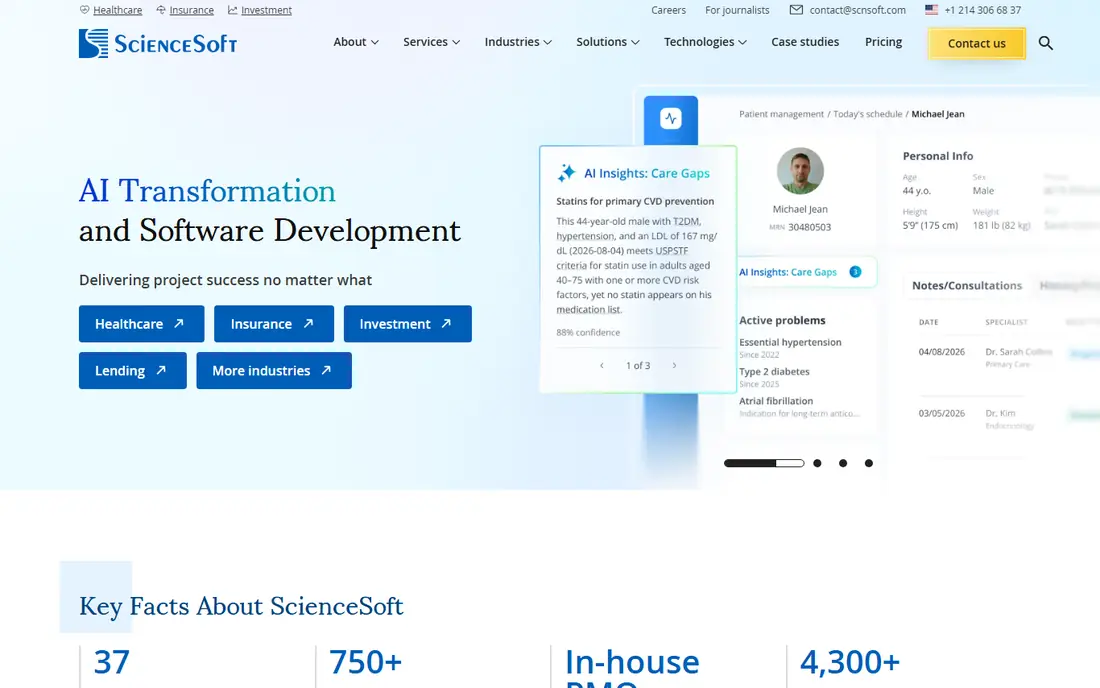
ScienceSoft is the enterprise pick in this list, with deep experience in clinical systems, hospital software and data-heavy healthcare apps. Its compliance-first approach suits health systems that face audits and strict data rules.
The trade-off is pace and price: planning cycles run longer and rates sit in the mid-to-high range. For a small startup MVP, that weight may slow you down more than it helps.
- Deep compliance experience
- HL7 and FHIR integration
- Long healthcare track record
- Higher rates and longer planning cycles
- Less suited to tiny MVPs

Itransition suits larger healthcare organizations building hospital systems or care coordination platforms, where scale and process matter as much as code. Its teams handle complex integrations that smaller shops struggle with.
For an early-stage startup, its enterprise process can feel slow. It earns its place here for scale projects, not for the fastest possible prototype.
- Hospital system experience
- Care coordination
- Large delivery teams
- Mid-to-high rates
- Enterprise process can feel heavy for startups

Appinventiv is a strong choice for funded health tech teams building patient-facing apps, telemedicine features or EHR-connected products. Its accelerators can shorten the path to a working product.
The cost sits above budget firms, and its structured delivery is less suited to constant pivots. If your spec is fairly settled, that structure is an advantage.
- Strong mobile and patient app work
- EHR and telemedicine experience
- Pre-built accelerators
- Higher cost than budget shops
- Less flexible for rapid pivots at scale
Simform fits mid-market organizations that arrive with a clear specification and want cloud and mobile delivery at a competitive rate. Its healthcare work covers mobile apps, back ends and analytics.
It works best when you can define the product well, since it is not a healthcare-only shop. Bring clinical input in-house or budget for extra discovery time.
- Cloud and mobile strength
- HIPAA-aware delivery
- Competitive rates
- Needs well-defined specs
- Less healthcare-only depth than specialists
OSP Labs earns its place for providers that need custom builds around EHR integration, automation and patient apps. Its compliance depth covers HIPAA and related frameworks that matter in real deployments.
Rates sit in the mid-range and minimum project sizes apply, so it is not the cheapest prototype shop. For a provider with a real integration problem, that depth is worth paying for.
- EHR integration depth
- Automation
- Patient-facing app experience
- Mid-range rates
- Project minimums apply
- California and New York focus
Arkenea focuses only on healthcare, which means its teams start with clinical workflows rather than learning them on your budget. That focus suits startups and providers building telehealth or connected-care products.
It is smaller than the enterprise firms here, so very large multi-year programs may need a bigger partner. For a focused product, its specialization is a genuine advantage.
- Healthcare-only focus
- Telehealth and EHR experience
- Product-minded teams
- Smaller than enterprise rivals
- Rates vary by project scope
HTD Health is known for digital health transformation work, with telehealth, FHIR integration and UX design strengths, plus certifications that matter for regulated products. Its portfolio spans many production healthcare apps.
Pricing is custom and minimums apply, so small-budget MVPs should get a written estimate early. For a transformation project, its breadth across design and engineering helps.
- Telehealth and FHIR experience
- UX design strength
- Many production health apps
- Custom pricing
- Project minimums apply
- Less suited to tiny budgets
TATEEDA suits teams building diagnostics, compliance-heavy products or connected-device software, where regulatory detail and device data matter. Its US base and verified delivery record help with enterprise buyers.
Its niche strengths are less relevant for a simple wellness app with no clinical or device component. Match it to a project where compliance and devices are central.
- HIPAA delivery record
- Diagnostics and IoT experience
- US-based team
- Mid-range rates
- Niche focus may not fit simple consumer wellness apps
Boston Technology Corporation
Best for: Enterprise EHR, telemedicine and revenue cycle platforms
Boston Technology Corporation rounds out the list for mid-to-large organizations needing enterprise-grade EHR integration, telemedicine or revenue cycle platforms. Its AI decision-support work also suits larger operational projects.
Enterprise timelines and rates make it a poor fit for a tiny MVP. For a health system replacing or extending a core platform, its depth is the point.
- EHR integration
- Telemedicine
- Revenue cycle platform experience
- Enterprise rates and timelines
- Less suited to small MVPs
How we picked these
We compared firms on healthcare specialization, published compliance claims, integration experience with EHR and FHIR standards, and published hourly rate ranges from directories and vendor pages. We did not audit their code or security practices, so we treated compliance claims as questions to verify in diligence, not as guarantees. Where rates are quote-based, we say so.
How to choose a healthcare development partner
Start with compliance, not the portfolio. Ask how the firm handles protected health information, whether it signs a business associate agreement, and how it documents security, access control and audit trails. A firm that raises these topics before you do is usually a safer bet than one that treats them as an afterthought.
Next, match the firm to the integration problem. Building a patient-facing app on top of an existing EHR is a different job from building a new clinical system, and firms that have shipped FHIR and HL7 integrations will move faster. Ask for case studies in your exact area, such as telehealth, remote monitoring or revenue cycle work.
Finally, agree on ownership, timelines and support. Confirm who owns the code and documentation, how handover works, and what happens after launch when regulations or EHR versions change. A fixed-price quote looks tidy, but a phased plan with clear milestones often fits healthcare projects better. Also ask about testing and data migration in plain terms. A good partner will explain how it tests with synthetic data, how it migrates existing records and how it handles downtime during go-live. Get those answers in the statement of work, not just in a sales deck, so the project has a clear record if timelines slip. Also confirm who provides ongoing support and how quickly security patches are applied after launch and how urgent clinical issues are prioritized, since a healthcare product cannot wait for a generic support queue.
Sources
Frequently asked questions
How much does healthcare software development cost?
Most firms charge hourly, with ranges in this list roughly from $25 to $99 per hour, and minimum project sizes often starting at $25,000. Total cost depends on scope, compliance needs, integrations and team size.
What is HIPAA compliance in software development?
It means the software and the vendor handle protected health information under HIPAA rules, with safeguards for access, encryption, audit trails and breach response. Vendors usually sign a business associate agreement covering their role.
Should we hire a healthcare-only firm or a general software firm?
Healthcare-only firms usually understand clinical workflows, EHR integration and compliance faster. General firms can work well for a simple patient app, but they need more oversight on regulated parts of the project.
How long does a healthcare app take to build?
A focused minimum viable product can take a few months, while a system with EHR integration, compliance review and clinical testing often takes six to twelve months or more. Timelines stretch with integration complexity.
What should we ask before signing?
Ask for a business associate agreement, security documentation, similar project references, code ownership terms and post-launch support. Also ask how the firm tests with realistic clinical data without exposing real patient records.
What is FHIR and why does it matter?
FHIR is a standard for exchanging healthcare information between systems, and it matters because it lets apps, EHRs and devices share patient data in a consistent way. A firm with real FHIR experience will integrate faster and with fewer custom workarounds than one learning the standard on your project.