Best Hotel Management Software in 2026: 9 Tools Compared
By ToolNimba Editorial Team November 11, 2026 10 min read

- Top pick
 Cloudbeds
Independent hotels wanting one system
Starting priceSee websiteCheck out CloudbedsRead our review - Runner-up
 Mews
Hotels wanting automation and integrations
Starting priceSee websiteCheck out MewsRead our review - Also great
 SiteMinder
Properties focused on distribution
Starting priceSee websiteCheck out SiteMinderRead our review
How we researched this
We compared official pricing and feature pages, app store listings, privacy policies and public user reviews. Prices change, so check the provider's site before you pay.
Key takeaways
- Most hotel platforms price by quote, so the monthly total depends on room count, channels and add-ons rather than a single published rate.
- Cloudbeds and Mews suit different buyers: Cloudbeds leans toward an all-in-one setup, while Mews leans toward automation and custom integrations.
- A channel manager and a direct booking engine matter as much as the front desk tools, because they control where rooms sell and what commission you pay.
- Small properties should weigh setup time and support more than advanced revenue tools they may not use every week.
- Always confirm payment processing, taxes and onboarding fees in writing before signing, since those costs sit outside the headline software price.
Quick comparison
| Name | Best for | Starting price | Free plan | |
|---|---|---|---|---|
| Cloudbeds | Independent hotels wanting one system | See website | No | Visit |
| Mews | Hotels wanting automation and integrations | See website | No | Visit |
| SiteMinder | Properties focused on distribution | See website | No | Visit |
 Hotelogix | Small and mid-size hotels on a budget | See website | No | Visit |
 eZee Absolute | Hotels needing front desk plus distribution | See website | No | Visit |
 RoomRaccoon | Boutique hotels and small groups | See website | No | Visit |
 Little Hotelier | Small hotels, inns and bed and breakfasts | See website | No | Visit |
 Stayntouch | Hotels wanting a modern cloud front desk | See website | No | Visit |
 WebRezPro | Independent properties wanting a full system | See website | No | Visit |
The best hotel management software
The best hotel management software brings reservations, housekeeping, payments and channel distribution into one place, so staff spend less time copying details between systems. These nine options cover small inns through multi-property groups.
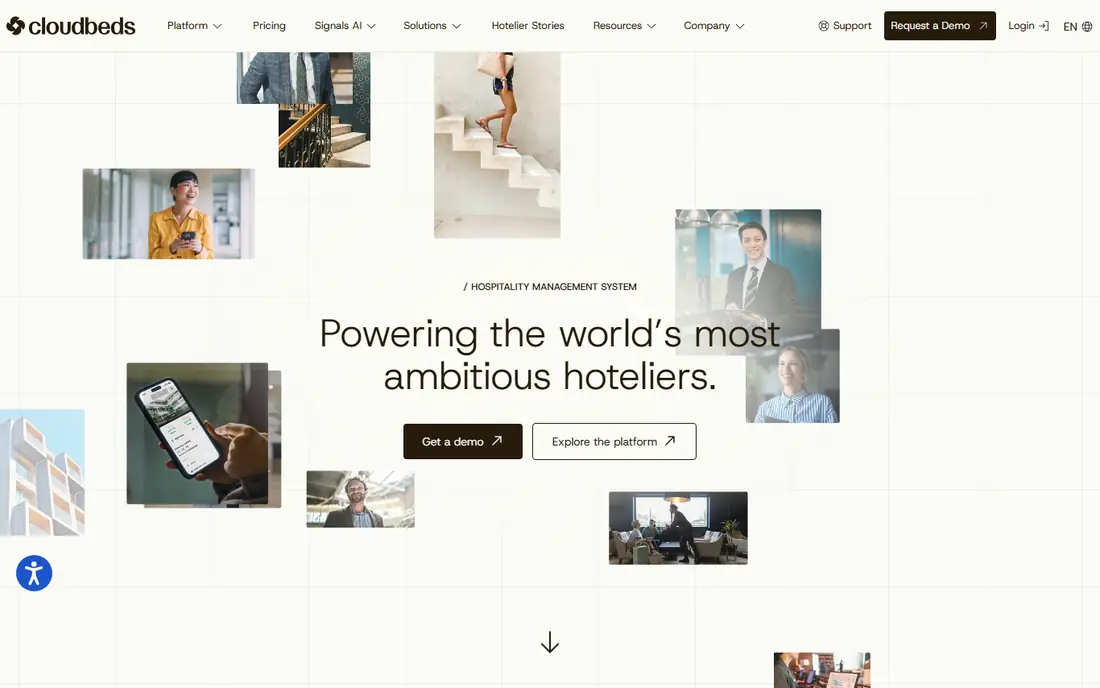
Cloudbeds suits an independent hotel that wants reservations, distribution and guest messaging without stitching together several vendors. The platform covers the front desk, housekeeping, payments and a booking engine, and it connects to many online travel agencies. That breadth helps a small team that cannot afford a long integration project or a dedicated revenue manager.
The catch is cost clarity. Because pricing depends on property size and the modules you choose, you will need a quote to compare it fairly with a simpler tool. Add-ons for revenue tools, guest marketing and reputation management can raise the total, so ask which features sit in the base plan and which are paid extras before you commit.
- All-in-one PMS, channel manager and booking engine
- Large integration marketplace
- Multi-property support
- Pricing is quote-based
- Advanced add-ons cost extra
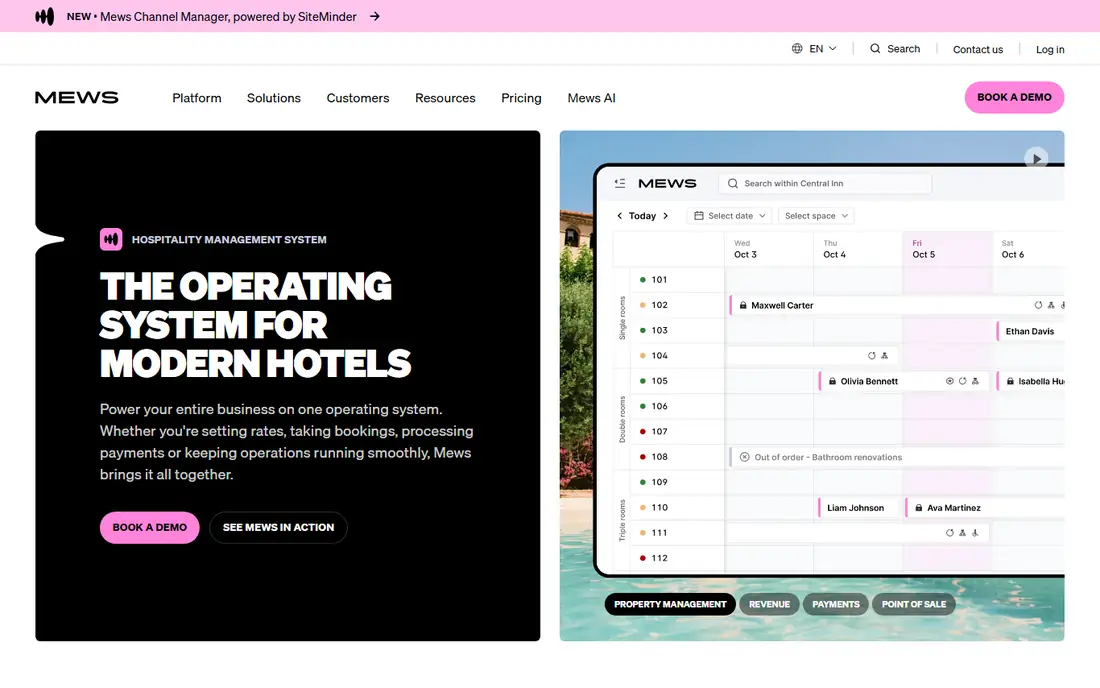
Mews fits hotels that want routine work to happen on its own, from check-in steps to payment and reporting flows. Its open API and marketplace make it a good match for properties that already use specialist tools for revenue, guest messaging or accounting and want them to share data cleanly. Multi-property operators also benefit from central control across sites.
The trade-off is complexity. A team that wants a simple, out-of-the-box setup may find the range of options and integrations more than it needs. Pricing is also quote-based, so a small property should confirm the entry cost and any implementation help before assuming Mews fits a tight budget.
- Strong automation and open API
- Large app marketplace
- Modern cloud interface
- Pricing is quote-based
- Setup can be heavier for very small teams
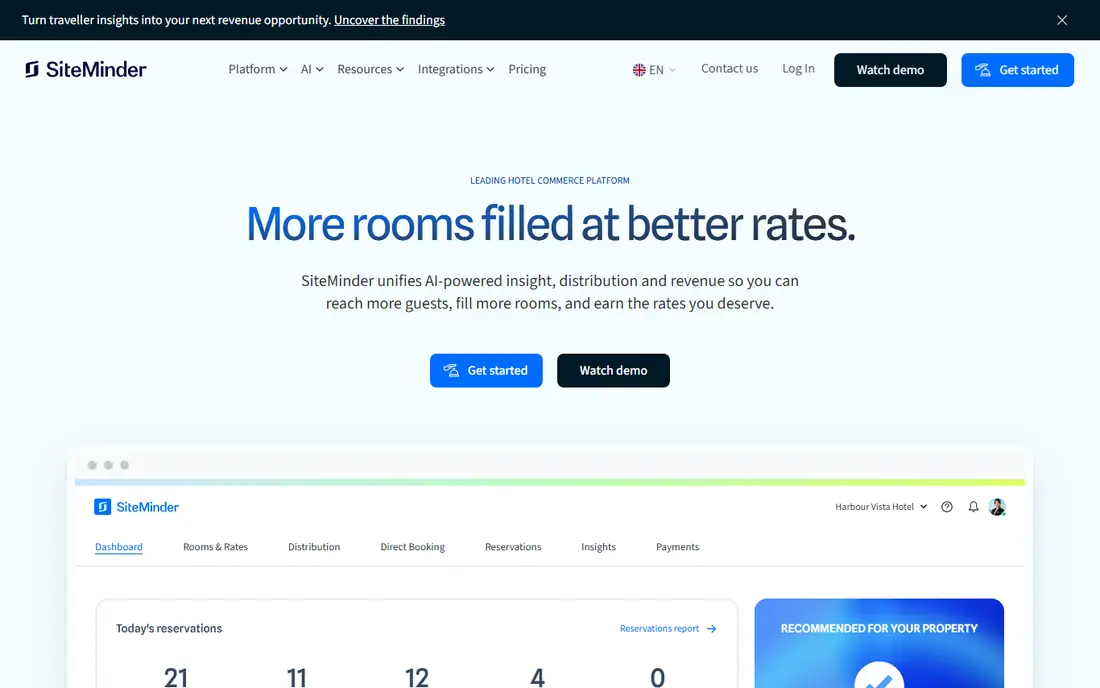
SiteMinder is best known for distribution, which makes it a strong pick when your main problem is keeping rates and availability correct across many booking sites. It helps hotels sell rooms through online travel agencies while also supporting direct bookings through its own booking tools. For properties that depend heavily on third-party channels, that control over inventory matters every day.
SiteMinder also offers wider hotel platform features, but buyers should check whether they need the full suite or mainly the channel tools. As with most enterprise-grade hotel software, pricing is quoted per property, so compare the total against the commission savings and time saved on manual updates.
- Broad channel connections
- Direct booking tools
- Widely used by hotels
- Pricing is quote-based
- Full platform may be more than a tiny inn needs
Hotelogix appeals to hotels that want core property management without a large enterprise budget or a long rollout. It covers reservations, front desk work, housekeeping and distribution, and it supports groups that run more than one property. For a small hotel moving off spreadsheets or an older desktop system, that scope is usually enough.
The honest weakness is polish. Some newer platforms look and feel more modern, and Hotelogix may not match them on advanced automation or design. If your team values a clean, current interface above all else, test the demo carefully and compare daily tasks such as check-in, rate changes and reporting.
- Cloud front desk and channel tools
- Multi-property support
- Comparatively simple setup
- Pricing is quote-based
- Interface feels less modern than some rivals
eZee Absolute covers a wide set of hotel needs, from reservations and front desk operations to restaurant point of sale and channel distribution. That makes it useful for properties that run food and beverage outlets alongside rooms, or for groups with mixed property types. The system is built to handle daily operations in one place rather than across separate tools.
Buyers should take time to map modules to their actual needs, because the range of options can make the first quote hard to compare. Ask for a clear list of included modules, support terms and training, and confirm how channel connections are priced before signing.
- Broad hotel modules including point of sale
- Channel manager options
- Works for varied property types
- Pricing is quote-based
- Module choices can confuse first-time buyers
RoomRaccoon targets boutique hotels, bed and breakfasts and small groups that want a single system for bookings, payments and distribution. Its booking engine supports direct reservations, which helps smaller properties reduce dependence on commission-based channels. The interface is designed for teams that handle many jobs themselves, not for a large back office.
Larger groups with complex revenue or enterprise reporting needs may outgrow it sooner than a platform built for chains. For a boutique property, though, the balance of price, simplicity and direct booking tools is often the right fit, provided the quote matches the room count and channel mix.
- All-in-one PMS and booking engine
- Good for boutique properties
- Channel connections included in plans
- Pricing is quote-based
- May be less suited to very large hotel groups
Little Hotelier, from the SiteMinder group, is designed for small hotels, motels, inns and bed and breakfasts rather than scaled back from an enterprise product. It covers reservations, guest details, payments and channel updates, plus a booking engine for direct stays. For an owner-operator, that focus keeps daily work manageable.
The limit is scale. A property that grows into a multi-site group or needs deep revenue management will likely need to move up to a larger platform later. That trade is acceptable for many small properties, as long as you check data export options in case you switch systems in future.
- Built for small properties
- Simple front desk and booking tools
- Channel manager included
- Pricing is quote-based
- Fewer advanced tools for large groups
Stayntouch offers a cloud front desk built for hotels that want staff to work from tablets and mobile devices, not only a fixed reception desk. It supports check-in, payments, housekeeping coordination and guest communication, with options for contactless arrival. That mobile approach suits modern hotels and resorts that want to shorten queues at reception.
Distribution and revenue features depend on the package and connected partners, so buyers should confirm which channels and tools are included. Pricing is quoted, and implementation support matters, especially for hotels moving from a legacy on-site system with years of guest and rate history.
- Cloud-native front desk
- Mobile check-in options
- Integration-friendly design
- Pricing is quote-based
- Distribution tools vary by package
WebRezPro is a cloud property management system for independent hotels, inns, resorts and vacation rental operators. It combines reservations, front desk, housekeeping, accounting links and a booking engine, with channel management through partners. Properties that want one dependable system without a chain brand behind it often find it a good match.
The interface prioritizes function over style, so hotels that want the most modern look may prefer a newer rival. On daily reliability, reporting and direct booking support, however, WebRezPro has a long track record with independent operators, which counts for a lot when the system runs the whole business.
- Full PMS with booking engine and channel tools
- No per-room pricing surprises in its model
- North American support focus
- Pricing is quote-based
- Design is practical rather than flashy
How we picked these
We compared official feature pages, pricing pages and product documentation for hotel platforms that serve independent hotels, boutique properties and groups in October 2026. We favored systems that combine a property management system with channel distribution and a direct booking engine, since those three pieces decide most of the daily value. We left out tools that only handle one narrow job, such as a standalone channel manager with no front desk, and we used See website wherever a vendor prices by quote rather than publishing a single rate.
What to check before you buy hotel software
Start with your channel mix. Count how many booking sites you use, how often rates change, and how much commission you pay each month. A system that updates all channels at once can pay for itself in saved time and fewer overbookings, but only if it connects to the channels you actually use. Ask for the full connection list, not a headline number.
Next, test the front desk workflow with real tasks. Walk through a reservation, a walk-in, a room move, a split bill and a housekeeping update. Note how many clicks each task takes and whether the mobile view works for staff on the floor. A pretty dashboard means little if check-in slows down on a busy Friday evening.
Also confirm payments, taxes and guest data handling. Ask which payment providers are supported, how deposits and refunds work, and how guest details are stored and exported. Finally, get the full contract cost in writing, including onboarding, training, support hours and any per-booking or per-transaction fees, then compare that total across two or three finalists on the same room count.
Sources
Frequently asked questions
What is hotel management software?
Hotel management software, often called a property management system, handles reservations, check-in and check-out, housekeeping, billing and guest records in one system. Many platforms add a channel manager and a booking engine so rooms can sell across booking sites and direct. Together, those tools replace spreadsheets and separate systems that need manual updates.
How much does hotel management software cost?
Most hotel platforms price by quote based on room count, property type, channels and modules, so there is no single price that fits every hotel. Small properties may pay a modest monthly fee, while larger groups pay far more for added features and support. Always ask for onboarding, payment and add-on costs in addition to the monthly software fee.
Do I need a channel manager as well as a PMS?
Many modern platforms include a channel manager, but some sell it as a separate module or partner product. If you sell on several booking sites, a channel manager is worth having because it keeps availability and rates in sync and reduces double bookings. If most guests book direct or by phone, a simpler PMS with a booking engine may be enough.
Can small hotels use the same software as large chains?
Small hotels can use many of the same platforms, but the right setup differs. Large chains often need multi-property reporting, complex rate rules and deep integrations, while a small inn needs fast check-in and simple channel updates. Choose the package that matches your current size, and check that you can add features later without switching systems.
How long does it take to set up hotel software?
Setup time ranges from days for a small property with simple rates to weeks or months for a larger hotel with many channels, rate plans and past data to move. Training staff and testing payment and channel connections takes time too. Ask the vendor for a written timeline and a named contact for onboarding before you sign.