Best Incident Management Software in 2026: 9 Tools Compared
By ToolNimba Editorial Team November 9, 2026 9 min read

- Top pick
 PagerDuty
Complex on-call at scale
Starting price$21 per user per month billed annuallyCheck out PagerDutyRead our review - Runner-up
 incident.io
Slack-native response
Starting price$15 per user per month billed annuallyCheck out incident.ioRead our review - Also great
 xMatters
Communication-driven incidents
Starting price$16 per user per monthCheck out xMattersRead our review
How we researched this
We compared official pricing and feature pages, app store listings, privacy policies and public user reviews. Prices change, so check the provider's site before you pay.
Key takeaways
- PagerDuty remains the default for complex on-call rotations, with a free tier for five users and Professional at $21 per user per month billed annually.
- incident.io is the best Slack-native pick, with a free Basic tier for five users and Team at $15 per user per month billed annually.
- FireHydrant is the best free option for larger responder groups, with a free tier for up to ten responders.
- Squadcast is the best budget alternative to PagerDuty, with Pro at $9 per user per month billed annually.
- Opsgenie is excluded here: Atlassian ended new sales in June 2025 and sunsets it in April 2027, so new buyers should pick another tool.
Quick comparison
| Name | Best for | Starting price | Free plan | |
|---|---|---|---|---|
| PagerDuty | Complex on-call at scale | $21 per user per month billed annually | Yes | Visit |
| incident.io | Slack-native response | $15 per user per month billed annually | Yes | Visit |
| xMatters | Communication-driven incidents | $16 per user per month | Yes | Visit |
 Squadcast | Budget PagerDuty alternative | $9 per user per month billed annually | Yes | Visit |
 Rootly | AI-assisted response in Slack | $20 per user per month | Free trial | Visit |
 FireHydrant | Runbooks and retrospectives | $25 per responder per month billed annually | Yes | Visit |
 Jira Service Management | Atlassian shops and ITSM depth | $20 per agent per month | Yes | Visit |
 Better Stack | Monitoring plus on-call | $29 per responder per month billed annually | Yes | Visit |
 Grafana Cloud IRM | Grafana-native on-call | $20 per active IRM user per month | Yes | Visit |
The best incident management software
Incident management software pages the right engineer, coordinates the response in Slack, and turns the aftermath into a retrospective that prevents repeats. The tools below cover classic on-call platforms, Slack-native response tools, and ITSM suites, so the right pick depends on your team size, your chat tool, and whether you need monitoring bundled in.

PagerDuty remains the default for complex on-call rotations. It handles alerting, escalation policies, and on-call schedules across many teams, with the largest integration ecosystem in the category. The free tier covers five users, and Professional costs $21 per user per month billed annually, or $25 monthly.
Most teams actually need Business features at around $41 per user per month once add-ons enter the picture, and setup takes effort. For engineering organizations that need dependable alerting at scale, PagerDuty is our top pick.
- Dependable alerting and on-call management
- Largest integration ecosystem
- Free tier for five users
- Professional at $21 per user per month is only the start once add-ons enter
- Business features cost more
- Complex setup
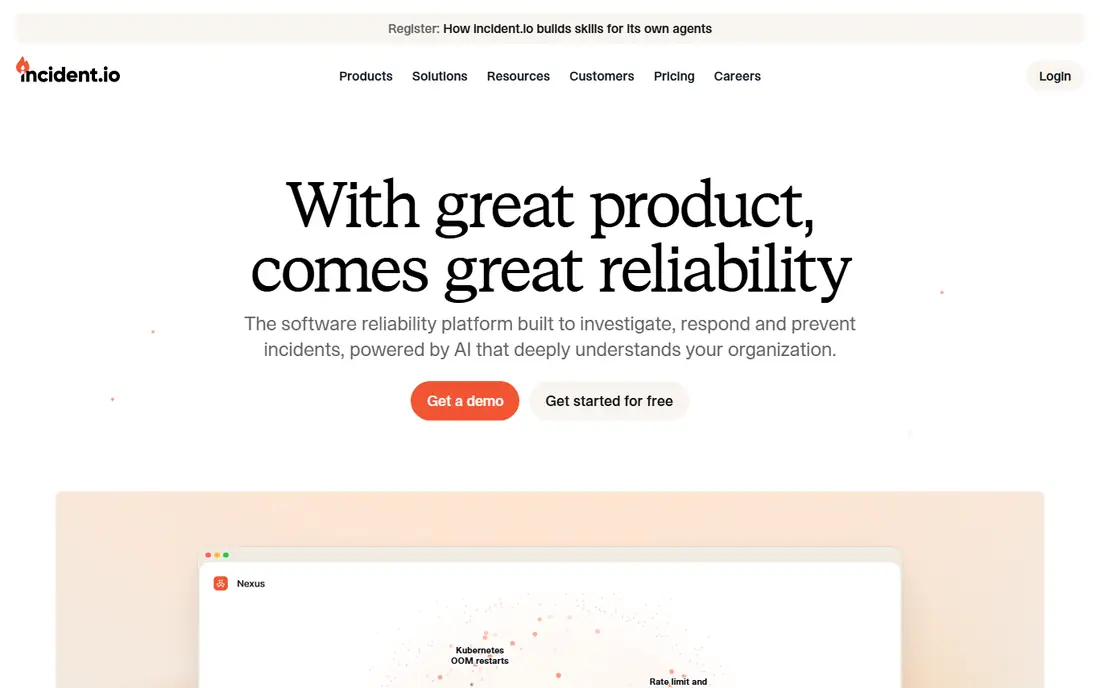
incident.io is the strongest modern pick for Slack-native teams. Incidents run in Slack channels with automated lifecycle steps, status updates, and retrospectives, and the free Basic tier covers up to five users. Team pricing starts at $15 per user per month billed annually.
AI-assisted retrospectives and insights sit on Enterprise tiers, and teams outside Slack get less value. For engineering teams that live in Slack, incident.io is the best modern choice.
- Strong incident lifecycle automation in Slack
- Free Basic tier for five users
- Modern interface
- AI features gated to Enterprise
- Slack-centric
- Smaller ecosystem than PagerDuty
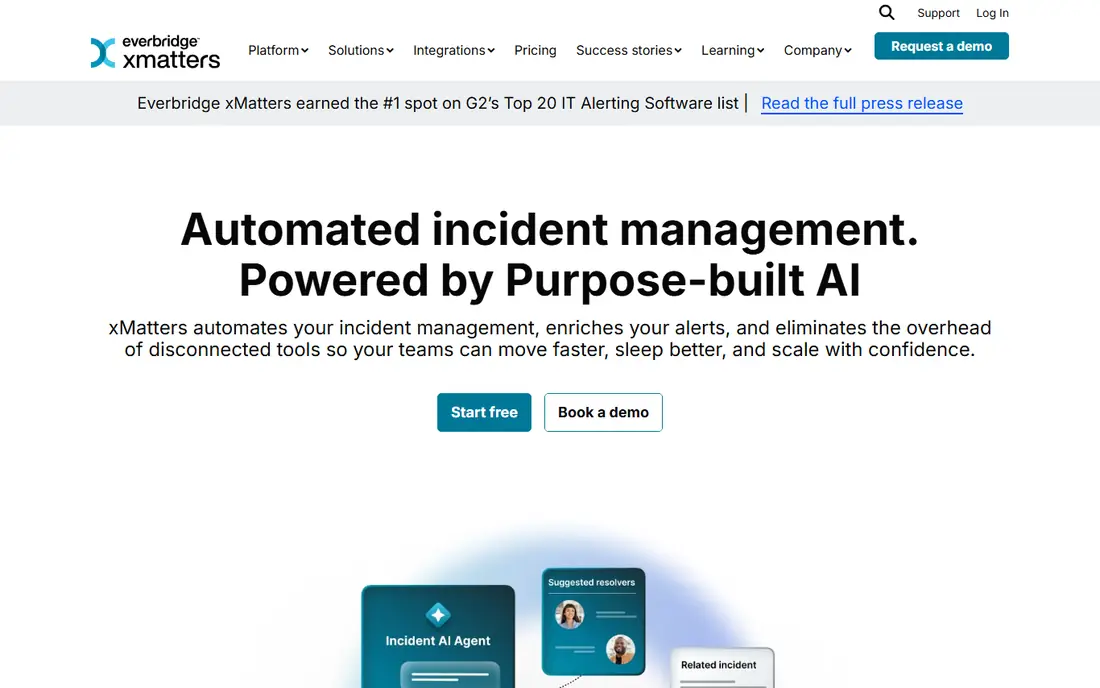
xMatters suits IT and DevOps teams that want communication-driven incident management. It routes alerts across phone, SMS, email, and chat with flexible escalation, and the free tier covers up to ten users, with Starter at $16 per user per month. Regulated enterprises value its audit and compliance depth.
Larger deals need a sales conversation, and the interface feels enterprise-heavy. For organizations where reaching the right person fast matters most, xMatters is a strong fit.
- Communication-first incident management
- Free tier for up to ten users
- Strong for regulated enterprises
- Pricing needs a sales conversation for larger deals
- Interface feels enterprise-heavy
- Smaller community
Squadcast gives startups and mid-size engineering teams PagerDuty-style alerting at lower cost. The free tier covers five users, and Pro costs $9 per user per month billed annually, or $12 monthly, with a 14-day trial on higher plans. On-call schedules, escalation, and status pages cover the core workflow.
Market presence is smaller and integrations fewer than PagerDuty's. For teams that want dependable alerting without enterprise pricing, Squadcast is the best budget pick.
- PagerDuty-style alerting at lower cost
- Free tier for five users
- Simple setup
- Smaller market presence
- Fewer integrations than PagerDuty
- Advanced features on higher tiers
Rootly is the AI-assisted response tool for Slack teams. It automates incident workflows, generates retrospectives with AI assistance, and tracks reliability metrics, with Incident Response Essentials at $20 per user per month and a 14-day trial.
There is no free plan, and teams outside Slack get less value. For SRE-minded teams that want automation plus AI-assisted learning from incidents, Rootly is a strong modern option.
- AI-assisted response and retrospectives in Slack
- Strong automation
- Good for SRE teams
- No free plan, only a 14-day trial
- Slack-centric
- Pricing rises with team size
FireHydrant suits SaaS engineering teams that want automated incident response in Slack with executable runbooks and a service catalog. The free tier covers up to ten responders, and Pro costs $25 per responder per month billed annually, with a 14-day trial that needs no card.
The Freshworks acquisition creates some roadmap uncertainty, and the workflow centers on Slack. For teams that want runbooks and retrospectives as first-class features, FireHydrant is the best fit.
- Executable runbooks and service catalog
- Free tier for up to ten responders
- Strong retrospectives
- Freshworks acquisition creates roadmap uncertainty
- Pro costs $25 per responder per month
- Slack-centric
Jira Service Management is the pick for Atlassian shops and teams that need ITSM depth. It combines incident, problem, and change management with Jira integration, and it is the official migration path for Opsgenie customers. Pricing starts at $20 per agent per month, with a free tier for up to three agents.
It is heavier than dedicated on-call tools, and incident features need configuration to shine. For organizations already on Jira, it is the natural incident platform.
- Deep ITSM and Jira integration
- Official Opsgenie migration path
- Free tier for three agents
- Heavier than dedicated on-call tools
- Incident features need configuration
- Per-agent pricing adds up
Better Stack is the value play that bundles monitoring with on-call. It covers uptime monitoring, incident management, on-call scheduling, and status pages in one bill, with unlimited phone and SMS alerts included per responder license. Responder pricing starts at $29 per month billed annually, with a free tier for monitors and status pages.
Per-responder costs become expensive beyond 15 people, and monitoring covers external HTTP and TCP checks only, without APM or real-user monitoring. For teams under 15 engineers who want one vendor, Better Stack is the best bundle.
- Monitoring, on-call, and status pages in one bill
- Unlimited phone and SMS alerts per responder
- Free tier included
- Per-responder costs scale linearly
- External monitoring only, no APM
- Smaller integration ecosystem
Grafana Cloud IRM suits teams already on Grafana Cloud. On-call schedules, alerting, and incident response run natively alongside dashboards and alerts, with three active IRM users free each month and paid users at $20 per active IRM user per month above that.
Outside Grafana Cloud it offers less reason to switch. For Grafana shops, there is no reason to add another vendor for on-call.
- Native Grafana integration
- Free tier with three active IRM users
- Strong observability link
- Best only inside Grafana Cloud
- Paid users cost $20 per month above the free tier
- Smaller standalone feature set
How we picked these
We compared official pricing pages and independent 2026 comparisons of incident management tools, favoring tools with current availability in October 2026, a real free tier or trial, and a clear job: complex on-call, Slack-native response, budget alerting, ITSM depth, or bundled monitoring. We excluded Opsgenie because Atlassian ended new sales in June 2025 and sunsets it in April 2027. Prices change often, so confirm on each vendor page before you buy. We did not test every tool hands-on; our comparison rests on published features, pricing, and public reviews.
Running incidents that actually improve reliability
Two practices matter more than the tool. First, page only for incidents that need a human now; everything else should be a ticket, or your team will learn to ignore pages. Second, run blameless retrospectives that fix systems, not people, and track whether the same failure repeats.
Check the free tier math before committing: per-user and per-responder pricing scales linearly, so ten responders at $29 per month is $3,480 per year. Start with the free tier, prove the workflow, then pay for the seats you actually page.
Sources
- https://rankite.com/blog/best-incident-management-software
- https://rankite.com/blog/best-incident-response-software-for-cloud
- https://devhelm.io/blog/best-incident-management-tools
- https://www.spotsaas.com/list/pagertree-free-alternative
- https://www.pagerduty.com
- https://incident.io
- https://www.xmatters.com
- https://www.squadcast.com
- https://www.rootly.com
- https://www.firehydrant.com
- https://www.atlassian.com
- https://betterstack.com
- https://grafana.com
Frequently asked questions
What is the best incident management software?
For most engineering organizations, PagerDuty remains the default for complex on-call, with a free tier for five users. incident.io is best for Slack-native teams, Squadcast is the best budget alternative, and FireHydrant is best for runbooks and retrospectives.
How much does incident management software cost?
Entry prices here run from free tiers at PagerDuty, incident.io, xMatters, Squadcast, FireHydrant, and Grafana to $9 per user per month billed annually for Squadcast, $15 for incident.io, $16 for xMatters, $20 for Rootly and Jira Service Management, $21 for PagerDuty, $25 for FireHydrant, and $29 for Better Stack.
Is Opsgenie still available?
No, not for new buyers. Atlassian ended new Opsgenie sales in June 2025 and sunsets the product in April 2027. Existing customers should migrate, with Jira Service Management as the official path, or evaluate PagerDuty, incident.io, or Squadcast.
What is the difference between PagerDuty and incident.io?
PagerDuty is a classic on-call platform built for complex rotations across many teams, with the largest integration ecosystem. incident.io is a modern Slack-native response tool that runs incidents in Slack channels with automated workflows. Teams that live in Slack often prefer incident.io; teams with complex on-call needs prefer PagerDuty.
Do incident management tools include status pages?
Many do. Better Stack bundles status pages with monitoring and on-call, PagerDuty and Squadcast include them, and FireHydrant covers status updates as part of incident workflows. Check whether public status pages are included on your tier before you buy a separate status tool.