Best Investing and High Return Platforms in 2026: 8 Platforms Compared
By ToolNimba Editorial Team November 9, 2026 9 min read

- Top pick
 Fidelity Investments
Best overall
Starting priceFreeCheck out Fidelity InvestmentsRead our review - Runner-up
 Charles Schwab
Active traders
Starting priceFreeCheck out Charles SchwabRead our review - Also great
 Vanguard
Long-term index investors
Starting priceFreeCheck out VanguardRead our review
How we researched this
We compared official pricing and feature pages, app store listings, privacy policies and public user reviews. Prices change, so check the provider's site before you pay.
Key takeaways
- No platform can promise high returns, and any service that does should be treated with caution.
- Fidelity and Charles Schwab offer the broadest mix of low costs, research and account types for most US investors.
- Robinhood and Webull suit mobile-first traders, while Interactive Brokers suits advanced and global traders.
- Most major brokers now charge $0 commission on US stock and ETF trades, so fund fees, cash yields and advisory fees matter more.
- This is not financial advice. Investing carries risk, including loss of principal, and returns are never guaranteed.
Quick comparison
| Name | Best for | Starting price | Free plan | |
|---|---|---|---|---|
| Fidelity Investments | Best overall | Free | Yes | Visit |
| Charles Schwab | Active traders | Free | Yes | Visit |
| Vanguard | Long-term index investors | Free | Yes | Visit |
 Robinhood | Mobile-first beginners | Free | Yes | Visit |
 Webull | Active mobile traders | Free | Yes | Visit |
 Interactive Brokers | Global and advanced traders | Free | Yes | Visit |
 SoFi Invest | All-in-one finance | Free | Yes | Visit |
 Betterment | Automated investing | See website | No | Visit |
The best investing and high return platforms
We compared official pricing pages, account features and public reviews for eight investing platforms active in October 2026. This is not financial advice. Investing carries risk, including loss of principal, and returns are never guaranteed. Past performance does not predict future results.
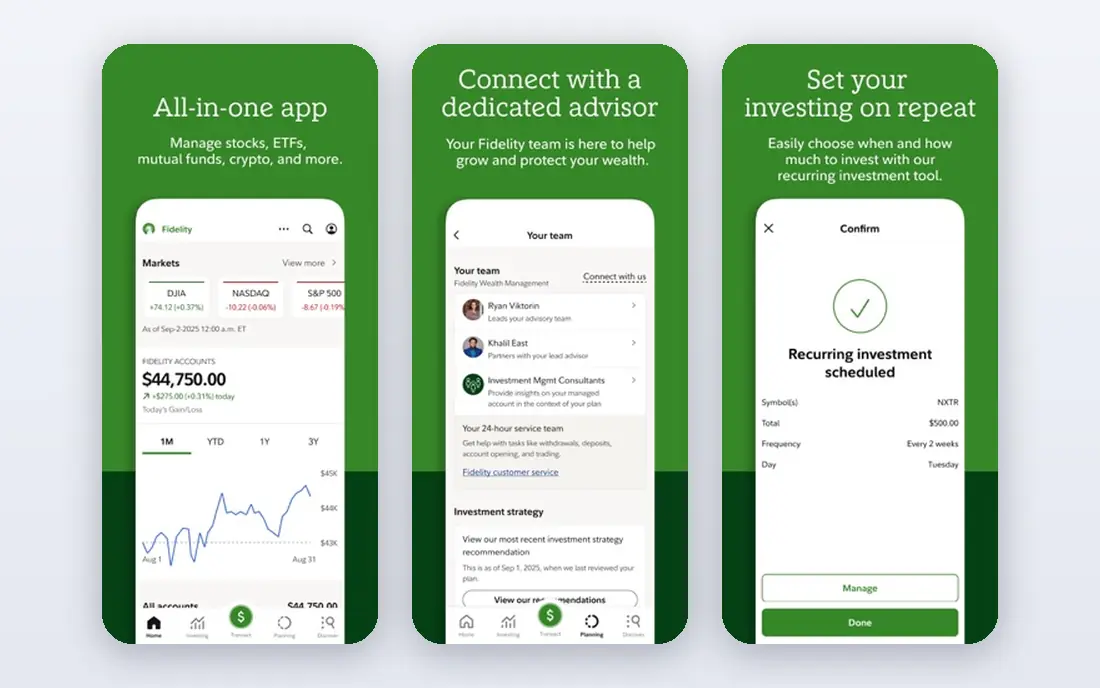
Fidelity is the strongest all-round platform for most US investors. It charges $0 commission on US stock and ETF trades, offers its own zero-expense-ratio index funds, and supports taxable accounts, IRAs and HSAs in one place. Research tools, screeners and educational material are deep without feeling gated behind a paywall. The platform also offers fractional shares, automatic investing and a cash management account, which makes it easy to build a regular investing habit. The main complexity is choice: Active Trader Pro and the range of fund options can overwhelm a beginner. Start with a simple index fund plan, then explore advanced tools only when you need them.
- $0 commission on US stock and ETF trades
- Zero-expense-ratio index funds
- Broad research and retirement account options
- Active Trader Pro takes time to learn
- Cash sweep options need attention to get the best yield

Schwab pairs a full-service brokerage with thinkorswim, one of the most respected trading platforms for active traders. Charting, options analysis and paper trading are strong, and the platform is free with a Schwab brokerage account. Branches and integrated banking appeal to investors who want in-person help and a checking account beside their investments. The catch is cash. Schwab's default cash sweep often pays a low yield unless you move uninvested cash into a money market fund yourself. Options traders also pay $0.65 per contract. If you keep most money invested and use thinkorswim for active trades, Schwab is hard to beat; if you hold large cash balances, check the sweep terms first.
- $0 commission on US stock and ETF trades
- Thinkorswim platform for active traders
- Large branch network and banking options
- Default cash sweep yield is often low
- Options contracts cost $0.65 each
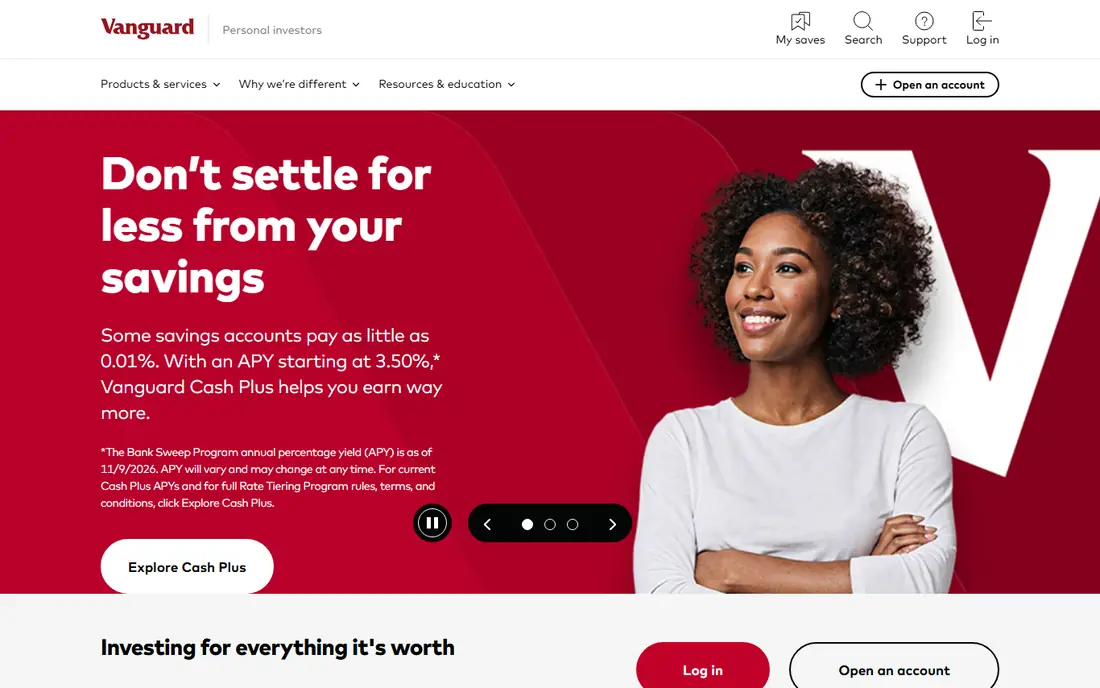
Vanguard built its name on low-cost index investing, and it still sets the standard for buy-and-hold investors. Its index funds and ETFs carry very low expense ratios, and its target-date funds give hands-off retirement savers a single-fund option. Account minimums for ETFs are $0, and US stock and ETF trades are commission-free. The trade-off is polish. Vanguard's app and website trail Fidelity and Schwab for usability, and active traders will miss advanced charting. For investors who plan to buy index funds monthly and check their balance a few times a year, that simplicity is a strength. Returns still depend on the market, not on the platform, so low fees are the main advantage here.
- Very low-cost index funds and ETFs
- $0 commission on US stock and ETF trades
- Strong target-date retirement funds
- Mobile app and website feel less polished than rivals
- Fewer active trading tools
Robinhood is the easiest platform in this list to start on. The mobile app is clean, fractional shares let you invest small amounts, and US stock and ETF trades are commission-free. Robinhood Gold, at $5 per month, adds a 3 percent IRA contribution match and a higher cash yield, which can pay for itself for regular IRA contributors. The limit is depth. Research, screeners and retirement planning tools are lighter than at Fidelity or Schwab, and the simple interface can encourage frequent trading, which rarely helps long-term returns. Use Robinhood for a simple, automated plan rather than daily speculation, and keep position sizes modest until you have experience.
- $0 commission on US stock and ETF trades
- Simple mobile app with fractional shares
- Gold plan adds IRA match and higher cash yield
- Research tools are lighter than Fidelity or Schwab
- Gold costs $5 per month
Webull suits traders who want serious charting on a phone. Its mobile app offers technical indicators, level 2 data options and a paper trading sandbox for practice without real money. Extended-hours trading lets active traders react to news outside regular market hours. Webull is less suited to hands-off retirement savers. Mutual fund access and retirement planning tools are thinner than at Fidelity or Vanguard, and the feature-rich interface can push beginners toward short-term trading. Treat Webull as a trading tool for money you can afford to risk, and keep long-term retirement savings on a simpler, diversified plan elsewhere if needed.
- $0 commission on US stock and ETF trades
- Strong mobile charting and paper trading
- Extended-hours trading
- No mutual fund trading in the same way as full-service brokers
- Fewer retirement planning tools
Interactive Brokers is the platform for advanced and global investors. It offers access to a wide range of international markets beyond US-listed stocks, low margin rates for eligible accounts, and a powerful desktop platform with API access for custom strategies. IBKR Lite offers $0 commission US stock and ETF trades for US clients. Complexity is the price of that power. The platform has a steep learning curve, and beginners can feel lost among order types and market data options. Margin trading also magnifies losses as well as gains, so it is not suitable for most new investors. Choose Interactive Brokers when you need global access or advanced tools that other brokers do not offer.
- Access to many global markets
- Low margin rates for eligible accounts
- Powerful desktop platform and API
- Interface is complex for beginners
- Some features need a Pro account or higher balances
SoFi Invest fits people who want banking, lending and investing in one app. You can hold a checking account, invest in stocks and ETFs commission-free, and use an automated investing portfolio beside self-directed trading. Fractional shares and a clean mobile design make starting simple. The trade-off is depth. Research and advanced trading tools are lighter than at Schwab or Fidelity, and the automated portfolios charge no advisory fee but still carry fund expenses. SoFi is a good choice for a beginner who values one login for several money tasks, provided you keep your investing plan simple and diversified.
- $0 commission on US stock and ETF trades
- Banking, loans and investing in one app
- Automated investing option
- Research tools are lighter than full-service brokers
- Fewer advanced trading features
Betterment is a robo-advisor, not a stock-picking app. You answer questions about your goals and risk tolerance, and it builds and manages a diversified ETF portfolio, rebalances it automatically, and offers tax-loss harvesting on eligible plans. That hands-off design suits investors who want to set a monthly contribution and stop worrying about daily market moves. The cost is an advisory fee on top of fund expenses, and you give up control over individual holdings. Returns still depend on the market, and automation does not remove risk. Betterment is best for long-term goal savers who know they will not manage a portfolio themselves, and who value discipline over picking stocks.
- Automated diversified portfolios
- Automatic rebalancing and tax-loss harvesting on eligible plans
- Clear goal-based planning
- Advisory fee applies
- Less control over individual stock picks
How we picked these
We compared official pricing, fee and account pages for major US investing platforms in October 2026, plus public reviews on tools, account types and usability. We kept platforms that offer real brokerage or robo-advisor accounts to US investors, and we left out services that promise guaranteed returns, since no legitimate platform can do that. Prices are listed as "See website" where advisory fees or plan terms varied by account type.
How to think about high returns
High returns always come with high risk, and the two cannot be separated. A platform does not create returns; the investments you hold do, and markets fall as well as rise. The most reliable ways to improve long-term outcomes are lower fees, diversification across many stocks or bonds, regular contributions, and avoiding frequent trading based on short-term news. Be cautious with margin, options and borrowed-money products. They can amplify gains, but they can also produce losses larger than your original investment, and they need experience to use safely. If a platform, influencer or ad promises a specific return, treat that as a warning sign, not a selling point. Check that any broker you use is registered and that your account is covered by SIPC protection for securities, noting that SIPC does not protect against market losses.
A simple starting plan
Open an account with no minimum, set up an automatic monthly contribution to a diversified index fund or a robo-advisor portfolio, and review it twice a year. Keep an emergency fund in cash outside your investments, and avoid investing money you will need within a few years. That boring plan has historically served most investors better than chasing the highest-return product of the moment.
Sources
Frequently asked questions
Which investing platform gives the highest returns?
No platform gives higher returns by itself. Returns depend on what you invest in, fees, and market performance. Low-cost diversified index funds on Fidelity, Schwab or Vanguard have historically served long-term investors well, but future returns are never guaranteed.
Is investing risky?
Yes. Investing carries risk, including loss of principal, and values can fall sharply. Diversification, a long time horizon and an emergency fund reduce risk, but they do not remove it. This is not financial advice, so consider speaking to a qualified adviser about your own situation.
Can I start investing with a small amount?
Yes. Most platforms in this list have $0 account minimums and offer fractional shares, so you can start with a small monthly amount. Automatic contributions matter more than a large starting sum for most beginners.
Do I need a robo-advisor or a self-directed account?
A robo-advisor suits hands-off savers who want a managed portfolio, while a self-directed account suits investors who want to pick funds and stocks themselves. Many people use both: a robo-advisor for retirement goals and a brokerage account for learning.
What fees should I watch besides commission?
Watch fund expense ratios, advisory fees, options contract fees, margin interest and cash sweep yields. Even a small annual fee compounds over decades, so compare total costs, not only the headline commission.