Best Mobile Apps Developers in 2026: 8 Firms Compared
By ToolNimba Editorial Team November 12, 2026 9 min read

- Top pick
 Fueled
Design-led consumer and enterprise apps
Starting priceSee websiteCheck out FueledRead our review - Runner-up
 WillowTree
Large enterprise platforms
Starting priceSee websiteCheck out WillowTreeRead our review - Also great
 ArcTouch
Native apps and connected devices
Starting priceSee websiteCheck out ArcTouchRead our review
How we researched this
We compared official pricing and feature pages, app store listings, privacy policies and public user reviews. Prices change, so check the provider's site before you pay.
Key takeaways
- Fueled and WillowTree suit large, design-led enterprise products, while Designli and Chop Dawg suit founders building a first product or MVP.
- ArcTouch and Dogtown Media bring strength in connected devices, health, and integration-heavy work, while Utility leads on consumer design and growth.
- Sidebench is the strongest pick for healthcare and regulated products that need systems integration alongside mobile work.
- Agency pricing is project-based and rarely published, so shortlist on shipped work, client references, and post-launch support, not on a headline rate.
Quick comparison
| Name | Best for | Starting price | Free plan | |
|---|---|---|---|---|
| Fueled | Design-led consumer and enterprise apps | See website | No | Visit |
| WillowTree | Large enterprise platforms | See website | No | Visit |
| ArcTouch | Native apps and connected devices | See website | No | Visit |
 Utility | Consumer design and growth | See website | No | Visit |
 Sidebench | Healthcare and regulated products | See website | No | Visit |
 Chop Dawg | MVP planning and rebuilds | See website | No | Visit |
 Designli | Founders needing a product team | See website | No | Visit |
 Dogtown Media | Health, IoT, and focused builds | See website | No | Visit |
The best mobile apps developers
The firms below are US mobile app development agencies and companies, not app tools for developers. Each builds iOS, Android, or cross-platform apps for clients, and each has a distinct strength, from enterprise platforms to founder MVPs. Pricing is project-based, so we list "See website" and advise getting a scoped quote, rather than repeating hourly estimates as if they were fixed prices.
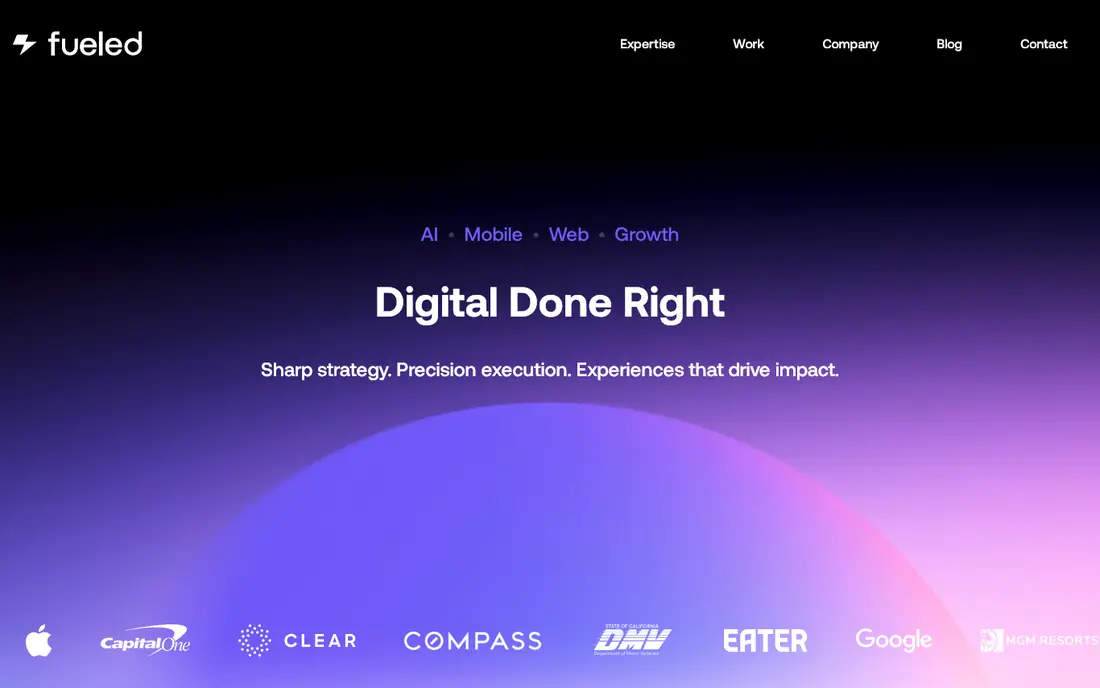
Fueled works like a product lab rather than a staff vendor. Its teams combine design precision with engineering depth, which suits consumer apps where look, feel, and performance decide whether users stay. Startups use Fueled for speed and polish, while larger companies use it for flagship apps that carry the brand.
The trade-off is price. Fueled is not cheap, and that is intentional, since its senior teams and design process cost more than a small shop. Founders with a very small budget may get more scope elsewhere. If your app lives or dies on consumer experience and you can fund a proper product team, Fueled is a strong first call.
- Product-lab approach with strong design and engineering
- Consumer and media experience
- Polished shipped apps
- Premium pricing
- Not the best fit for a tiny MVP budget

WillowTree, now part of a larger digital consultancy group, specializes in large-scale digital products where mobile is one part of a wider platform. It handles legacy system integration, complex data flows, and multi-platform releases that smaller agencies struggle to staff. Telecom, hospitality, and enterprise clients form a large part of its portfolio.
That enterprise strength is also its limit for small buyers. Minimum engagements are larger, processes are heavier, and a founder with a single MVP may find the pace slower than a boutique firm. For a company replacing or extending a major platform, WillowTree's ability to handle complexity is exactly the point, and it is worth the premium.
- Enterprise-grade delivery
- UX and strategy depth
- Experience with telecom, hospitality, and large platforms
- Enterprise focus means higher minimum engagement
- Slower fit for a quick solo MVP
ArcTouch builds native mobile apps and connected experiences, including apps that pair with devices, wearables, and smart home products. Its long track record in native development suits clients who need performance, platform-specific design, and hardware integration, rather than a quick cross-platform wrapper. Sports, media, and consumer brands appear often in its work.
ArcTouch is less suited to founders hunting the lowest MVP price, since its senior native teams and process carry a higher cost. Project pricing also requires a scoping conversation, so budget comparisons need a written proposal. If your app must feel native on both platforms or talk to hardware, ArcTouch deserves a shortlist spot.
- Strong native iOS and Android work
- IoT and connected device experience
- Long track record
- Less focused on low-cost MVP work
- Project pricing needs a scoping call
Utility is a New York agency known for consumer apps where design and growth carry unusual weight. Its work covers sports, media, and consumer brands, with an emphasis on presentation, onboarding, and retention, not just functional code. Clients who need an app that looks and feels like a flagship product, and that grows after launch, often pick Utility for that reason.
The focus cuts both ways. Utility is less known for regulated enterprise systems or deep backend integration than Sidebench or WillowTree, so a complex compliance project may fit elsewhere. Pricing is also premium. For a consumer app where design is the differentiator, Utility is one of the best US agencies to call.
- Design-led consumer apps
- Growth and product presentation strength
- Sports and media experience
- Consumer focus means less depth in regulated enterprise systems
- Premium pricing
Sidebench is a product development studio with strength in healthcare, regulated products, and integration-heavy work. It combines product strategy, design, and engineering, which helps clients whose apps must connect to existing systems, meet compliance rules, and handle sensitive data. That combination is rarer than pure app coding, and it is why Sidebench ranks well for complex products.
Its specialization means it is not the first pick for a simple consumer app or a tiny MVP, where a smaller firm may be faster and cheaper. Pricing is project-based and varies with scope, so a scoping call is needed. If your app sits in healthcare or a regulated field and must integrate with other systems, Sidebench is a strong fit.
- Healthcare and regulated product experience
- Systems integration strength
- Product strategy plus engineering
- Specialized focus means less consumer app volume
- Project pricing varies by scope
Chop Dawg suits founders and companies that need a structured path from idea to launch, and then ongoing product work after launch. Its MVP planning process helps clients define scope, cut features that do not matter yet, and ship a testable product, rather than building everything at once. Rebuilds of aging apps are another strength, since the team is used to untangling old code.
Team size is the limit. Chop Dawg is smaller than WillowTree or Fueled, so a very large enterprise program with many parallel workstreams may need a bigger firm. For a startup MVP, a rebuild, or a product that needs steady iteration after launch, Chop Dawg offers a practical balance of process and price.
- Structured MVP planning
- Rebuild and ongoing product work
- Streaming and real estate experience
- Smaller team than enterprise agencies
- Less suited to very large platform programs
Designli gives founders a full product team without hiring one. Its process moves from discovery and design through development and launch, which suits non-technical founders who need guidance on scope, priorities, and product decisions, not just code. Clients often cite the structured approach as the reason a first product shipped on time.
Designli is not an enterprise platform firm, so a large company replacing a complex system should look at WillowTree or Sidebench instead. Pricing is project-based, so founders need a scoping call to get a real number. If you are a founder with an idea and a budget for a proper team, Designli is a strong, founder-friendly choice.
- Structured product team for founders
- Clear process from discovery to launch
- Good for non-technical founders
- Less suited to large enterprise platforms
- Pricing is project-based and needs a quote
Dogtown Media is a US studio focused on mobile builds in healthcare, connected devices, and focused consumer products. Its work includes health apps, IoT companions, and focused builds where a small, senior team can move faster than a large agency. Clients who need a dedicated team for one product, rather than a large program, often fit well here.
Breadth is the trade-off. Dogtown Media does not cover the same range of enterprise platforms as WillowTree, and its team is smaller than the largest firms. For a focused health or IoT app, that focus is an advantage, since the team brings relevant experience. For a multi-platform enterprise program, a larger firm may be safer.
- Healthcare and IoT focus
- Focused mobile builds
- Long-running US studio
- Smaller portfolio breadth than larger agencies
- Less suited to huge enterprise programs
How we picked these
We compared agency portfolios, client reviews on platforms such as Clutch and GoodFirms, and recent US agency roundups, and we kept firms with verifiable shipped mobile work in October 2026 and a clear US presence. We favored a mix of enterprise, consumer, healthcare, and founder-focused firms, so readers can match firm to project type. We excluded firms without a working official site or a verifiable mobile portfolio, and firms whose main work was web-only or marketing alone.
How to choose the right mobile app developer
Start with project type, not with size or fame. A founder MVP needs a firm like Designli or Chop Dawg, a consumer flagship needs Fueled or Utility, and a regulated health product needs Sidebench or Dogtown Media. Ask each shortlisted firm for three shipped apps in your category, then download them, use them, and ask the firm what it built versus what the client built.
Next, check process and post-launch support before price. Ask who will be on your team, how often you will see working software, who owns the code and accounts, and what happens after launch for fixes and updates. Get a scoped proposal with milestones, not just an hourly rate, since rates alone hide scope differences. A firm that answers those questions clearly is usually a safer hire than a cheaper firm that cannot.
Sources
- https://nerdbot.com/2026/07/13/7-best-custom-mobile-app-development-agencies-in-the-us-for-2026/
- https://warego.co/blog/best-mobile-app-development-companies-in-the-usa/
- https://www.goodfirms.co/directory/platform/app-development
- https://www.fueled.com
- https://www.willowtree.com
- https://www.arctouch.com
- https://www.utilitynyc.com
- https://www.sidebench.com
- https://www.chopdawg.com
- https://www.designli.com
- https://www.dogtownmedia.com
Frequently asked questions
What is the best mobile app development company in the USA?
There is no single best firm, since project type decides fit. Fueled and WillowTree lead for large, design-led and enterprise products, Utility leads for consumer design, Sidebench leads for healthcare and regulated work, and Designli leads for founders needing a full product team. Shortlist by your project type, then judge on shipped work and references.
What are the best app development companies for startups?
Designli and Chop Dawg are the strongest startup picks, thanks to structured MVP processes and ongoing product support. Dogtown Media suits focused health and IoT startups, while Utility suits consumer startups where design drives growth. Avoid large enterprise firms for a first MVP unless your product genuinely needs their scale, since cost and process will slow you down.
How much does it cost to hire a mobile app development firm?
Most US firms price by project, not by a fixed rate, and costs vary widely by scope. Simple apps can cost tens of thousands of dollars, mid-level apps often cost far more, and enterprise platforms can cost hundreds of thousands or more. Hourly rates in industry surveys range roughly from $75 to $250 per hour, but a scoped proposal for your exact features is the only reliable number.
Should I choose native or cross-platform development?
Native iOS and Android apps, built with Swift and Kotlin, usually give the best performance and platform feel, and suit apps with hardware, media, or complex interactions. Cross-platform tools such as Flutter or React Native can cut cost and time for simpler apps with one codebase. Ask your firm to justify the choice for your features, since the wrong stack is costly to change later.
How do I check an app development agency before hiring?
Download apps the firm shipped, check client reviews on Clutch and GoodFirms, and ask for references you can call. Ask who owns the code, where it is stored, and what post-launch support costs. A firm that is vague about ownership, team, or past work is a warning sign, however good its sales deck looks.