Best Online Doctor App in 2026: 9 Services Compared
By ToolNimba Editorial Team November 9, 2026 10 min read

- Top pick
 Teladoc Health
Broad insured telehealth
Starting priceSee websiteCheck out Teladoc HealthRead our review - Runner-up
 Sesame
Transparent self-pay visits
Starting priceSee websiteCheck out SesameRead our review - Also great
 MDLIVE
24/7 urgent care
Starting priceSee websiteCheck out MDLIVERead our review
How we researched this
We compared official pricing and feature pages, app store listings, privacy policies and public user reviews. Prices change, so check the provider's site before you pay.
Key takeaways
- Sesame is the best online doctor app for transparent self-pay pricing, while Teladoc suits insured patients who want broad coverage.
- PlushCare suits ongoing primary care with the same doctor, while MDLIVE and Doctor on Demand suit fast urgent care.
- GoodRx Care and Amazon Clinic suit simple, low-cost visits, but they are not a replacement for ongoing primary care.
- This article is general information only, not medical advice, and urgent or emergency symptoms need emergency care, not a video visit.
Quick comparison
| Name | Best for | Starting price | Free plan | |
|---|---|---|---|---|
| Teladoc Health | Broad insured telehealth | See website | No | Visit |
| Sesame | Transparent self-pay visits | See website | No | Visit |
| MDLIVE | 24/7 urgent care | See website | No | Visit |
 Doctor on Demand | Urgent care plus mental health | See website | No | Visit |
 Amwell | Urgent care and therapy | See website | No | Visit |
 PlushCare | Ongoing primary care | See website | No | Visit |
 GoodRx Care | Low-cost simple visits | See website | No | Visit |
 Lemonaid Health | Simple prescriptions and care | See website | No | Visit |
 Amazon Clinic | Quick message and video visits | See website | No | Visit |
The best online doctor app
We compared visit types, self-pay pricing, insurance acceptance, availability, and scope of care, focusing on services that US patients can actually use in 2026 for common needs.

Teladoc Health is the best telehealth company for insured patients who want one service for many needs. Urgent care is available around the clock, and dermatology, mental health, and primary care options sit in the same platform, which helps families that do not want a separate app for each need. Employer and health plan coverage often reduces the visit to a standard copay, so check your benefits before you pay self-pay rates.
Without insurance, Teladoc visits can cost more than Sesame or GoodRx Care, so self-pay patients should compare prices first. Continuity with the same doctor also depends on the service and plan you use, and Teladoc is not a substitute for an in-person primary care doctor for complex conditions. For broad, insured access, though, Teladoc remains a strong default among the best telehealth platforms.
- 24/7 urgent care, dermatology, and mental health
- Wide employer and insurance coverage
- Large provider network
- Self-pay visit price can be higher than low-cost rivals
- Ongoing primary care continuity varies by plan
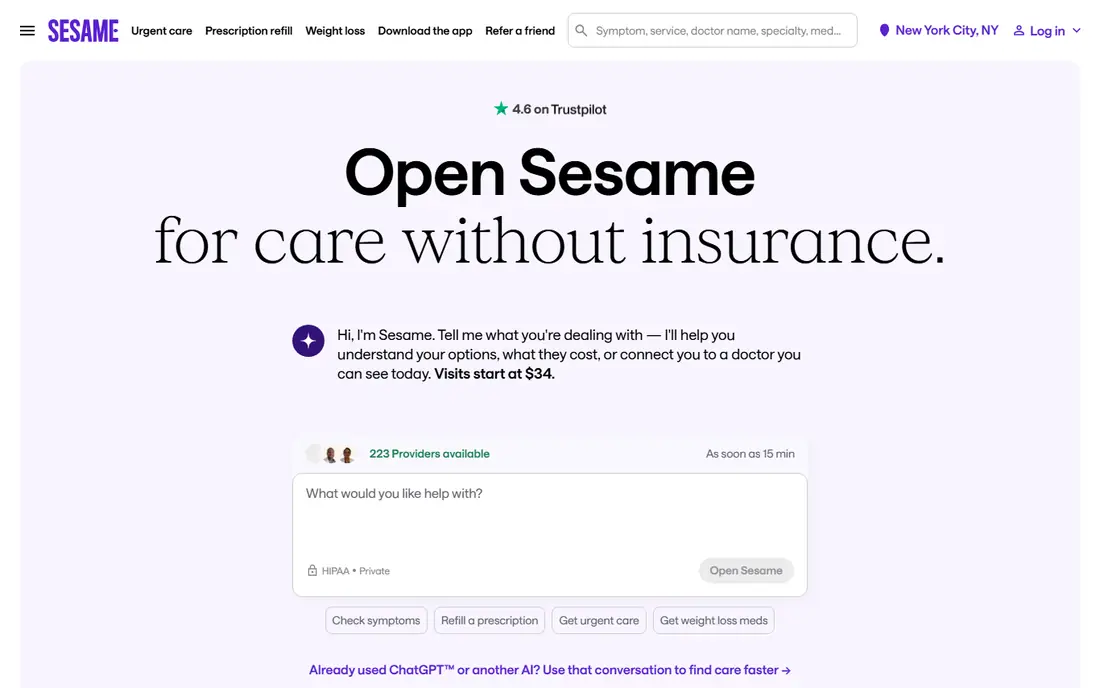
Sesame is our pick for patients paying out of pocket. Prices are shown upfront before you book, which removes the surprise bill problem that makes many people avoid care. Video visits cover urgent care, primary care, mental health, and specialist topics, and in-person options exist in many areas, so you can choose the format that fits the problem.
Availability and price vary by provider and location, and Sesame is a marketplace, so the doctor you see may differ from visit to visit unless you choose continuity. For a one-off urgent issue, a refill question, or a second opinion, that trade-off is usually worth it for the price clarity. For ongoing care, pair Sesame with a regular primary care doctor when you can.
- Upfront prices before booking
- Video and in-person options in many areas
- Useful for uninsured and high-deductible patients
- Provider availability varies by location
- Membership and visit prices vary by service
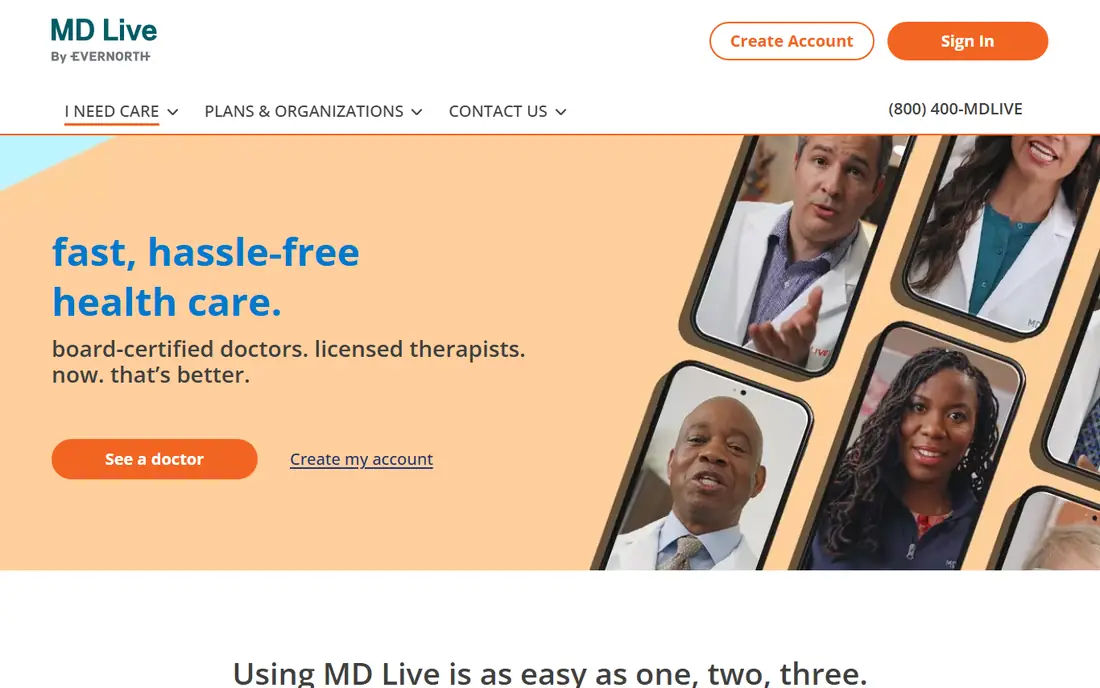
MDLIVE suits late-night and weekend urgent care, when a clinic is closed and the issue cannot wait until morning. Board-certified doctors handle common problems such as colds, flu, sinus issues, rashes, and urinary symptoms, and dermatology visits use photo uploads for skin concerns. Many insurance plans are accepted, which can lower the cost to a copay.
Self-pay pricing varies, so check the price for your visit type before you start. MDLIVE is best for episodic urgent care and behavioral health support, not as a full replacement for a primary care doctor who knows your history. For fast, anytime access, it is one of the best telemedicine services for urgent needs.
- Around-the-clock urgent care
- Dermatology and behavioral health options
- Many insurance plans accepted
- Self-pay prices vary by visit type
- Not ideal as a sole primary care replacement
Doctor on Demand appeals to patients who want to choose a specific provider and keep mental health care in the same place as medical care. Urgent care visits cover common illnesses, while therapy and psychiatry options support ongoing mental health needs. The ability to browse providers and read profiles helps patients who value continuity and fit, not just speed.
Without insurance, visit prices can be higher than low-cost rivals, so self-pay patients should compare Sesame or GoodRx Care for simple issues. Availability also varies by state, since licensing rules affect which providers can see you. For insured patients who want provider choice plus mental health care, Doctor on Demand is a strong pick among the best telehealth apps.
- Choice of providers
- Urgent care, mental health, and preventive care
- Strong insurance acceptance
- Visit prices can be higher without insurance
- Availability varies by state and specialty
Amwell is a well-established telehealth platform for urgent care and behavioral health. Patients can see doctors for common illnesses, and therapy and psychiatry services cover ongoing mental health needs in the same system. Many employers and health plans include Amwell, which can make visits affordable for insured patients, and the platform has a long track record in the US market.
The main caution is pricing clarity for self-pay patients, since costs depend on plan, visit type, and coverage. Check your benefits and the visit price before you book, especially for therapy, where session prices differ from urgent care. For insured patients who want a dependable, broad service, Amwell remains one of the best telehealth companies to consider.
- Urgent care, therapy, and psychiatry
- Many health plans accepted
- Established provider network
- Pricing depends on plan and visit type
- App experience varies by service
PlushCare is the best telemedicine service for ongoing primary care, rather than one-off urgent visits. You can see the same doctor over time, which helps with chronic conditions, medication management, and follow-up, and same-day appointments reduce the wait for routine care. Lab orders and referrals support a fuller primary care model than a simple urgent care app.
Costs include membership and visit fees in some cases, and insurance coverage varies, so check the total before you join. PlushCare is not an emergency service, and complex or serious conditions still need in-person care. For patients who want a virtual primary care doctor with continuity, PlushCare is a strong choice among the best telehealth platforms.
- Continuity with the same doctor
- Same-day appointments
- Lab orders and chronic condition support
- Membership plus visit costs can add up
- Insurance coverage varies
GoodRx Care suits simple, common problems where price matters most. Visits for urinary symptoms, acne, rashes, and other straightforward conditions are priced low, and the flow is built for speed, with a questionnaire, a clinician review, and a prescription sent to a pharmacy when appropriate. That makes it useful for patients without insurance or with high deductibles.
The scope is deliberately narrow, and GoodRx Care will direct unsuitable cases to other care. It is not a replacement for a primary care doctor, especially for chronic or complex conditions. For a quick, low-cost visit for a simple issue, though, GoodRx Care is one of the best telehealth apps for value, and it pairs well with a regular doctor for ongoing care.
- Low prices for common conditions
- Simple visit flow
- Prescription delivery or pharmacy pickup options
- Scope is limited to suitable conditions
- Not a full primary care service
Lemonaid Health focuses on efficient care for straightforward conditions, including birth control, urinary symptoms, acne, hair loss, and other common needs. The visit flow uses questionnaires and clinician review, which keeps the process fast and the price clear by service. Medication delivery options add convenience for patients who prefer not to visit a pharmacy.
As with GoodRx Care, the scope is limited, and Lemonaid is not a full primary care service. Patients with complex, chronic, or urgent conditions should use a broader telehealth service or in-person care. For a simple, repeatable need where speed and price matter, Lemonaid is a practical and well-known option among the best telemedicine companies for physicians and patients alike in this category.
- Fast visits for straightforward conditions
- Clear pricing by service
- Medication delivery options
- Limited to suitable conditions
- Ongoing complex care needs another provider
Amazon Clinic offers message-based and video visits for common conditions, with upfront pricing shown before you choose a clinician. That clarity suits patients who want a quick answer without a phone call or a long wait, and the service integrates with Amazon Pharmacy for medication delivery where appropriate. For simple issues, the message-based option can be faster than scheduling a live video visit.
Availability and scope vary by state, and Amazon Clinic is not a substitute for ongoing primary care or emergency care. Complex conditions, serious symptoms, and cases needing an exam should go to a broader telehealth service or in-person care. For a fast, transparent visit for a suitable condition, Amazon Clinic is a convenient addition to the best telehealth platforms list.
- Message-based and video visits
- Upfront pricing
- Convenient for Amazon account users
- Scope limited to suitable conditions
- Not a full primary care replacement
- Availability varies by state
How we picked these
We compared official service pages, visit types, pricing models, and insurance information, along with recent independent comparisons from 2026. We kept only services that are actively available to US patients and that cover common telehealth needs, and we noted where pricing is self-pay, membership-based, or insurance-dependent. We did not claim hands-on clinical testing, and we treated vendor pricing as a starting point to verify on the service site, since prices vary by visit type and state. This article is general information only, not medical advice.
How to choose a telehealth service for your situation
Start with your need, not the app. Urgent care suits MDLIVE, Teladoc, and Doctor on Demand, while ongoing primary care suits PlushCare. Simple, low-cost visits suit GoodRx Care, Lemonaid, and Amazon Clinic, while self-pay transparency suits Sesame. Check insurance first, since a covered visit can cost far less than the self-pay price, and check state availability, since licensing affects which providers can see you.
Know the limits of a video visit
Telehealth works well for common illnesses, rashes, mental health, refills, and follow-up, but it cannot replace an exam, lab work, imaging, or emergency care when those are needed. Seek emergency care for chest pain, breathing difficulty, severe bleeding, stroke symptoms, or other urgent warning signs. If a clinician says you need in-person care, follow that advice promptly, and keep a regular primary care doctor for ongoing and complex needs.
Sources
Frequently asked questions
What is the best online doctor app for urgent care?
Teladoc Health, MDLIVE, and Doctor on Demand are strong choices for urgent care, with fast access and broad coverage. Sesame is a good self-pay alternative when you want an upfront price. The best online doctor app for urgent care depends on insurance, time of day, and whether you need dermatology or mental health care as well.
What are the best telehealth companies for uninsured patients?
Sesame, GoodRx Care, and Amazon Clinic are among the best telehealth companies for uninsured patients, because they show upfront self-pay prices for suitable visits. Lemonaid Health also offers clear pricing by service. Compare the total visit price, not just the starting price, since prices vary by condition and state.
What are the best telehealth platforms for primary care?
PlushCare is the best telehealth platform for ongoing primary care with continuity, while Teladoc and Amwell offer broader services that include primary care options. Sesame can also support primary care visits on a self-pay basis. For complex or chronic conditions, a virtual primary care doctor should work alongside in-person care, not replace it entirely.
Can telehealth doctors prescribe medication?
Yes, for many common conditions, telehealth doctors can prescribe non-controlled medications and send prescriptions to a pharmacy. Controlled substances have stricter rules and often need in-person care or specific evaluations. Prescribing rules vary by state and condition, so the clinician will decide whether a prescription is appropriate after your visit.
Do telehealth apps accept insurance?
Many do, including Teladoc Health, MDLIVE, Doctor on Demand, and Amwell, often through employer or health plan benefits. Sesame and GoodRx Care focus more on self-pay pricing, though some visits may be eligible for reimbursement depending on your plan. Check your plan and the service price before you book, since a copay can be much lower than self-pay.
What are the best telemedicine companies for physicians to work with?
That depends on the physician, since platforms differ on scheduling, pay structure, specialty focus, and support. Teladoc, Amwell, MDLIVE, and Doctor on Demand are large platforms with broad clinician networks, while PlushCare focuses on primary care continuity. Physicians should compare credentialing, scheduling control, and clinical support before joining any platform, and patients should choose based on care quality and fit, not only on the platform name.