Best Platforms to Sell Digital Products in 2026: 9 Platforms Compared
By ToolNimba Editorial Team November 10, 2026 8 min read

- Top pick
 Gumroad
Fastest first launch
Starting priceFreeCheck out GumroadRead our review - Runner-up
 Payhip
Low-fee free store
Starting priceFreeCheck out PayhipRead our review - Also great
 Sellfy
Storefront with no sale fees
Starting price$22 per monthCheck out SellfyRead our review
How we researched this
We compared official pricing and feature pages, app store listings, privacy policies and public user reviews. Prices change, so check the provider's site before you pay.
Key takeaways
- Gumroad and Payhip are the fastest free starts, but their per-sale fees matter once volume grows.
- Sellfy and Podia suit sellers who prefer a monthly plan with low or no per-sale fees.
- Lemon Squeezy and Gumroad handle global sales tax as merchant of record, which saves paperwork for international sellers.
- Etsy and Shopify bring built-in traffic or a full store, but they serve different kinds of digital products.
Quick comparison
| Name | Best for | Starting price | Free plan | |
|---|---|---|---|---|
| Gumroad | Fastest first launch | Free | Yes | Visit |
| Payhip | Low-fee free store | Free | Yes | Visit |
| Sellfy | Storefront with no sale fees | $22 per month | Free trial | Visit |
 Podia | Courses and community | $42 per month | Free trial | Visit |
 Teachable | Structured courses | $39 per month | Free trial | Visit |
 Lemon Squeezy | Software with tax handled | Free | Yes | Visit |
 Etsy | Marketplace traffic | Free | Yes | Visit |
 Shopify | Full branded store | $29 per month | Free trial | Visit |
 Ko-fi | Tips plus a light shop | Free | Yes | Visit |
The best platforms to sell digital products
Selling digital products is a fee problem as much as a store problem. A platform can charge monthly, per sale, or both, and the cheapest option depends on your price and volume. The platforms below cover free starts, monthly stores, course hubs, and marketplaces.

Gumroad is our pick for a first product because you can list and sell the same day with no monthly cost. Upload a file, set a price, and share the link, and Gumroad handles checkout, delivery, and global sales tax as merchant of record. That simplicity suits ebooks, templates, presets, and small software tools.
The fee is the catch. At 10 percent plus 50 cents per direct sale, a low-priced product keeps noticeably less, and high-volume sellers often move to a monthly plan elsewhere. Start on Gumroad to prove demand, then run the fee math before you scale.
- No monthly fee
- Merchant-of-record tax handling
- Simple product pages and checkout
- 10 percent plus 50 cents per direct sale
- Marketplace sales cost more
- Limited store customization
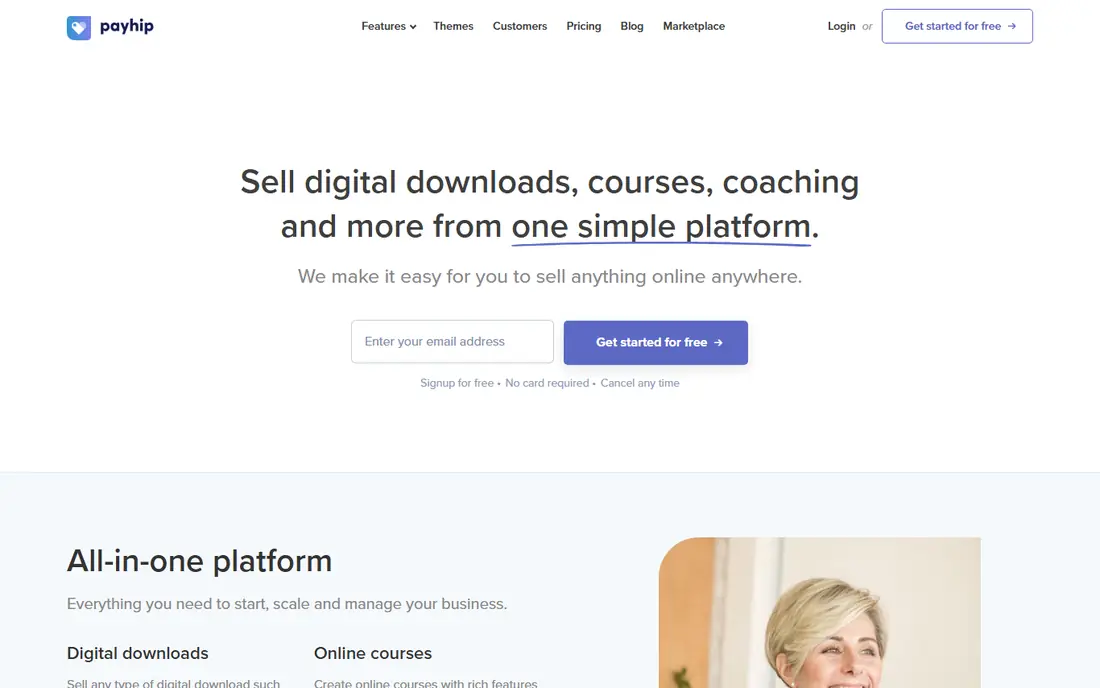
Payhip is the strongest free alternative to Gumroad for many sellers, because the free plan includes all features and charges 5 percent per sale instead of 10 percent. It supports digital downloads, courses, memberships, and coaching, with instant payouts through connected payment accounts.
Tax handling is another advantage, with EU and UK VAT and US sales tax collection covered for sellers. Paid plans lower the platform fee to 2 percent or zero, so growing sellers can stay on Payhip rather than migrating. The storefront is functional rather than highly customizable, which is fine for link-driven sales.
- Free plan with all features
- 5 percent fee on the free plan
- Handles EU and UK VAT and US sales tax
- Payment processing fees apply on top
- Store design is simpler than Shopify

Sellfy suits sellers who would rather pay monthly than give up a share of every sale. The platform charges no transaction fee on top of payment processing, and it combines digital downloads with print-on-demand merchandise in one store. That mix helps creators who sell both files and merch.
The starter plan, at 22 dollars per month on annual billing, carries an annual sales cap, so high-volume sellers need a higher tier. Sellfy does not act as merchant of record in the same way as Gumroad, so international tax work needs more attention. For steady sellers, the fee saving still outweighs that extra work.
- Zero percent platform transaction fees
- Storefront plus print-on-demand
- Simple setup
- Monthly cost from the start
- Starter plan has an annual sales cap
- Tax handling is more hands-on
Podia is an all-in-one home for creators who sell courses alongside downloads and memberships. Students get a clean course player, community spaces, and email from the same platform, which reduces the need for separate tools. That integration is the main reason to choose Podia over a simple file store.
The entry Mover plan, at 42 dollars per month on annual billing, charges a 5 percent transaction fee, while higher plans remove it. Creators who mainly sell single files may not need the course and community tools, but course sellers often find the bundle cheaper than separate services.
- Courses, downloads, community, and email in one place
- No platform fee on higher plans
- Clean student experience
- No permanent free plan
- Entry plan charges a 5 percent fee
- Less marketplace traffic than Etsy
Teachable is built for structured online courses, with lessons, quizzes, certificates, and drip content. Coaches can add one-to-one sessions, and the platform handles checkout and tax as merchant of record. For a flagship course with a clear curriculum, Teachable gives a professional student experience.
The starter fee is steep at 7.5 percent, so sellers should price the next tier, which removes the platform fee, into their plan. Teachable is less suited to single-file sellers, who will find Gumroad or Payhip simpler and cheaper to start.
- Strong course builder and student tools
- Coaching and community features
- Merchant-of-record tax handling
- Starter plan charges a 7.5 percent fee
- Monthly cost plus fees can add up early
Lemon Squeezy is a favorite for software and SaaS sellers because it acts as merchant of record, handling global sales tax, invoicing, and compliance. It supports one-time purchases, subscriptions, and license keys, which covers most indie software business models without extra tax tools.
The fee, at 5 percent plus 50 cents per sale, is lower than Gumroad for direct sales, though international and payment-method surcharges can raise the total. For software sellers with global customers, the tax handling alone often justifies the fee.
- No monthly fee
- Merchant-of-record tax handling worldwide
- License keys and subscriptions for software
- 5 percent plus 50 cents per sale
- Extra fees can apply for international and PayPal payments
Etsy is different from the other platforms here because buyers come to Etsy to shop. Digital printables, planners, templates, and art files can find customers through search without the seller driving all traffic. Listing is simple, and checkout is familiar to millions of buyers.
Fees include a listing fee per item plus a transaction fee, and sellers compete with similar products in search results. Brand control is limited, since the shop lives inside Etsy. Use Etsy for discovery, and consider a standalone store once repeat buyers know your name.
- Built-in buyer traffic for printables and art
- Easy listing for digital downloads
- Trusted checkout
- 6.5 percent transaction fee plus listing fee
- Marketplace rules and competition
- Limited brand control
Shopify suits sellers who want a real brand store, not just a checkout link. You control the domain, design, product pages, and email, and apps handle digital delivery, licensing, and subscriptions. That control matters once a product line grows beyond a few files.
The trade-off is traffic and effort. Shopify brings no built-in buyers, so you must drive visits yourself, and the monthly cost applies even in slow months. Choose Shopify when brand and scale matter more than the fastest possible launch.
- Full control over branding and store design
- Strong app ecosystem
- Digital delivery apps available
- Monthly cost plus payment fees
- No built-in marketplace traffic
- Setup takes longer than Gumroad
Ko-fi started as a tipping platform and grew into a light shop for digital products, memberships, and commissions. Fans can tip, join a membership, or buy a file from one page, which suits artists and writers with an existing audience. Donations carry no platform fee, though payment processing still applies.
The shop is simpler than Gumroad or Payhip, with fewer delivery and licensing options. Ko-fi is best as a supporter hub with a small shop attached, rather than as the main store for a large catalog.
- Free to start
- Tips with no platform fee on donations
- Simple shop and membership options
- 5 percent fee on shop sales on the free plan
- Shop tools are lighter than dedicated stores
How we picked these
We compared official pricing pages and fee documentation for the major digital product platforms, focusing on monthly cost, per-sale fees, free plan availability, and tax handling. We favored platforms that are actively maintained and widely used by creators, and we noted where fees differ for marketplace sales versus direct sales.
Work out your real fee before you choose
Run a simple example with your own numbers. Take a product price, subtract the platform fee and payment processing, and multiply by expected monthly sales, then add any monthly plan cost. A free plan with a 10 percent fee can cost more than a 29 dollar monthly plan once sales pass a few hundred dollars.
Also check tax handling for your buyers. If you sell worldwide, a merchant-of-record platform can save registration and filing work that dwarfs a small fee difference. If you sell only in one country, that benefit matters less, and a monthly store may win.
Sources
- https://www.gumroad.com
- https://www.payhip.com
- https://www.sellfy.com
- https://www.podia.com
- https://www.teachable.com
- https://www.lemonsqueezy.com
- https://www.etsy.com
- https://www.shopify.com
- https://www.ko-fi.com
- https://rankite.com/blog/best-platforms-to-sell-digital-products-online
- https://colorlib.com/wp/platforms-for-selling-digital-products/
Frequently asked questions
What is the best platform to sell digital products for beginners?
Gumroad or Payhip, because both let you start free with no monthly cost. Payhip charges a lower per-sale fee on its free plan, while Gumroad offers simpler merchant-of-record tax handling.
Which platform has the lowest fees?
It depends on volume. Sellfy charges no platform transaction fee but has a monthly cost, while Payhip and Lemon Squeezy charge per sale with no monthly fee. Run your expected sales through both models before choosing.
Do I need to handle sales tax myself?
Not always. Gumroad, Lemon Squeezy, and Teachable act as merchant of record and handle much of the global tax work. On other platforms, you may need to collect and remit tax yourself or use a tax tool.
Can I sell on Etsy and my own store at the same time?
Yes, many sellers use Etsy for discovery and a standalone store for repeat buyers. Keep prices and product names consistent, and check that you are not breaking any marketplace exclusivity rule for a specific program.
What digital products sell best on these platforms?
Ebooks, templates, planners, presets, courses, software, and printables are common sellers. The best product depends on your audience, so validate demand with a small launch before building a large catalog.