Best Trucking Dispatch Software in 2026: 9 Tools Compared
By ToolNimba Editorial Team November 11, 2026 11 min read

- Top pick
 Truckbase
Small to mid-sized carriers
Starting price$290 per monthCheck out TruckbaseRead our review - Runner-up
 Rose Rocket
Growing carriers wanting a modern TMS
Starting price$233 per monthCheck out Rose RocketRead our review - Also great
 AscendTMS
Very small teams wanting a free start
Starting priceFreeCheck out AscendTMSRead our review
How we researched this
We compared official pricing and feature pages, app store listings, privacy policies and public user reviews. Prices change, so check the provider's site before you pay.
Key takeaways
- Truckbase is our pick for most small to mid-sized carriers, thanks to its modern dispatch workflow and a published minimum of $290 per month.
- AscendTMS is the best entry point for very small teams, with a free plan for teams under three users and a premium plan at $99 per user per month.
- Datatruck is the clearest value for fleets priced by truck count, with plans from $99 per month for up to six trucks.
- The right tool depends on fleet size and freight type: owner-operators, small carriers, and large fleets need very different software.
Quick comparison
| Name | Best for | Starting price | Free plan | |
|---|---|---|---|---|
| Truckbase | Small to mid-sized carriers | $290 per month | No | Visit |
| Rose Rocket | Growing carriers wanting a modern TMS | $233 per month | No | Visit |
| AscendTMS | Very small teams wanting a free start | Free | Yes | Visit |
 Datatruck | Fleets priced by truck count | $99 per month | Free trial | Visit |
 ITS Dispatch | Owner-operators | $50 per month | No | Visit |
 PCS Software | Established carriers wanting dispatch plus accounting | $410 per user per month | No | Visit |
 McLeod Software | Large carriers and brokerages | See website | No | Visit |
 Tailwind TMS | Small carriers wanting an all-in-one system | See website | No | Visit |
 Alvys | Carriers and brokers wanting a modern cloud TMS | See website | No | Visit |
The best trucking dispatch software
Trucking dispatch software, often called a transportation management system or TMS, covers the daily work of a carrier: building loads, assigning drivers, tracking trucks, sending documents, billing customers, and paying drivers. We compared official pricing pages, product pages, and public reviews for tools used by US carriers in 2026, focusing on dispatch workflow, driver apps, accounting, and total cost. Where a vendor does not publish a clear price, we wrote See website. Pricing models differ a lot here: some tools charge per user, some per truck, and some a flat monthly fee, so compare the total for your fleet size, not just the headline number.
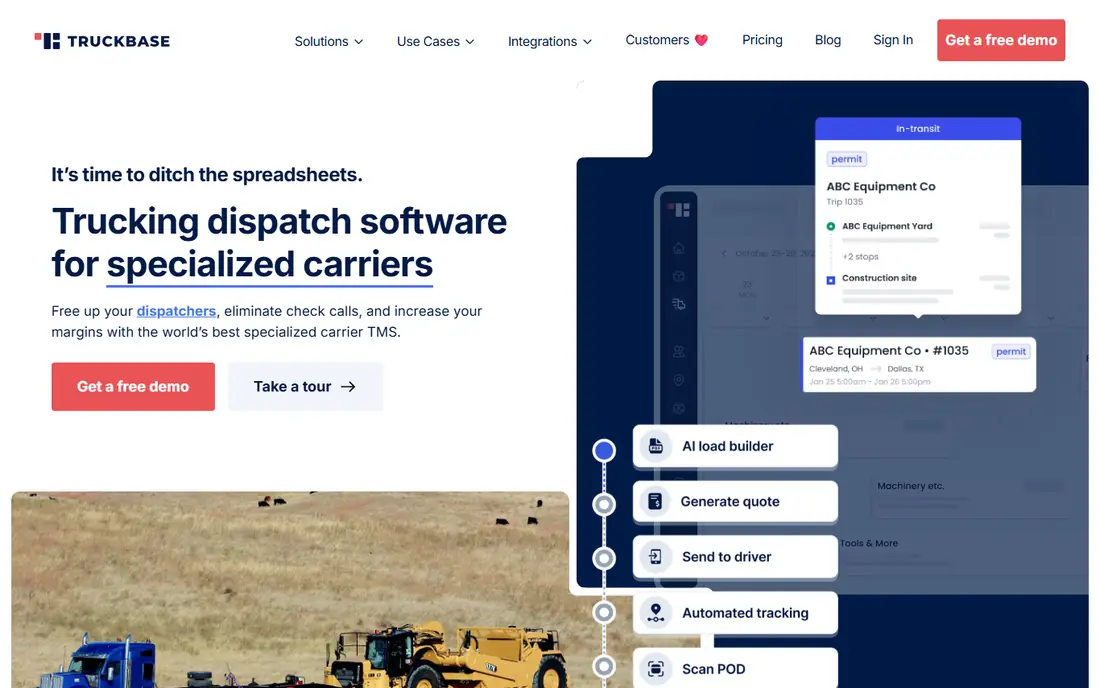
Truckbase is our pick for most small to mid-sized carriers because it pairs a modern, easy-to-learn dispatch system with flexible pricing. The vendor lists a minimum price of $290 per month billed annually, with options to pay per truck, per driver, per load, or at a flat annual rate, which lets seasonal carriers choose a model that fits their operation. Free live onboarding, cloud updates, and US-based support are included, which helps smaller teams that lack IT staff.
The minimum price is the catch for a single-truck owner-operator, who may find a cheaper tool below. Some plans also require a minimum number of seats, so confirm the total for your team size. For a growing carrier that wants dispatch, billing, and settlements in one intuitive system, Truckbase is a strong first choice.
- Intuitive dispatch workflow
- Flexible pricing by truck, driver, load, or flat rate
- Free live onboarding and US-based support
- Minimum price of $290 per month may be high for a single truck
- Some plans need a minimum seat count

Rose Rocket suits small to mid-sized carriers and third-party logistics firms that want a modern TMS without a long implementation. Its order management, dispatching, and customer portal give clients live tracking and document access, which improves the customer experience without extra tools. A driver mobile app keeps drivers in the loop, and product updates arrive every two weeks, so the platform keeps improving.
Customization is the limit: firms with very complex workflows or unusual rating structures may find it less flexible than larger systems. Published comparisons put its starting price at $233 per month, which is easy to budget. If ease of use and customer-facing tools matter more than deep customization, Rose Rocket is a solid pick.
- Modern interface that is easy to learn
- Customer and partner portals
- Driver mobile app and consolidated billing
- Limited customization for complex workflows
- Some users report a learning curve at first
AscendTMS is the most accessible starting point in this list, with a free plan for teams under three users that covers basic shipment management, plus a premium plan at $99 per user per month. It includes load management, document handling, asset tracking, and IFTA filing that pulls fuel, route, and state data automatically, which saves real time at tax season. A free truckload rate index also helps small carriers check lane rates before accepting a load.
The free plan will not suit a larger fleet, and very high-end transport operations may need more customization than AscendTMS offers. For a new carrier, a dispatcher starting out, or a tiny team testing a TMS for the first time, the free entry point makes AscendTMS the obvious place to start.
- Free plan for teams under three users
- IFTA tax filing included
- Free truckload rate index
- Premium features need the paid plan
- Less depth for very large operations
Datatruck prices by truck count rather than per user: Basic is $99 per month for one to six trucks, Pro is $299 for seven to 25 trucks, and Big Fleet is $499 for 26 to 40 trucks, with a free trial on paid plans. That model is easy to budget and often cheaper than per-user pricing for a fleet with several office staff. Its AI tools read rate confirmations to create loads quickly, and its accounting module tracks profit per truck, per driver, and per lane.
AI add-ons, such as the AI Dispatcher at $399 per month, cost extra, so price the full package you actually need. Datatruck is also newer than legacy vendors, so ask for references from fleets your size. For a carrier that wants clear, truck-count pricing with modern AI features, Datatruck is a strong value pick.
- Clear pricing by truck count
- AI load import from rate confirmations
- Accounting and dispatch on one database
- AI add-ons cost extra
- Newer vendor than McLeod or PCS
ITS Dispatch is built for owner-operators and very small carriers, with a starting price of $50 per month in published comparisons. It covers the essentials: dispatching loads, tracking, invoicing, and driver settlements, without the complexity of a large TMS. That focus makes it easy to learn and cheap to run for a one-truck or few-truck operation.
The simplicity is also its limit. A growing fleet that needs customer portals, advanced accounting, or complex integrations will outgrow it. But for an owner-operator who wants to replace spreadsheets with a proper dispatch tool at a low monthly cost, ITS Dispatch is the most affordable serious option here.
- Low starting price of $50 per month
- Built for owner-operators
- Covers dispatch, billing, and driver settlements
- Simpler feature set than full TMS platforms
- Less suited to large multi-user fleets
PCS Software suits established carriers and brokerages that want dispatch, fleet management, and accounting under one roof. Its integrated accounting module handles payroll, invoice settlements, and freight reconciliation, with connections to QuickBooks and Dynamics 365, and its mobile app gives drivers two-way messaging and electronic proof of delivery. That depth matters when billing and settlements get complex.
The price is the main barrier: published comparisons put it at $410 per user per month, so the total climbs fast with a larger dispatch team. Users also describe the interface as dated. If your operation needs full accounting depth and you can pay per user, PCS is a capable heavy-duty choice. Smaller carriers should start with Truckbase or Datatruck first.
- Dispatch, accounting, and fleet management in one system
- Strong QuickBooks integration
- Driver app with proof of delivery
- High per-user price
- Interface feels dated to some users
McLeod Software is the enterprise standard for many large carriers and brokerages, covering dispatch, load planning, brokerage, fleet management, and accounting in one system. Its depth and integration range suit firms with complex operations, multiple terminals, and large driver pools. Many carriers that outgrow a small TMS eventually evaluate McLeod, which says something about its staying power in the industry.
Pricing is quoted and enterprise-level, and implementation takes planning and training. A small carrier should not start here. For a large fleet that needs a proven, full-featured platform and can fund an enterprise rollout, McLeod remains the benchmark against which other large systems are judged.
- Long track record with large fleets
- Broad dispatch, brokerage, and accounting coverage
- Deep integrations
- Quote-based enterprise pricing
- Implementation effort for large deployments
Tailwind TMS offers an all-in-one system for small and mid-sized carriers, covering dispatch, order entry, billing, driver settlements, and customer management in one place. That breadth helps a growing carrier avoid stitching together separate tools for each job, and its driver app keeps communication in one channel. It is a practical middle ground between a simple owner-operator tool and a full enterprise platform.
Pricing is quoted rather than published, so get a written quote for your fleet size and user count before comparing it to Truckbase or Datatruck. The vendor is also smaller than the enterprise names, so ask for references from similar carriers. For a small carrier that wants one system for the whole back office, Tailwind is worth a demo.
- All-in-one dispatch, billing, and settlements
- Driver app and customer tools
- Suited to small and mid-sized carriers
- Quote-based pricing
- Smaller vendor than McLeod or PCS
Alvys is a modern cloud TMS built for carriers, brokers, and shippers, with dispatch, accounting, and workflow automation in one system. Its cloud design and integrations suit firms that want a current, web-based platform rather than a legacy desktop system, and its coverage across carrier and broker workflows helps firms that do both. Automation features aim to cut manual entry on loads, invoices, and settlements.
Pricing is quoted, and as a newer platform, its fit depends on your freight type, so ask for references from carriers like yours and test it on your typical loads. For a firm that wants a modern cloud TMS and is willing to evaluate a newer vendor, Alvys is a forward-looking final option for this list.
- Modern cloud design
- Covers carriers, brokers, and shippers
- Workflow automation and integrations
- Quote-based pricing
- Newer platform, so check references for your freight type
How we picked these
We compared official pricing pages, product pages, and public reviews for dispatch software used by US carriers in 2026. We favored tools with real dispatch, driver app, billing, and settlement features, and we mixed owner-operator, small carrier, and enterprise options so different fleet sizes can find a fit. Where a vendor does not publish a price, we wrote See website, and we noted whether pricing is per user, per truck, or flat, since that changes the total cost. We did not test these tools on live loads, and we based our judgment on vendor documentation and public user feedback.
What to check before you buy
Start with your fleet size and freight type. An owner-operator needs simple dispatch and billing, a small carrier needs driver apps and settlements, and a large fleet needs accounting depth and integrations. Run a real week of loads through any trial, including a difficult load with changes, since a demo on easy loads hides workflow problems.
Pricing model and total cost
Compare the total for your team, not the headline price. A $99 per user plan for five users costs $495 per month, while a $290 flat plan may be cheaper, and a $99 truck-count plan may beat both for a small fleet. Ask what is included: ELD integration, load board access, accounting, and support often cost extra, and seat minimums can raise the real price.
Driver app and integrations
Check that the driver app works on your drivers' phones, supports document scanning and proof of delivery, and connects to your ELD provider. Also confirm integrations with load boards, factoring companies, and accounting software you already use, since a TMS that does not connect to your existing tools will create double entry.
Sources
Frequently asked questions
What is the best trucking dispatch software?
Truckbase is our top pick for most small to mid-sized carriers, thanks to its intuitive workflow and published $290 per month minimum. AscendTMS is best for very small teams starting free, Datatruck is best for fleets priced by truck count, and McLeod is best for large carriers.
What is the best dispatch software for owner-operators?
ITS Dispatch, starting at $50 per month, is a strong owner-operator choice, with dispatch, billing, and settlements at a low cost. AscendTMS is another good option, since its free plan covers teams under three users and its premium plan is $99 per user per month.
What is the best truck dispatching software for small carriers?
Truckbase and Rose Rocket are both strong for small carriers, with Truckbase starting at $290 per month and Rose Rocket at $233 per month. Datatruck is also worth comparing, since its $99 per month Basic plan covers fleets up to six trucks.
How much does trucking dispatch software cost?
Prices range from free for AscendTMS small teams and $50 per month for ITS Dispatch, up to $410 per user per month for PCS and quote-based enterprise pricing for McLeod. Always compare the total for your fleet size, since per-user, per-truck, and flat pricing give very different totals.
Do I need a TMS, or can I use spreadsheets?
Spreadsheets work for a single truck with a few loads a week, but they break down as volume grows, since tracking, billing, and settlements get tangled. A TMS centralizes loads, documents, and payments, which saves time and reduces billing errors once you run several trucks or loads per week.
What integrations should trucking dispatch software have?
Look for ELD integration for tracking, load board connections for finding freight, document scanning in the driver app, and accounting or factoring integrations for billing and settlements. If you already use specific tools, confirm those integrations before you buy, since gaps mean double entry.