How Many Grams in a Cup? Conversions by Ingredient
 By Shihab Mia June 20, 2026 6 min read
Quick answer
There is no single number because a cup measures volume and grams measure weight. The grams in one US cup depend on the ingredient: water is about 236 g, all-purpose flour about 125 g, and granulated sugar about 200 g. Always match the ingredient to its own conversion.
It feels like a cup should weigh a fixed number of grams, but it never does. A cup is a measure of volume, the amount of space something fills. A gram is a measure of weight. Because every ingredient has a different density, the same cup of space holds a different mass. A cup of feathers and a cup of lead share a volume but not a weight, and the same logic applies to flour, sugar and water in your kitchen.
Why a cup is not a fixed number of grams
A US cup is defined as roughly 236.6 milliliters of volume. Fill that space with water and you get about 236 grams, because water has a density very close to 1 gram per milliliter. Fill the same cup with flour and you get far less, around 125 grams, because flour is light and full of air. Fill it with sugar and you land near 200 grams, because sugar grains pack more tightly than flour.
This is the single most important idea in kitchen conversions: grams and cups are not interchangeable without knowing the ingredient. That is also why serious bakers prefer a scale. If you want to understand the related weight units, our guide on how many grams are in an ounce breaks down the weight side, while how many ounces are in a cup covers the volume side.
Grams in a cup by common ingredient
The chart below gives approximate grams for one level US cup of everyday baking and cooking ingredients. Values are rounded and can vary by brand, humidity and how you fill the cup, but they are accurate enough for almost any recipe.
Approximate weight of 1 US cup by ingredient
| Ingredient | Grams per cup | Notes |
|---|---|---|
| Water | 236 g | Density near 1 g per ml |
| Milk | 244 g | Slightly heavier than water |
| All-purpose flour | 125 g | Spoon and level, do not pack |
| Bread flour | 127 g | Very close to all-purpose |
| Granulated sugar | 200 g | Packs tighter than flour |
| Brown sugar (packed) | 220 g | Press firmly into the cup |
| Powdered sugar | 120 g | Light and airy |
| Butter | 227 g | Equal to 2 US sticks |
| Honey | 340 g | Dense and heavy |
| Rolled oats | 90 g | Very light and bulky |
| Cocoa powder | 100 g | Sift before measuring |
| Rice (uncooked) | 185 g | Long grain, white |
The three numbers worth memorizing
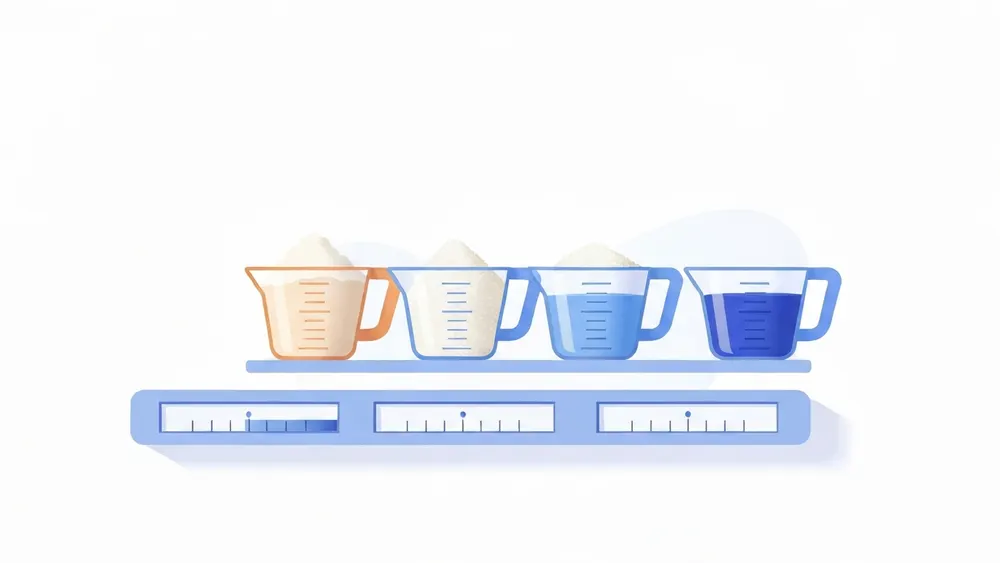
If you only remember three conversions, make them the workhorses of baking. They cover most recipes you will ever follow.
- Water: 1 cup is about 236 g. This also works as a rough guide for milk, juice and most thin liquids.
- All-purpose flour: 1 cup is about 125 g. This is the standard used by most modern recipe sites and cookbooks.
- Granulated sugar: 1 cup is about 200 g. Brown sugar is heavier when packed, around 220 g.
How to convert cups to grams: a worked example
Say a recipe calls for 2 cups of all-purpose flour and you want the weight in grams. Here is the simple process.
- Identify the ingredient. In this case it is all-purpose flour.
- Find the grams per cup for that ingredient. Flour is about 125 g per cup.
- Multiply the grams per cup by the number of cups: 125 g times 2 cups.
- The answer is 250 g of flour.
- For a fraction, multiply the same way. Half a cup of sugar is 200 g times 0.5, which equals 100 g.
That is the entire method: grams per cup multiplied by the number of cups. If you would rather skip the arithmetic, the cooking converter below handles any ingredient and amount instantly. For a deeper look at scaling whole recipes, our piece on how many tablespoons are in a cup pairs well with this one.
How to measure flour so the grams are right
Flour is the ingredient where cup measurements go wrong most often, because flour compresses. The widely used standard of 125 grams per cup assumes the spoon-and-level method, not scooping straight from the bag. To hit that number reliably, stir the flour first to loosen it, spoon it gently into the cup until it mounds over the rim, then sweep the excess off flat with the back of a knife. Never tap, shake or press the cup.
The difference is large enough to ruin a recipe. A dip-and-scoop cup of all-purpose flour can weigh 150 to 160 grams, roughly 25 percent more than a spooned cup. Across a few cups, that extra flour turns cakes dry and dense and makes bread tough. This is exactly why professional bakers list flour in grams, and it is the strongest argument for keeping a small kitchen scale on the counter.
Butter, sticks and other tricky ingredients
Some ingredients have their own quirks. One US cup of butter is 227 grams, the same as two standard sticks, which is why butter wrappers print tablespoon and gram markings. Sticky liquids like honey and syrup are dense, so a cup weighs around 340 grams, far more than water. Chopped or grated foods such as cheese or nuts vary wildly with piece size, so a cup of finely grated cheese weighs more than a cup of coarse shreds. When precision matters with these, weigh in grams rather than trusting a cup.
Common mistakes to avoid
- Using one number for every ingredient. A cup of honey weighs nearly three times a cup of oats. Always look up the specific ingredient.
- Packing flour into the cup. Scooping straight from the bag compacts flour and can add 20 to 30 percent extra weight. Spoon it in and level the top.
- Confusing US and metric cups. A US cup is about 236 ml, while a metric cup is 250 ml, so grams will differ slightly between recipe systems.
- Mixing up dry and liquid measuring tools. They hold the same volume, but the right tool makes leveling and pouring accurate.
- Trusting volume for precise baking. For bread, pastry and anything that needs reliability, weigh in grams rather than measuring by cup.
US cups vs metric cups
The cup itself is not the same size everywhere. A US customary cup is about 236.6 ml, the cup used in most American recipes. A metric cup, common in Australia and parts of Europe, is exactly 250 ml. The UK historically used an imperial cup of about 284 ml, though modern British recipes usually rely on grams and milliliters instead.
Cup size by region
| Cup type | Volume | Water weight |
|---|---|---|
| US customary cup | 236.6 ml | about 236 g |
| Metric cup | 250 ml | about 250 g |
| UK imperial cup | 284 ml | about 284 g |
Good to know
When a recipe gives weights in grams, it removes this whole problem. Grams are universal, so a scale lets you follow recipes from any country without worrying about which cup the author used. When in doubt, weigh it.
Convert cups to grams instantly
Rather than memorize a chart, let the tool do it. Pick your ingredient, enter the cups, and get the exact grams.
🥄 Try the free tool Cooking Measurement Converter Free cooking converter for cups, tablespoons, teaspoons, fluid ounces, pints, quarts, ml and litres. Instant US customary kitchen measurement conversions.The bottom line is simple: a cup is volume and grams are weight, so the conversion always depends on what you are measuring. Keep the three core numbers handy, water at 236 g, flour at 125 g and sugar at 200 g, and reach for a scale whenever precision matters.
Frequently asked questions
How many grams are in a cup?
It depends on the ingredient, because a cup measures volume and grams measure weight. One US cup of water is about 236 g, all-purpose flour about 125 g, and granulated sugar about 200 g. Always use the conversion for your specific ingredient.
How many grams of flour are in a cup?
One US cup of all-purpose flour weighs about 125 grams when you spoon it in and level the top. If you scoop straight from the bag and pack it, you can end up with 150 grams or more, which is why weighing flour gives more reliable baking results.
How many grams of sugar are in a cup?
One US cup of granulated sugar weighs about 200 grams. Packed brown sugar is heavier at around 220 grams because it presses together, while light, airy powdered sugar is only about 120 grams per cup.
Why is a cup of water not 250 grams?
A US customary cup is about 236.6 ml, and water weighs roughly 1 gram per ml, so a US cup of water is about 236 grams. The 250 gram figure comes from a metric cup, which is 250 ml. The difference is the cup size, not the water.
Is it better to measure in cups or grams?
Grams are more accurate and consistent. Cups depend on how you fill them and which cup size you use, which introduces error. For precise baking like bread and pastry, weigh ingredients in grams. For casual cooking, cups are fast and usually good enough.
How do I convert cups to grams?
Find the grams per cup for your ingredient, then multiply by the number of cups. For example, 2 cups of flour at 125 grams per cup equals 250 grams. A cooking converter does this automatically for any ingredient and amount.
How many grams of butter are in a cup?
One US cup of butter weighs 227 grams, which equals two standard American sticks. Half a cup is 113 grams, or one stick, and a quarter cup is about 57 grams. Most butter wrappers print these gram and tablespoon markings on the side to make measuring easier.
Is 250 grams equal to 1 cup?
Only for some ingredients. A metric cup of water is 250 ml and weighs about 250 grams, so the two line up for water. But a US cup is 236 grams of water, and a cup of flour is just 125 grams. The 250 gram rule only holds for water in a metric cup.
How many grams are in half a cup?
Take the grams per cup for your ingredient and halve it. Half a US cup of water is about 118 grams, all-purpose flour is about 63 grams, granulated sugar is about 100 grams, and butter is 113 grams. The exact number always depends on which ingredient you are measuring.