How Many Tablespoons Are in a Cup?
 By Shihab Mia June 20, 2026 5 min read
Quick answer
There are 16 tablespoons in 1 US cup. So half a cup is 8 tablespoons, a third of a cup is 5 tablespoons plus 1 teaspoon, and a quarter cup is 4 tablespoons.
This single fact rescues more recipes than almost any other kitchen conversion. When your measuring cups are dirty, missing, or buried in the dishwasher, your measuring spoons can fill in. It also saves you when a recipe scales down and you suddenly need an awkward part of a cup. Because cups and tablespoons are both volume units, the 16 to 1 ratio holds true for wet and dry ingredients alike, from water and oil to flour and sugar.
Where the number 16 comes from
A US cup is defined as exactly 16 tablespoons because the customary system was built for halving and doubling.
The US customary system defines a cup as exactly 16 tablespoons, and each tablespoon as 3 teaspoons. Multiply those together and you get 48 teaspoons in a cup. In fluid ounces, one US cup is 8 fluid ounces, which means every tablespoon is half a fluid ounce. These tidy relationships are not an accident. The customary measuring system was built around halving and doubling, so a cup splits cleanly into halves, quarters and eighths without any messy decimals.
That design is why baking by volume feels so natural in American kitchens. You can go from 1 cup down to 1 tablespoon just by repeatedly halving, and almost every step lands on a whole number of spoons. It also means you rarely have to reach for a calculator mid recipe, since the pattern is easy to hold in your head once you have used it a few times.
Cup to tablespoon chart
Here is every common cup fraction converted to tablespoons, teaspoons and fluid ounces in one place.
| Cups | Tablespoons | Teaspoons | Fluid ounces |
|---|---|---|---|
| 1/16 cup | 1 tbsp | 3 tsp | 0.5 fl oz |
| 1/8 cup | 2 tbsp | 6 tsp | 1 fl oz |
| 1/4 cup | 4 tbsp | 12 tsp | 2 fl oz |
| 1/3 cup | 5 tbsp + 1 tsp | 16 tsp | 2.67 fl oz |
| 1/2 cup | 8 tbsp | 24 tsp | 4 fl oz |
| 2/3 cup | 10 tbsp + 2 tsp | 32 tsp | 5.33 fl oz |
| 3/4 cup | 12 tbsp | 36 tsp | 6 fl oz |
| 1 cup | 16 tbsp | 48 tsp | 8 fl oz |
Notice that almost every row is a whole number of tablespoons. The exceptions are the thirds. One third of a cup is 5 tablespoons plus 1 teaspoon, and two thirds is 10 tablespoons plus 2 teaspoons. That is because 16 does not divide evenly by 3, so you are left with a leftover teaspoon. Everything else divides cleanly, which is exactly what makes the system so spoon friendly. If you often work with multiple cups, just multiply the top row: 2 cups is 32 tablespoons, and 3 cups is 48 tablespoons.
US vs UK and metric differences
The 16 tablespoon rule only holds for US cups, so a foreign recipe can quietly change the math.
The 16 tablespoon rule is a US customary rule. Once you cross borders, the numbers shift, and that is where a lot of baking disasters begin. Here are the key differences worth knowing before you trust a foreign recipe.
- US cup: 240 ml and 16 US tablespoons (each tablespoon is about 14.79 ml).
- Metric cup (Australia, New Zealand): 250 ml, and the metric tablespoon is 20 ml, so a metric cup is only about 12.5 metric tablespoons.
- UK: the modern UK tablespoon is 15 ml, and there is no single legally fixed cup, so British recipes usually rely on weight in grams instead.
- Australian tablespoon: 20 ml, larger than almost everywhere else, which is the single most common reason imported recipes go wrong.
- Canada: a metric cup is often taken as 250 ml with a 15 ml tablespoon, so about 16.7 tablespoons per cup, close to the US figure but not identical.
The practical takeaway is simple. If a recipe comes from the US, assume 16 tablespoons per cup. If it comes from Australia or New Zealand, double check, because their bigger 20 ml tablespoon changes the math. When in doubt, weigh your ingredients in grams, since a gram is a gram everywhere. For the heavier conversions, our cooking converter and the related grams in an ounce guide will keep you honest.
A worked example: scaling a recipe down
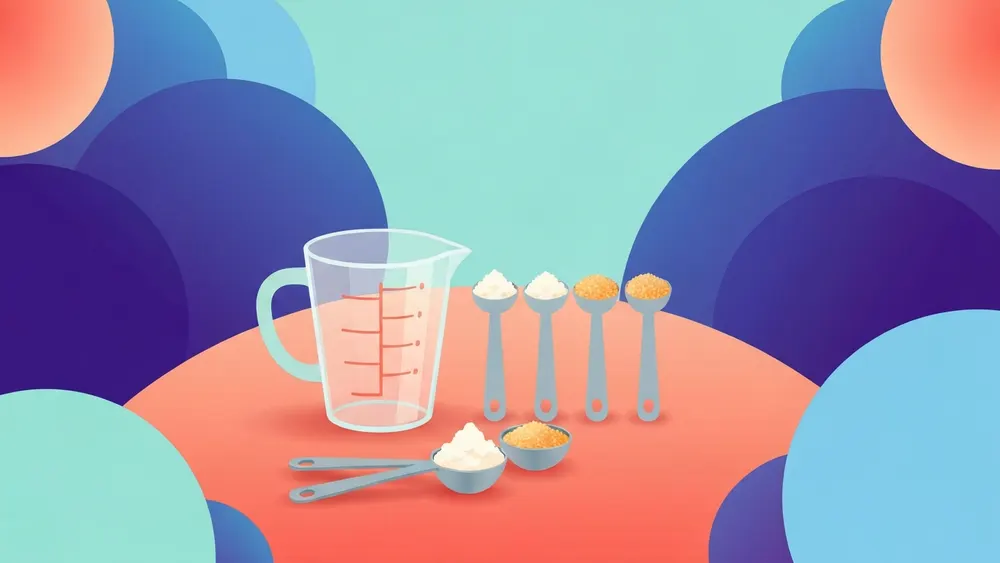
To scale down, convert each cup amount to tablespoons first, then take the fraction you need.
Say a pancake recipe calls for 1 cup of flour, 3/4 cup of milk and 1/4 cup of sugar, but you only want to make a third of the batch. Convert each amount to tablespoons before you cut it down. One cup of flour is 16 tablespoons, so a third of that is about 5 tablespoons plus 1 teaspoon. The 3/4 cup of milk is 12 tablespoons, and a third of 12 is a clean 4 tablespoons. The 1/4 cup of sugar is 4 tablespoons, and a third of that is roughly 1 tablespoon plus 1 teaspoon.
Working in tablespoons keeps the awkward fractions manageable, because you are dividing small whole numbers instead of fighting with a third of a cup. This is the same trick professional kitchens use when they halve or third a recipe on the fly.
Practical kitchen examples
Conversions are easiest to remember when you tie them to real cooking. A few situations come up again and again.
- You need 3/4 cup of melted butter but only own spoons: scoop 12 tablespoons, since 8 plus 4 gets you there.
- A salad dressing calls for 1/4 cup olive oil: that is 4 tablespoons, easy to count straight into the bowl.
- Halving a recipe that uses 1 cup of sugar: you want 8 tablespoons, the same as 1/2 cup.
- Stick of US butter math: one stick is 8 tablespoons, which is exactly half a cup, so two sticks make a full cup.
- A cocktail or sauce that needs 2 tablespoons: that is 1/8 cup, or one fluid ounce, handy for scaling drinks up.
Keeping the butter stick fact in mind is a shortcut on its own. Because each standard US stick is marked in tablespoons on the wrapper, you can measure cups of butter without any cup at all.
Common mistakes to avoid
Most measuring errors are not about the numbers, they are about technique and assumptions. Watch out for these.
- Heaped instead of level spoons: a heaped tablespoon can hold nearly double a level one, which wrecks baking. Always level off with a flat edge.
- Mixing up tablespoons and teaspoons: there are 3 teaspoons in a tablespoon, so swapping them triples or thirds your amount. Salt and baking soda are unforgiving here.
- Assuming all tablespoons are equal: an Australian 20 ml tablespoon is bigger than a US 14.79 ml one, so a foreign recipe can throw your ratios off.
- Packing versus spooning dry goods: scooping flour packs it down and adds extra weight, while spooning it in stays lighter. Recipes assume one method, usually the lighter one.
- Forgetting the leftover teaspoon in thirds: 1/3 cup is not exactly 5 tablespoons, it is 5 tablespoons plus 1 teaspoon. Rounding it off slowly drifts your recipe off target.
Good to know: dry vs liquid measuring
The 16 tablespoon rule is about volume, so it stays the same whether an ingredient is wet or dry.
People sometimes worry that a cup of flour and a cup of water hold a different number of tablespoons. They do not. A cup is always 16 tablespoons of space, no matter what fills it, because tablespoons and cups both measure volume rather than weight. What changes with the ingredient is the weight in grams, not the tablespoon count. A cup of flour weighs about 120 grams while a cup of water weighs about 240 grams, yet both are still 16 tablespoons.
The reason cooks keep separate dry and liquid measuring cups is accuracy, not a difference in the ratio. Liquid cups have a spout and let you fill to a line at eye level, while dry cups are made to be filled and leveled off with a straight edge. For the smaller end of the scale, the teaspoons in a tablespoon guide covers how spoons break down further.
Convert any amount instantly
Once you move beyond simple cup fractions, the mental math gets fiddly, especially when grams, millilitres and ounces enter the picture. Rather than juggling several conversions at once, let a tool do it. The cooking converter below switches between tablespoons, cups, teaspoons, millilitres and grams in one step. You can also cross check volumes with our ounces in a cup guide when a recipe lists fluid ounces instead.
🥄 Try the free tool Cooking Measurement Converter Free cooking converter for cups, tablespoons, teaspoons, fluid ounces, pints, quarts, ml and litres. Instant US customary kitchen measurement conversions.Frequently asked questions
How many tablespoons are in a cup?
There are 16 tablespoons in 1 US cup. From there, half a cup is 8 tablespoons, a third of a cup is 5 tablespoons plus 1 teaspoon, and a quarter cup is 4 tablespoons. The 16 to 1 ratio is exact for both wet and dry ingredients because cups and tablespoons are both volume units.
How many tablespoons in 1/3 cup?
One third of a US cup is 5 tablespoons plus 1 teaspoon, which works out to roughly 5.33 tablespoons. It is not a clean whole number because 16 does not divide evenly by 3. Do not round it down to 5 tablespoons, since that leftover teaspoon matters in baking.
How many tablespoons in 1/2 cup and 3/4 cup?
Half a US cup is exactly 8 tablespoons, and three quarters of a cup is 12 tablespoons. Both divide cleanly because 16 splits evenly into halves and quarters. That makes these two fractions the easiest to measure with spoons alone when a measuring cup is not handy.
How many teaspoons are in a cup?
There are 48 teaspoons in 1 US cup. The math is simple: each cup holds 16 tablespoons, and each tablespoon holds 3 teaspoons, so 16 times 3 gives you 48. That makes a quarter cup equal to 12 teaspoons and a half cup equal to 24 teaspoons.
Is a US tablespoon the same as a metric tablespoon?
No. A US tablespoon is about 14.79 ml, the UK tablespoon is 15 ml, and the Australian metric tablespoon is 20 ml. Because of that larger Australian spoon, a 250 ml metric cup is only about 12.5 metric tablespoons, not 16. Always check which system a recipe uses.
Does the number of tablespoons change for dry ingredients?
No. A cup always holds 16 tablespoons whether it is filled with flour, sugar, water or oil, because both units measure volume. What changes between ingredients is the weight in grams, not the tablespoon count. So the 16 to 1 ratio is safe to use for any ingredient in a US recipe.
How many tablespoons are in a stick of butter?
One standard US stick of butter is 8 tablespoons, which is exactly half a cup or 4 fluid ounces. That means two sticks make a full cup of butter. Most US butter wrappers are printed with tablespoon markings, so you can slice off the amount you need without a measuring cup.
How do I convert a UK recipe that uses cups?
UK recipes rarely fix a cup size by law, so the safest approach is to weigh ingredients in grams instead of measuring by volume. If you must use cups, treat the UK tablespoon as 15 ml and a cup as roughly 240 to 250 ml, then verify with a cooking converter to avoid drift.