How to Calculate Cubic Feet: Formula, Steps and Examples
 By Shihab Mia June 20, 2026 8 min read

Quick answer
To calculate cubic feet, multiply length by width by height, with all three measurements in feet. A box that is 3 feet long, 2 feet wide and 2 feet tall is 3 x 2 x 2 = 12 cubic feet. If you measured in inches, multiply the three inch numbers together and then divide by 1,728 to get cubic feet.
Cubic feet measure volume, the amount of space inside a three dimensional object. You reach for it constantly: sizing a moving box or storage unit, ordering concrete or mulch, checking whether a fridge or freezer fits your needs, or working out how much air a room holds. The math is short and forgiving once you know the formula and the one conversion factor that turns inches into cubic feet. This guide walks through both, with worked examples and the small slips that lead to wrong answers.
The cubic feet formula
The formula for cubic feet is simply cubic feet = length (ft) x width (ft) x height (ft). Volume is three measurements multiplied together, which is why the unit is cubic feet rather than square feet. One cubic foot is a cube that measures one foot on every side, and the total tells you how many of those cubes would fill the space.
Notice the difference from area. Square footage uses two measurements, length times width, and describes a flat floor. Cubic footage adds a third measurement, height or depth, and describes the room or box that sits on top of that floor. If you are still firming up the flat version first, our guide to how to calculate square feet covers the two dimensional case, and cubic feet is the natural next step.
The one rule that matters is that all three numbers must be in the same unit, feet, before you multiply. Mixing feet and inches in the same calculation is the single most common way people get a wrong answer.
How to calculate cubic feet step by step
For any rectangular box or room, the process takes under a minute. Here is the full sequence using a storage box that measures 4 feet long, 3 feet wide and 2 feet tall.
- Measure the length in feet. Say it is 4 feet.
- Measure the width in feet. Say it is 3 feet.
- Measure the height or depth in feet. Say it is 2 feet.
- Multiply all three together: 4 x 3 x 2 = 24.
- Add the unit. The box holds 24 cubic feet.
That is the entire method for any rectangular space. A perfect cube is just the special case where all three sides are equal, so a 2 by 2 by 2 box is 2 x 2 x 2 = 8 cubic feet. The order you multiply in never changes the result, so you can measure the sides in whatever order is convenient.
A quick reality check helps on bigger spaces. Estimate the volume in your head first, then compare it to the calculated figure. A single storage room is rarely more than a few hundred cubic feet, so if your arithmetic returns tens of thousands, you almost certainly mixed inches into a feet calculation somewhere. This one glance catches most order-of-magnitude errors before they turn into a wrong concrete order or an oversized storage unit rental.
Common rectangular spaces and their cubic feet
| Space | Dimensions (L x W x H) | Cubic feet |
|---|---|---|
| Small moving box | 1.5 x 1.5 x 1.5 ft | 3.4 cu ft |
| Standard moving box | 1.5 x 1.5 x 1.3 ft | 4.5 cu ft |
| Large moving box | 2 x 2 x 2 ft | 8 cu ft |
| 5 x 5 storage unit (8 ft ceiling) | 5 x 5 x 8 ft | 200 cu ft |
| 10 x 10 storage unit (8 ft ceiling) | 10 x 10 x 8 ft | 800 cu ft |
| Small bedroom | 10 x 10 x 8 ft | 800 cu ft |
Converting inches to cubic feet (the 1,728 rule)
Most real objects get measured in inches, not whole feet, so this is the conversion you will use most. There are 12 inches in a foot, and because a cubic foot is 12 inches in every direction, one cubic foot contains 12 x 12 x 12 = 1,728 cubic inches. So to go from inches to cubic feet, multiply the three inch measurements together to get cubic inches, then divide by 1,728.
Worked example. A package measures 24 inches long, 18 inches wide and 12 inches tall. Multiply: 24 x 18 x 12 = 5,184 cubic inches. Now divide by 1,728: 5,184 / 1,728 = 3 cubic feet. You could also convert each side to feet first (24 in = 2 ft, 18 in = 1.5 ft, 12 in = 1 ft) and multiply (2 x 1.5 x 1 = 3), which lands on the same answer. Both routes are correct, so use whichever feels easier.
Cubic inches and feet and inches converted to cubic feet
| Measurement | In cubic inches | In cubic feet |
|---|---|---|
| 12 x 12 x 12 in | 1,728 | 1 cu ft |
| 24 x 12 x 12 in | 3,456 | 2 cu ft |
| 24 x 18 x 12 in | 5,184 | 3 cu ft |
| 36 x 24 x 12 in | 10,368 | 6 cu ft |
| 48 x 36 x 24 in | 41,472 | 24 cu ft |
If you ever need a different volume unit, a few conversions help. One cubic foot is about 7.48 US gallons, roughly 28.3 litres, and 1/27 of a cubic yard, since a cubic yard is 3 feet on each side. To divide cubic feet by 27 gives cubic yards, which is how concrete and topsoil are usually ordered. A quick volume converter handles all of these swaps for you.
Calculating cubic feet for cylinders and odd shapes
Not every space is a box. Water tanks, drums, silos and round planters are cylinders, and the length times width times height rule does not apply directly. For a cylinder, the volume is pi x radius squared x height, with every measurement in feet. The radius is half the diameter, and pi is about 3.1416.
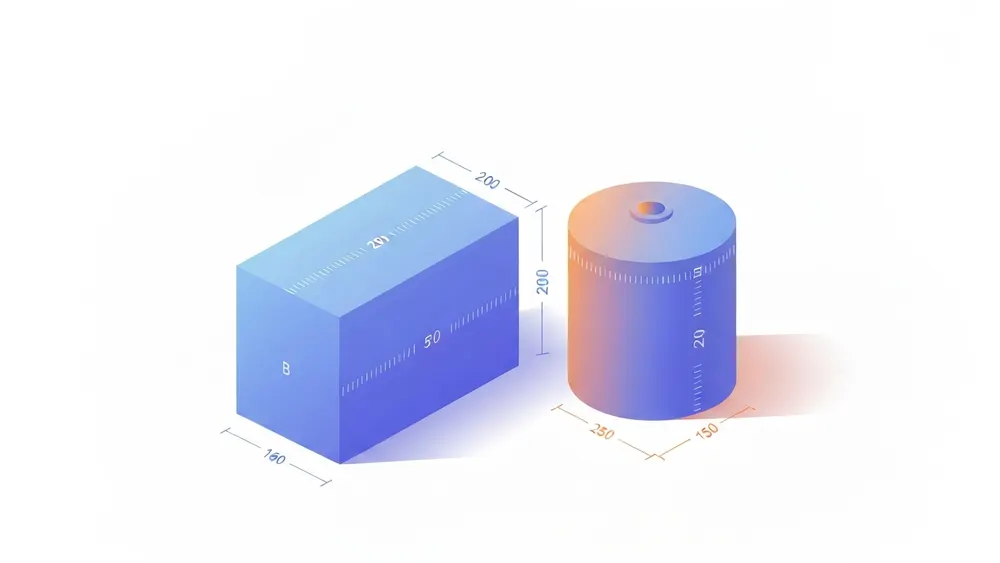
Worked example for a cylinder. A barrel has a radius of 1 foot and a height of 3 feet. Square the radius (1 x 1 = 1), multiply by pi (3.1416 x 1 = 3.1416), then multiply by the height (3.1416 x 3 = 9.42). The barrel holds about 9.42 cubic feet. For an L-shaped room or any irregular space, split it into separate boxes, calculate the cubic feet of each, and add the totals together, exactly the way you would break a floor plan into rectangles for area.
Two more shapes come up often enough to keep handy. For a triangular prism, such as the space under a pitched roof, use 1/2 x base x height x length, again in feet. For a sphere, such as a round tank, use 4/3 x pi x radius cubed. A half-cylinder gutter or trough is just the cylinder formula divided by two. In every case the rule is the same: find the area of the cross section, then multiply by the depth or length that the shape runs. If the cross section changes along the length, slice the object into pieces where it stays constant, size each piece, and add them.
Common mistakes to avoid
The arithmetic is easy, but a handful of habits cause most wrong answers. Run your number against this list before you trust it.
- Mixing feet and inches. Multiplying a length in feet by a width in inches gives a meaningless result. Get all three measurements into the same unit first.
- Dividing by the wrong number. To turn cubic inches into cubic feet you divide by 1,728, not by 12 and not by 144. The 144 figure is for square feet, not cubic feet.
- Forgetting the third dimension. Multiplying only length by width gives square feet, a flat area. Volume always needs the height or depth multiplied in as well.
- Using diameter instead of radius for cylinders. The cylinder formula needs the radius, which is half the diameter. Using the full diameter overstates the volume four times over.
- Rounding too early. Round only at the final step. Rounding each measurement first lets small errors compound across a large space.
- Confusing cubic feet with cubic yards. Suppliers of concrete and soil often quote cubic yards. Divide your cubic feet by 27 before you place that kind of order.
Good to know: where cubic feet matters
Cubic feet shows up all over daily life. Refrigerators, freezers, microwaves and chest coolers are rated by their interior cubic feet, so the number tells you how much they actually hold. Moving companies and self storage units are sized the same way, which is how you judge whether your belongings will fit. Shipping carriers calculate dimensional weight from cubic volume, landscapers sell mulch and soil by the cubic foot or cubic yard, and HVAC sizing depends on the cubic footage of the air in a room.
A few common ratings make the numbers concrete. A typical full size home refrigerator runs about 18 to 26 cubic feet of interior space, a compact dorm fridge sits near 3 to 5 cubic feet, and a standard countertop microwave holds roughly 1 to 2 cubic feet. Bagged garden mulch is usually sold in 2 cubic foot bags, so a bed that needs 12 cubic feet of cover takes six bags. Knowing the volume up front tells you exactly how much to buy instead of guessing and making a second trip.
Typical cubic feet ratings for everyday items
| Item | Typical interior volume |
|---|---|
| Countertop microwave | 1 to 2 cu ft |
| Compact or dorm fridge | 3 to 5 cu ft |
| Full size refrigerator | 18 to 26 cu ft |
| Chest freezer (mid size) | 10 to 16 cu ft |
| Bag of garden mulch | 2 cu ft |
| Cubic yard of concrete or soil | 27 cu ft |
Once you are comfortable with volume, related calculations follow naturally. The same multiply everything idea drives how to calculate volume in any unit, and if you work with round containers a lot, the dedicated breakdown of the volume of a cylinder shows where the pi times radius squared times height formula comes from. Cubic feet is just volume expressed in feet.
Calculate cubic feet instantly
Rather than do the arithmetic by hand, enter your measurements below and let the tool return the volume right away. It converts between cubic feet, cubic inches, cubic yards, litres and gallons, so you can switch units without touching the 1,728 math yourself.
🧪 Try the free tool Volume Converter Free volume converter for liters to gallons, ml to cups, tablespoons and fluid ounces. Type in any unit and the rest update instantly with exact US factors.Cubic feet really comes down to one move: get all three measurements into feet and multiply length by width by height. If you measured in inches, multiply and then divide by 1,728. Split anything irregular into boxes and add the pieces. With that habit, you can size a moving truck, order the right amount of concrete, or compare two fridges with total confidence.
Frequently asked questions
How do you calculate cubic feet?
Multiply length by width by height, with all three measured in feet. A box that is 3 feet long, 2 feet wide and 2 feet tall is 3 x 2 x 2 = 12 cubic feet. The answer is in cubic feet because you are multiplying three measurements that are all in feet.
How do you convert inches to cubic feet?
Multiply the three inch measurements together to get cubic inches, then divide by 1,728. A package that is 24 by 18 by 12 inches is 5,184 cubic inches, and 5,184 divided by 1,728 equals 3 cubic feet. The 1,728 comes from 12 x 12 x 12.
Why do you divide by 1,728 to get cubic feet?
Because one cubic foot is 12 inches on every side, and 12 x 12 x 12 equals 1,728 cubic inches. So every 1,728 cubic inches make up exactly one cubic foot. Dividing your total cubic inches by 1,728 converts the figure into cubic feet.
How many cubic feet is a 2x2x2 box?
A box that is 2 feet long, 2 feet wide and 2 feet tall holds 8 cubic feet, because 2 x 2 x 2 equals 8. Any perfect cube is just length times width times height where all three numbers match, so you cube the side length.
How do you calculate the cubic feet of a cylinder?
Use pi times the radius squared times the height, with every measurement in feet. The radius is half the diameter. A barrel with a 1 foot radius and a 3 foot height is about 3.1416 x 1 x 3, which equals roughly 9.42 cubic feet.
How do you convert cubic feet to cubic yards?
Divide the number of cubic feet by 27, since a cubic yard is 3 feet on each side and 3 x 3 x 3 equals 27. For example, 54 cubic feet divided by 27 is 2 cubic yards. Concrete and soil are often ordered in cubic yards.
What is the difference between cubic feet and square feet?
Square feet measure flat area using two dimensions, length times width, while cubic feet measure volume using three dimensions, length times width times height. A floor is measured in square feet, but the room of air above it is measured in cubic feet. Adding the height is what turns a square footage into a cubic footage.
How many cubic feet are in a gallon?
One US gallon is about 0.134 cubic feet, and one cubic foot holds about 7.48 US gallons. To convert cubic feet to gallons, multiply by 7.48; to go the other way, divide gallons by 7.48. This is useful for sizing tanks, aquariums and water drums.