LinkedIn Alternatives in 2026: 10 Platforms Compared
By ToolNimba Editorial Team November 10, 2026 10 min read

- Top pick
 Indeed
Broad job search
Starting priceFreeCheck out IndeedRead our review - Runner-up
 Glassdoor
Company and salary research
Starting priceFreeCheck out GlassdoorRead our review - Also great
 Wellfound
Startup jobs and hiring
Starting priceFreeCheck out WellfoundRead our review
How we researched this
We compared official pricing and feature pages, app store listings, privacy policies and public user reviews. Prices change, so check the provider's site before you pay.
Key takeaways
- No single platform replaces everything LinkedIn does, so the best alternative depends on whether you want a job, clients, collaborators, or local contacts.
- Indeed and Glassdoor are the strongest picks for pure job searching and company research, and both are free for job seekers.
- Wellfound is the pick for startup jobs, Behance and The Dots suit creative professionals, and GitHub carries real weight for developers.
- Meetup and Alignable win for real-world relationships, since in-person contact still beats a connection count for referrals.
Quick comparison
| Name | Best for | Starting price | Free plan | |
|---|---|---|---|---|
| Indeed | Broad job search | Free | Yes | Visit |
| Glassdoor | Company and salary research | Free | Yes | Visit |
| Wellfound | Startup jobs and hiring | Free | Yes | Visit |
 XING | Professionals in German-speaking Europe | Free | Yes | Visit |
 Meetup | Local and in-person networking | Free | Yes | Visit |
 Behance | Designers and visual creatives | Free | Yes | Visit |
 GitHub | Developers proving their work | Free | Yes | Visit |
 The Dots | Creative, media, and marketing professionals | Free | Yes | Visit |
 Alignable | North American small-business owners | Free | Yes | Visit |
 Handshake | Students and recent graduates | Free | Yes | Visit |
The best LinkedIn alternatives
People leave LinkedIn for different reasons: too much sales spam, too little signal in their industry, or a feed that no longer matches their work. The platforms below each replace a different part of LinkedIn, and the right one depends on which part you actually use.
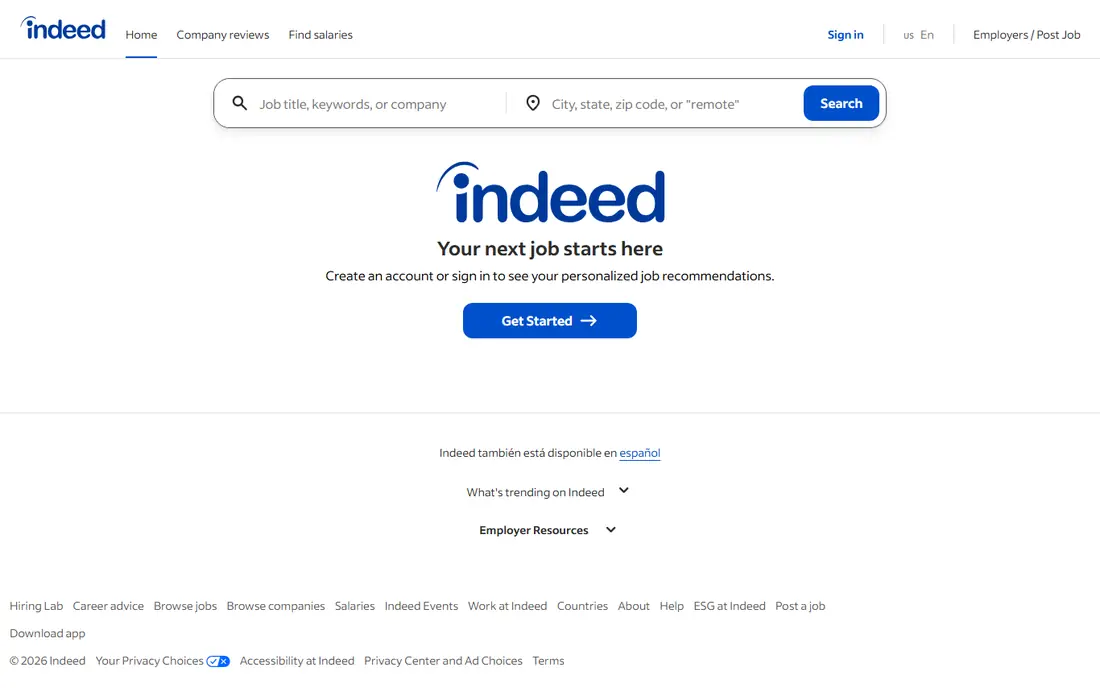
Indeed is the most direct replacement for LinkedIn job searching. It aggregates listings across industries and experience levels, and job seekers can search, set alerts, and apply without paying. Company reviews and salary estimates help you research an employer before applying.
The limit is networking. Indeed is a job marketplace, not a place to build a professional identity or a relationship graph, so it will not replace the connection and content side of LinkedIn. For the job hunt itself, though, its breadth is unmatched, and most job seekers should use it alongside a networking platform rather than instead of one.
- Largest job board for most industries
- Free for job seekers
- Company reviews and salary estimates built in
- Not a professional social network
- Networking features are thin
- Job quality varies by listing
Glassdoor replaces the research half of LinkedIn. Before you apply or accept, you can read employee reviews, see reported salaries for a role, and read interview reports that describe the actual hiring process. That transparency helps you avoid a bad fit that a polished job post would hide.
The job board itself is smaller than Indeed, and some salary data requires you to contribute a review or salary first. Review quality also varies, since a single unhappy employee can skew a small sample. Used as a research tool next to a job board, Glassdoor is one of the most useful free resources in a job search.
- Employee reviews and interview reports
- Salary data by role and company
- Job listings alongside research
- Fewer job listings than Indeed
- Review quality varies
- Some data sits behind a contribution wall
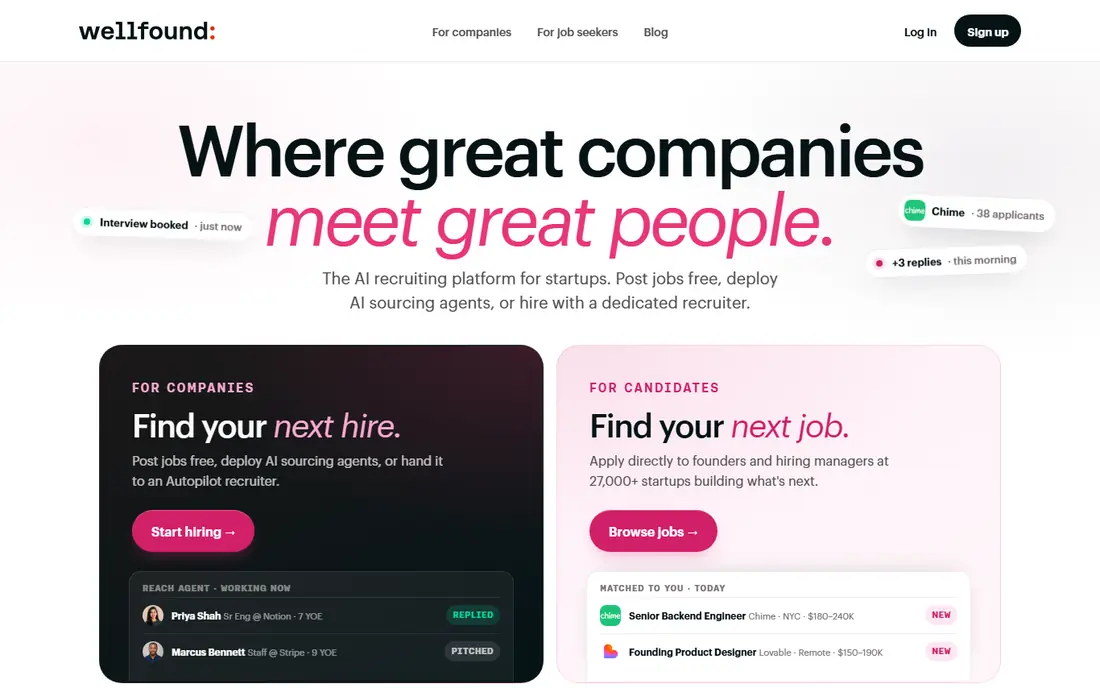
Wellfound, formerly AngelList Talent, is the best LinkedIn alternative for startup work. Candidates see salary ranges and equity upfront, apply directly, and talk with hiring teams without recruiter layers. For founders, it is a hiring channel where candidates already want startup jobs.
The focus is also the limit. If you want a corporate role, a government job, or work outside tech, Wellfound has little for you. But for engineers, designers, product people, and operators who want startup roles, it is more useful than LinkedIn, since every listing is in the world you actually want.
- Free for job seekers
- Startup jobs with salary and equity shown upfront
- Direct contact with hiring teams
- Narrow by design, focused on startups and tech
- Little value outside that world
XING is the closest thing to a regional LinkedIn. In Germany, Austria, and Switzerland, it remains a serious professional network with profiles, job search, recruiter discovery, and events, and many local employers recruit there first. If your career sits in that region, a XING profile can matter as much as a LinkedIn one.
Outside German-speaking Europe, its value drops sharply. The network is regional by design, and it has grown more job-focused over time. For professionals working in or targeting the DACH region, XING is essential. For everyone else, it is a niche addition at best.
- Strongest professional network in Germany, Austria, and Switzerland
- Local jobs and events
- Recruiter discovery
- Regional focus limits value elsewhere
- Increasingly job-first rather than a broad network
Meetup replaces the part of LinkedIn that never worked well online: actual relationships. Local professional groups, industry meetups, and skill-sharing events turn a profile view into a conversation, and repeated attendance builds the trust that produces referrals. For many professionals, one good local group beats a thousand online connections.
The catch is geography. A strong tech scene in one city may have ten active groups, while another city has one quiet one, and quality depends on the organizer. Attending also costs evenings. But if your work depends on referrals and local reputation, Meetup is the most effective alternative on this list.
- Turns online contacts into real relationships
- Groups for almost every profession and interest
- Recurring events build trust
- Quality varies sharply by city and organizer
- Attending takes real time
- Some groups charge fees
Behance is where design work speaks for itself. Designers, illustrators, photographers, and motion artists publish projects, get discovered by agencies and hiring managers, and find freelance and full-time work through the platform. For a visual creative, a strong Behance profile carries more weight than a text resume.
It is not a general professional network. There is no broad job marketplace, and the relationship tools are thin compared with LinkedIn. But for the audience it serves, that does not matter, since the work is the credential. If you make things people can see, Behance should be part of your presence.
- Best portfolio discovery for visual work
- Followed by hiring managers and agencies
- Freelance and full-time leads
- Weak as a conventional resume or relationship graph
- Little value outside visual fields
For software developers, a GitHub profile often does more networking than any social platform. Public code, contributions, and collaboration history show hiring managers what you can actually build, and many technical recruiters search GitHub directly. A developer with strong public work can get inbound interest without posting content.
The limits are clear. GitHub has no broad LinkedIn-style job marketplace, and it means little outside software. It also rewards people with time for public work, which not every good engineer has. Still, for developers, keeping a GitHub profile current is one of the highest-return career habits available.
- Code is the credential
- Collaboration history is public
- Followed by technical hiring managers
- No broad job marketplace
- Profile only matters inside software
- Non-code work is invisible
The Dots is a professional network built for creative, media, fashion, and marketing people. It combines portfolios, job listings, advice, and events in one place, which suits careers that do not fit a standard corporate resume. Individual access is free, and the community feel is closer to a creative industry hub than a general job board.
Its gravity remains strongest in the UK, so professionals elsewhere may find fewer local jobs and contacts. It also has little value outside creative fields. For a creative professional, especially one with UK ties, The Dots is a warmer, more relevant alternative to LinkedIn than the big general platforms.
- Free individual access
- Portfolio plus jobs plus advice and events
- Built for creative careers
- Strongest gravity remains in the UK
- Less relevant outside creative industries
Alignable is the network for the owner of a local business rather than an employee. It focuses on referrals, introductions, groups, and local events, which is how small businesses actually win customers. A plumber, a bakery, or a marketing consultant can find nearby businesses to refer work back and forth.
It is not a job search tool, and a conventional job seeker will find little here. The reach is also smaller than the big platforms. But for a North American small-business owner, Alignable often produces more direct business value than LinkedIn, since the connections are local and commercially motivated.
- Built for local referrals and introductions
- Groups and events for small businesses
- Strong in North America
- Not designed for conventional job seekers
- Smaller reach than the big networks
Handshake is the career platform built for students and recent graduates. It connects students with employers, internships, and career events, and it works best when a school actively uses it. For a student with little work history, a Handshake profile plus campus recruiting can open doors that a cold LinkedIn message cannot.
The value fades after graduation, and it depends heavily on whether your school and target employers are active on the platform. Mid-career professionals will find little here. But for a student or recent graduate starting a job search, Handshake is the most purpose-built alternative on this list.
- Built for students and recent graduates
- Career events and employer connections
- Free for students
- Value depends on your school and employer ecosystem being active there
- Less useful mid-career
How we picked these
We compared recent 2026 roundups of LinkedIn alternatives and favored platforms that are free for individuals, still active in 2026, and genuinely useful for a specific goal rather than a clone of LinkedIn. We left out platforms that have shut down or faded, and we left out LinkedIn itself, since this list is about alternatives. Prices reflect individual access, and employer or recruiter plans usually cost extra.
What to check before you switch
Start with your goal, not the platform. If you want a job, start with Indeed and Glassdoor. If you want startup work, start with Wellfound. If you want clients, start with Meetup or Alignable. If you want your work seen, start with Behance or GitHub. One platform used well beats five profiles left empty.
Next, check where your people actually are. A network is only useful if the employers, clients, or peers you want are active there. Search for your target companies and your city before investing time in a profile.
Finally, keep LinkedIn in mind as a complement rather than an enemy. Many professionals use an alternative for the work and keep a basic LinkedIn profile for discoverability, since recruiters still search there. The goal is a better mix, not a pure replacement.
Sources
- https://searchenginewatch.com/linkedin-alternatives/
- https://www.folk.app/articles/8-linkedin-alternatives
- https://everything-pr.com/top-professional-networking-platforms
- https://www.indeed.com
- https://www.glassdoor.com
- https://wellfound.com
- https://www.xing.com
- https://www.meetup.com
- https://www.behance.net
- https://github.com
- https://the-dots.com
- https://www.alignable.com
- https://joinhandshake.com
Frequently asked questions
What are the best LinkedIn alternatives?
The best alternative depends on your goal. Indeed and Glassdoor lead for job searching, Wellfound leads for startup jobs, Behance and GitHub lead for creative and technical proof of work, and Meetup and Alignable lead for local relationships.
Is there a free alternative to LinkedIn?
Yes. Every platform on this list offers free individual access, including Indeed, Glassdoor, Wellfound, Behance, GitHub, and Handshake. Employer and recruiter features usually cost extra, but job seekers and networkers can use the core platforms free.
What is the best LinkedIn alternative for job seekers?
Indeed is the best general job search alternative, with the broadest listings, and Glassdoor is the best companion for researching companies and salaries. Wellfound is the best pick inside the startup world, and Handshake is the best pick for students.
Can I network professionally without LinkedIn?
Yes, and many people do it through a mix of platforms. Meetup and Alignable build local relationships, GitHub and Behance prove your work, and industry communities on other platforms keep you visible. The key is being present where your peers and clients already spend time.
Should I delete LinkedIn if I use an alternative?
Most people should not delete it outright. A basic, current LinkedIn profile keeps you discoverable to recruiters who still search there, while your real networking happens on the alternative that fits your work. Treat LinkedIn as a directory listing and the alternative as your active network.