Best React Alternatives in 2026: 9 Frameworks Compared
By ToolNimba Editorial Team November 9, 2026 11 min read

- Top pick
 Vue
Approachable full framework
Starting priceFreeCheck out VueRead our review - Runner-up
 Angular
Large enterprise apps
Starting priceFreeCheck out AngularRead our review - Also great
 Svelte
Lean interactive apps
Starting priceFreeCheck out SvelteRead our review
How we researched this
We compared official pricing and feature pages, app store listings, privacy policies and public user reviews. Prices change, so check the provider's site before you pay.
Key takeaways
- Vue is the easiest switch for most React developers, with clear templates, good documentation, and a flexible adoption path.
- Svelte, SolidJS, and Qwik focus on shipping less JavaScript, which helps public sites where load time matters.
- Angular suits large, long-lived enterprise apps that benefit from a full framework, TypeScript, and built-in tooling.
- For a small interactive widget on an existing page, Alpine.js, Lit, or Preact adds behavior without rebuilding the whole site.
Quick comparison
| Name | Best for | Starting price | Free plan | |
|---|---|---|---|---|
| Vue | Approachable full framework | Free | Yes | Visit |
| Angular | Large enterprise apps | Free | Yes | Visit |
| Svelte | Lean interactive apps | Free | Yes | Visit |
 SolidJS | Fine-grained reactive interfaces | Free | Yes | Visit |
 Preact | Small React-compatible apps | Free | Yes | Visit |
 Ember.js | Convention-driven product teams | Free | Yes | Visit |
 Qwik | Fast-starting public sites | Free | Yes | Visit |
 Alpine.js | Light interactivity in HTML | Free | Yes | Visit |
 Lit | Standard web components | Free | Yes | Visit |
The best React alternatives
React is a library, not a complete framework, so teams often add routing, state, and build tooling around it. The alternatives below make different trade-offs, and the right pick depends on team size, app type, and how much structure you want built in. All nine are free and open source, so the real cost is learning time and hiring, not licenses. Create React App was deprecated in February 2025, so teams starting fresh should also consider Vite or a meta-framework for any option here.
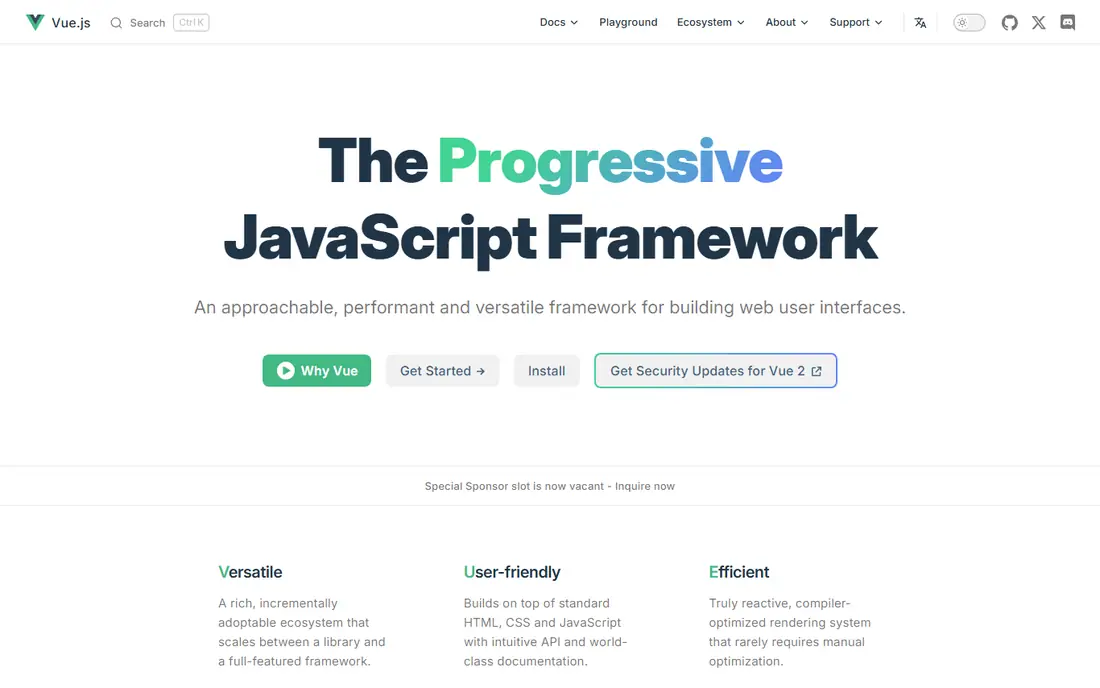
Vue lets you start with a small interactive widget and grow into a full single-page app, which is why it appeals to teams moving away from React without wanting a hard reset. Templates read close to HTML, the Composition API handles shared logic cleanly, and the official router and state libraries reduce the guesswork that comes with assembling a React stack from scratch. Documentation is widely praised for its clarity.
React still has the larger job market and the larger library catalog in the United States, so hiring Vue specialists can take longer in some cities. Some third-party Vue plugins are also less mature than their React equivalents, so check maintenance activity before adopting a niche library.
Vue is our pick for most people in this list. It balances approachability, performance, and a complete ecosystem, and it works well for marketing sites, dashboards, and product apps alike.
- Clear templates and documentation
- Progressive adoption
- Strong ecosystem with Vue Router and Pinia
- Smaller hiring pool than React in some markets
- Ecosystem quality varies by plugin
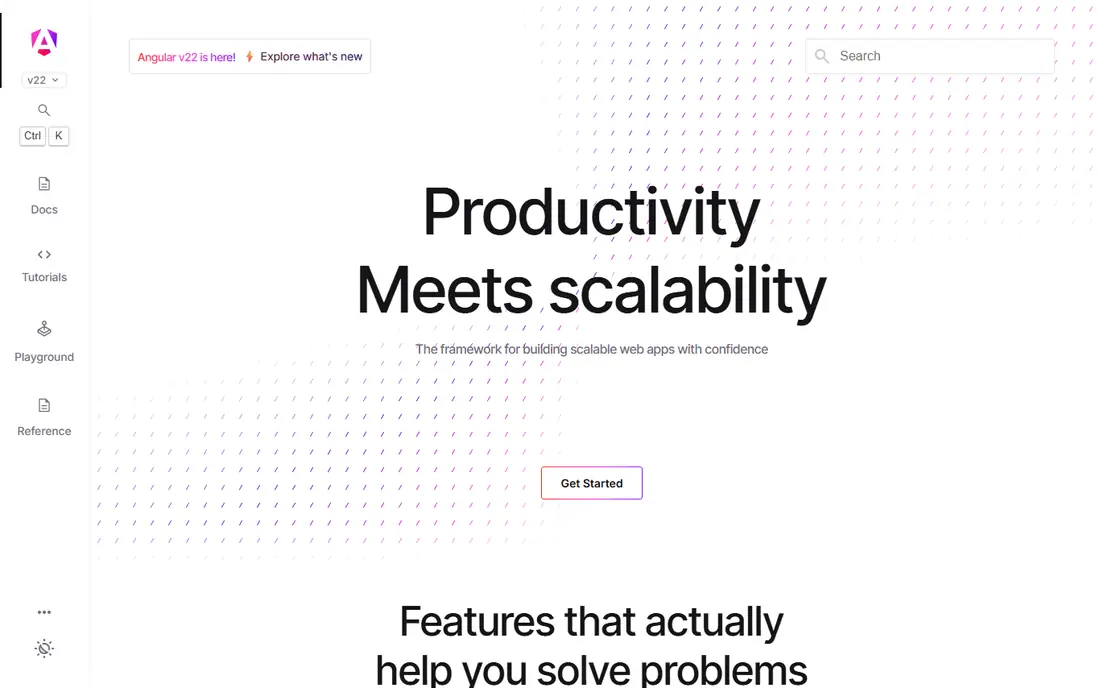
Angular is a complete platform, not just a view layer. Routing, forms, dependency injection, and testing tools come built in, and TypeScript is the default language. That consistency helps large teams, where many developers work on one codebase for years and where clear structure matters more than minimal bundle size. The Angular CLI handles scaffolding, builds, and updates in a standard way.
New developers must learn Angular-specific concepts such as modules, decorators, and change detection, even for a simple page. The framework also asks for a bigger commitment: switching away later is harder than swapping a small library.
Choose Angular when the app is large, long-lived, and built by a team that values consistency and enterprise support. For a small startup app, Vue or Svelte will usually get you moving faster.
- Full framework with routing, forms, and HTTP built in
- TypeScript by default
- Strong CLI and long-term support
- Steep learning curve
- Heavier commitment to one framework and its conventions
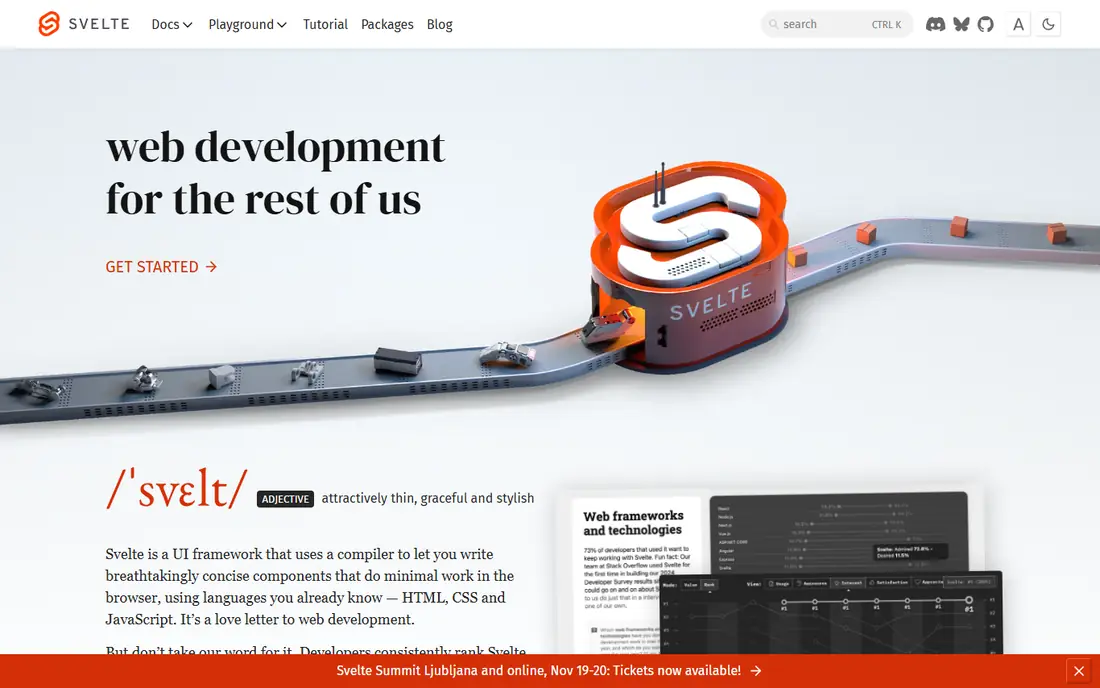
Svelte takes a different path from React: it compiles components into efficient JavaScript at build time, instead of shipping a virtual DOM library to the browser. The result is often smaller bundles and less runtime work, which users notice on slower phones and networks. Components combine markup, styles, and logic in one file, and reactivity works with plain variable assignments, which many developers find easy to read.
The ecosystem is smaller than React or Vue, so you may need to build a feature that already exists as a polished React package. Svelte 5 also changed reactivity with runes, which means older blog posts and courses may not match current code. Check that any tutorial you follow targets Svelte 5.
Svelte fits performance-sensitive apps, embedded widgets, and teams that like concise code. Pair it with SvelteKit when you need routing, server rendering, or API routes in the same project.
- Compiler approach ships less runtime code
- Concise components
- SvelteKit adds routing and server features
- Smaller ecosystem than Vue or Angular
- Svelte 5 changes mean some older tutorials are out of date
SolidJS looks like React at first glance, because it uses JSX and a similar component style. Under the surface it works differently: it tracks exactly which parts of the page depend on each piece of state, and updates only those parts. That fine-grained reactivity avoids re-rendering whole component trees, which gives SolidJS strong performance on highly interactive interfaces.
SolidJS has fewer component libraries, templates, and hiring candidates than Vue or Angular, and some React libraries cannot be dropped in directly despite the similar syntax. Developers also need to learn SolidJS signals and effects, which behave differently from React hooks in subtle ways.
Pick SolidJS when performance on a complex interactive interface is the top priority and the team is comfortable working with a smaller ecosystem. It is a strong technical choice, even if it is not the safest hiring choice.
- Very fast targeted updates
- JSX syntax feels familiar to React developers
- No virtual DOM overhead
- Smaller community and library catalog
- Fewer ready-made component libraries
Preact is a fast, small alternative to React that keeps the same modern API for most common code. Many React components run with little or no change, especially when using the compatibility package for libraries that expect React internals. That makes Preact a practical way to cut bundle size without rewriting an existing app.
A few React libraries rely on behavior that Preact does not copy exactly, so testing matters when you adopt it for an existing codebase. The community is also smaller, so answers and examples are less plentiful than for React.
Preact shines for widgets, embeds, and performance-sensitive pages where every kilobyte counts. If you like React but your app is small, Preact gives you a familiar workflow with a much lighter payload.
- Tiny size with a React-compatible API
- Easy migration path
- Works well for widgets and embedded apps
- Some React libraries need a compatibility layer
- Smaller ecosystem than React itself
Ember.js is a full framework with a clear opinion about how an app should be structured. Routing, data loading, templates, and testing follow established conventions, which reduces debate on large teams and makes it easier for a new developer to find their way around a mature codebase. Ember also emphasizes stability, with a careful upgrade path for long-lived products.
The community is smaller than it was a decade ago, and fewer new projects start with Ember today. That means fewer fresh tutorials and fewer developers who already know it. Learning the conventions also takes longer than picking up a small library such as Alpine.js.
Ember still fits product teams that want a complete, opinionated framework and plan to maintain one app for many years. It is less appealing for a quick marketing site or a team that prefers to choose every piece itself.
- Strong conventions and built-in tooling
- Stable upgrade path
- Good for ambitious long-lived apps
- Smaller community than in its peak years
- Conventions take time to learn
Qwik is built around resumability: the server renders the page, and the browser resumes interactivity without re-running all the code that built the page. In practice, that means public sites can start fast, because only the code for the part a visitor interacts with needs to load right away. For content-heavy sites and e-commerce pages, that first-load advantage is real.
The model is different from React, Vue, or Svelte, so developers need time to learn how Qwik splits code and serializes state. Some patterns that work elsewhere, such as closures over certain values, need adjustment. The ecosystem is also younger and smaller, so ready-made integrations are fewer.
Choose Qwik when time to interactive on public pages is a core business metric, and when the team is willing to learn a new model for that gain. For an internal dashboard behind a login, the benefit is smaller.
- Resumable design loads very little JavaScript on first paint
- Fine-grained lazy loading
- Good for content sites
- Different mental model from React
- Smaller ecosystem
- Serialization limits can surprise newcomers
Alpine.js adds reactivity to server-rendered HTML with attributes such as x-data and x-show. You can build dropdowns, tabs, modals, and small forms without a build step, a router, or a component framework. That makes it a natural replacement for the small interactive parts of a site that currently use React, especially when most of the page is static.
Alpine.js is not a full app framework. Large single-page apps with shared state, complex routing, and many screens will outgrow it quickly, and the code can become hard to follow if every behavior lives in HTML attributes. It works best as a complement to a server framework, not as a replacement for a product app.
We would pick Alpine.js for marketing sites, blogs, and admin pages that need a modest amount of interactivity. It is the lowest-friction option in this list, and it pairs well with tools such as htmx for server-driven updates.
- Tiny and easy to add to existing pages
- Behavior written directly in HTML attributes
- No build step required
- Not suited to large single-page apps
- State management gets messy at scale
Lit is a small library for building web components, the browser-native way to create reusable elements. A Lit component works in a React app, a Vue app, a plain HTML page, or a design system shared across teams, because it does not depend on a framework runtime. That portability is its main selling point, especially for organizations that maintain components used by several products.
Lit is not a full framework, so routing, state management, and data fetching are your responsibility. Building a complete app with Lit alone takes more planning than using Vue or Angular, and the component model can feel verbose for simple screens.
Pick Lit when you need reusable, framework-independent components, such as a design system or an embeddable widget. For a single product app, Vue or Svelte will usually be faster to build with.
- Built on standard web components
- Works in any framework
- Small and fast for reusable elements
- More boilerplate than Vue or Svelte for full apps
- Design system work needs extra planning
How we picked these
We compared official documentation, project descriptions, and public feature pages, and we favored frameworks that are actively maintained in October 2026 and that offer a genuinely different approach from React. We left React itself out, and we left out React meta-frameworks such as Next.js, since those still depend on React. We also left out backend frameworks and general libraries that do not build user interfaces.
We weighed learning curve, ecosystem size, bundle approach, and fit for different app types, rather than ranking by popularity alone. A framework can be the best technical choice for one project and a poor hiring choice for another, and both facts matter.
How to choose between them
Start by naming the app type. A public content site, an internal dashboard, a design system, and a large enterprise product pull in different directions, and no single framework wins all four.
Match size to structure
For a large team and a long-lived product, Angular or Ember.js give you structure and tooling out of the box. For a mid-size product app, Vue gives a good balance of structure and flexibility. For a small app or a performance-critical interface, Svelte, SolidJS, or Preact keep the payload light. For a mostly static site with light interactivity, Alpine.js or Lit may be all you need.
Test migration on one screen first
If you are leaving React, rebuild one real screen, not a toy demo, in the leading candidate. That test shows how routing, forms, data fetching, and testing feel in practice, and it reveals gaps in the library ecosystem before the whole team commits. Keep the existing React app running until the new screen passes real user testing.
Check hiring and maintenance
Look at recent releases, issue activity, and the availability of developers in your market before choosing a smaller framework. A technically excellent option that no one on your team can maintain is a risk. For many teams, that check pushes Vue or Angular ahead of a smaller but faster alternative.
Sources
Frequently asked questions
What is the best alternative to React?
Vue is the safest general pick, because it is approachable, well documented, and flexible enough for many app types. Angular suits large enterprise apps, while Svelte suits performance-focused apps. The best choice depends on team size, app type, and hiring needs.
What are the best alternatives to Create React App?
Create React App was deprecated in February 2025, and the React team now points developers to frameworks or build tools such as Vite. For alternatives in this list, use the official starter for Vue, SvelteKit for Svelte, the Angular CLI for Angular, or Vite directly for Preact, SolidJS, and Lit.
Is Vue better than React?
Vue is easier to learn for many developers and includes more built-in structure, while React has a larger ecosystem and hiring pool. Neither is better for every project. Vue often wins for small to mid-size teams that want clear conventions, and React often wins when ecosystem size matters most.
Which React alternative is fastest?
Svelte, SolidJS, and Qwik are built to ship less JavaScript and update the page efficiently, so they often produce faster load and interaction times than a typical React app. Real results depend on the app, the build setup, and the device, so measure a real screen rather than trusting a benchmark alone.
Can I use Preact with existing React code?
In many cases, yes. Preact offers a React-compatible API, and a compatibility package helps libraries that expect React internals. Test the specific libraries your app uses, since a few rely on behavior that Preact does not copy exactly.