Best AI Visibility Optimization Tools in 2026: 9 Tools Compared
By ToolNimba Editorial Team October 28, 2026 10 min read

- Top pick
 Profound
Enterprise GEO analytics
Starting priceSee websiteCheck out ProfoundRead our review - Runner-up
 Peec AI
Multi-engine agency tracking
Starting price$95 per monthCheck out Peec AIRead our review - Also great
 Otterly
Budget AI monitoring
Starting price$29 per monthCheck out OtterlyRead our review
How we researched this
We compared official pricing and feature pages, app store listings, privacy policies and public user reviews. Prices change, so check the provider's site before you pay.
Key takeaways
- Otterly is the cheapest working start for AI visibility tracking, from $29 per month, and suits small teams testing GEO.
- Profound leads on enterprise analytics and citation reporting, but its published pricing now centres on a free trial and custom enterprise terms in a recent October 2026 check, so confirm price before buying.
- Peec AI offers focused multi-engine tracking with unlimited seats in some plans, from about $95 per month, which helps agencies.
- Semrush and Ahrefs suit teams already inside those SEO suites, since AI visibility sits beside keyword and backlink data you already use.
- No tool can guarantee a mention in ChatGPT or Google AI Overviews, so treat these platforms as measurement and guidance, not as a ranking promise.
Quick comparison
| Name | Best for | Starting price | Free plan | |
|---|---|---|---|---|
| Profound | Enterprise GEO analytics | See website | Free trial | Visit |
| Peec AI | Multi-engine agency tracking | $95 per month | Free trial | Visit |
| Otterly | Budget AI monitoring | $29 per month | Free trial | Visit |
 Scrunch | Enterprise scale and personas | $250 per month | Free trial | Visit |
 Semrush AI Toolkit | Existing Semrush users | $99 per month | Free trial | Visit |
 Ahrefs Brand Radar | Citation and authority data | $129 per month | Free trial | Visit |
 AthenaHQ | ROI and revenue attribution | $295 per month | Yes | Visit |
 Writesonic GEO | Track plus content creation | $79 per month | Free trial | Visit |
 ZipTie | Google AI Overview analysis | $69 per month | Free trial | Visit |
The best ai visibility optimization tools
The best ai search visibility optimization tool is the one that tracks the engines your customers actually use, shows where your brand is cited, and turns that data into content fixes. We compared official pricing pages, engine coverage and feature lists, plus recent GEO comparisons from October 2026, for tools that serve brands and agencies today.

Profound is the enterprise standard in many GEO comparisons. It tracks brand visibility, sentiment and citations across major AI engines, with prompt volume data and reporting built for large brands and agencies. For a team that must prove AI visibility to executives, its depth is a real advantage.
Smaller teams should be cautious. Onboarding is less self-serve than cheaper tools, and Enterprise terms are custom quoted in a recent October 2026 check, after earlier $99 and $399 plans were removed from its pricing page. If you have an analyst to act on the data, Profound is strong. If you just want a weekly check, start cheaper.
- Deep prompt and sentiment tracking
- Citation intelligence
- Agency and enterprise reporting
- Self-serve onboarding is limited
- Best value needs an analyst
- Higher tiers cost far more
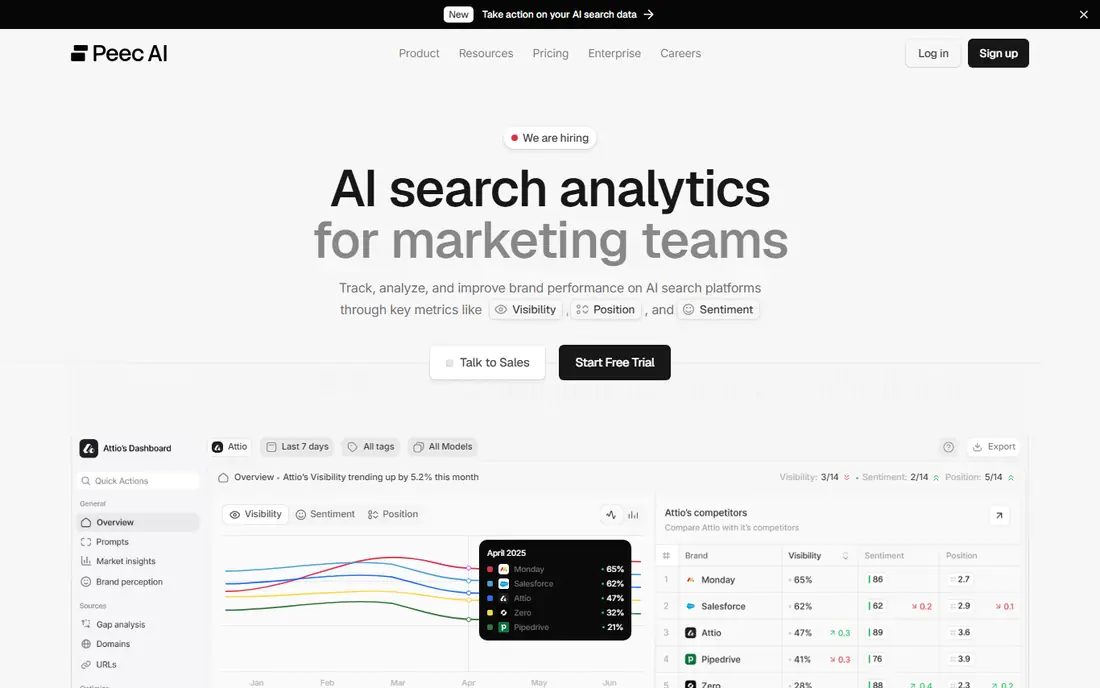
Peec AI suits agencies that need predictable tracking across clients. It monitors brand mentions across several AI engines, scores sentiment, and benchmarks competitors, with unlimited seats that avoid per-user cost growth. Daily per-engine data helps agencies spot changes fast.
Coverage is narrower than Profound or AthenaHQ, and its recommendations are less deep than content-first tools. For an agency that needs clean, client-ready tracking at a mid-range price, Peec AI is a practical choice. For enterprise attribution, look at AthenaHQ.
- Multi-engine tracking
- Sentiment scores per mention
- Unlimited seats on some plans
- Smaller engine coverage than the largest suites
- Content guidance is lighter
- Pricing varies by region
Otterly is the best first GEO tool for a small business or lean agency. From $29 per month, you can track brand visibility across major engines, see mentions and sentiment, and share results with a team without per-seat fees. That low entry price makes GEO testing affordable.
Depth is the trade-off. Diagnostic tools, prompt volume and enterprise reporting trail Profound and Scrunch, and limits rise with use. If you need to know whether AI answers mention you at all, Otterly answers that well. If you need deep optimisation workflows, budget for a mid-tier tool.
- Lowest honest entry price here
- Clear dashboards
- Unlimited team members on plans in comparisons
- Fewer diagnostic features than mid-tier tools
- Smaller prompt limits
- Less enterprise reporting
Scrunch positions itself as an agent experience platform, not just a tracker. It tests prompts by persona, structures content for AI visibility, and offers agency workspaces for managing many brands. For large teams that want to move visibility, not just watch it, that workflow matters.
The entry price from $250 per month in recent comparisons excludes small teams, and setup takes longer than a simple tracker. If you manage many client brands and need persona testing at scale, Scrunch is worth a demo. If you track one brand, a cheaper tool covers the basics.
- Persona-based prompt testing
- Agency workspaces
- Optimisation guidance beside tracking
- Price puts it out of reach for small teams
- Setup needs time
- Enterprise focus
Semrush AI Toolkit suits teams already paying for Semrush. You can track AI visibility, sentiment and share of voice beside keyword rankings, site audits and backlinks, without learning a new platform. That single-login benefit is strong for SEO-led teams.
Agencies pay per domain, so multi-client costs climb, and dedicated GEO tools offer deeper prompt and citation data. If your team lives in Semrush and needs GEO as part of SEO, the toolkit is the efficient choice. If GEO is your main job, compare Profound and Peec AI first.
- AI visibility inside a full SEO suite
- Cross-platform tracking
- Familiar workflow for SEO teams
- Per-domain pricing adds up for agencies
- GEO depth trails dedicated platforms
- Toolkit is an add-on
Ahrefs Brand Radar appeals to SEO strategists who trust Ahrefs data. It shows where AI answers mention your brand and which source URLs they cite, then pairs that with backlink and authority data you already use. That link between citations and authority is useful for outreach and content planning.
Pricing needs care, since some comparisons list Brand Radar as an add-on to a base Ahrefs plan, while others list a standalone figure. GEO depth is also newer than dedicated platforms. If you already use Ahrefs, Brand Radar is a natural extension. If you do not, a dedicated tracker may be cheaper.
- Shows citation source URLs
- Pairs AI mentions with backlink data
- Trusted SEO data
- Requires an Ahrefs subscription plus add-on in some comparisons
- Newer GEO product
- Less prompt depth
AthenaHQ suits enterprise teams that must tie AI visibility to traffic and revenue. It covers a wide engine set, including Grok and Copilot in recent comparisons, and connects AI mentions to GA4 and Shopify data. That attribution helps justify GEO spending to finance teams.
The price from $295 per month and the setup effort put it beyond small teams. A free Essential tier in some comparisons lets you test basic tracking, but full value needs paid plans and analytics setup. If ROI proof is your main need, AthenaHQ leads. If you only need monitoring, Otterly or Peec AI cost far less.
- Widest engine coverage in comparisons
- GA4 and Shopify attribution
- Predictive insights
- High entry price
- Enterprise focus
- Needs data setup to prove ROI
Writesonic GEO suits content teams that want to track visibility and fix content in the same place. You can monitor AI mentions, then generate or optimise pages to improve them, without switching tools. The entry price from $79 per month on annual billing in recent comparisons is friendly for mid-size teams.
It is not the deepest tracker here, and its own published tool comparisons should be read with its content business in mind. For a team that publishes often and wants a combined workflow, Writesonic GEO is practical. For pure enterprise measurement, Profound or AthenaHQ go deeper.
- Tracking plus AI writing in one platform
- Content optimisation beside visibility data
- Affordable entry
- Also sells content tools, so its comparisons need care
- GEO depth trails dedicated tools
- Limits vary
ZipTie, now at ziptie.ai for new users, fills a technical gap: Google AI Overviews. It analyses which pages appear in AI Overviews, how citations work, and what changes over time, which helps technical SEOs optimise for Google specifically. For teams where Google traffic still dominates, that focus is valuable.
It is not a full multi-engine brand tracker, so teams that also need ChatGPT, Perplexity and Claude coverage will need another tool beside it. Pair ZipTie with Otterly or Peec AI if you need both Google depth and broad engine tracking.
- Technical Google AI Overview analysis
- Clear citation and ranking data
- Useful for technical SEOs
- Narrower focus than all-engine trackers
- Less brand sentiment depth
- Smaller team features
How we picked these
We compared official pricing pages, engine coverage and feature lists, and checked them against recent GEO comparisons from October 2026. We kept only tools that track AI visibility across at least one major engine today, with real prompt, citation or sentiment data, and we mixed budget trackers, enterprise platforms and SEO suite add-ons.
We did not claim hands-on testing that did not happen. Prices vary by prompts, projects, engines and billing period, and some vendors list different figures for annual and monthly billing, so confirm the price for your prompt volume and engine list before buying.
How to choose an ai visibility tool
Start with the engines your audience uses. If customers ask ChatGPT and Perplexity, a tracker that only covers Google AI Overviews will miss most of your visibility. List your top three engines, then shortlist tools that cover all three at your budget.
Next, check what the tool measures. Mentions alone are not enough. Look for citation sources, sentiment, share of voice against competitors, and prompt-level detail, so you can see why a mention changed. A tool that only gives a single score will not guide content fixes.
Finally, test the action step. Can the tool suggest a page to update, a fact to add, or a citation to earn, and can you track whether that change worked? GEO tools earn their fee when they close the loop from measurement to content change to re-measurement.
Fix content for AI answers
AI systems favour clear, factual pages. Lead key sections with a direct answer, use clear headings, add structured data where it fits, and cite sources for claims. Keep important facts in text, not only in images, and make sure AI crawlers are not blocked by your robots file unless you have a reason to block them.
Report visibility honestly
AI answers change by prompt, location and model version, so a single mention is not a trend. Report visibility over weeks, across a set of prompts, and beside traffic and conversions where possible. Avoid promising a client a top mention, since no tool controls what an AI model outputs.
Sources
- https://www.tryprofound.com
- https://www.peec.ai
- https://www.otterly.ai
- https://www.scrunch.com
- https://www.semrush.com
- https://www.ahrefs.com
- https://www.athenahq.ai
- https://www.writesonic.com
- https://www.ziptie.ai
- https://rankcaster.ai/best-geo-platforms-for-seo-agencies
- https://humanizeai.com/blog/best-generative-engine-optimization-tools/
- https://otterly.ai/blog/the-25-best-ai-seo-tools/