Best App to Buy Stocks in 2026: 9 Apps Compared
By ToolNimba Editorial Team October 28, 2026 11 min read

- Top pick
 Fidelity
All-round investing and research
Starting priceFreeCheck out FidelityRead our review - Runner-up
 Charles Schwab
Active trading with thinkorswim
Starting priceFreeCheck out Charles SchwabRead our review - Also great
 Robinhood
Simple mobile-first investing
Starting priceFreeCheck out RobinhoodRead our review
How we researched this
We compared official pricing and feature pages, app store listings, privacy policies and public user reviews. Prices change, so check the provider's site before you pay.
Key takeaways
- Fidelity, Charles Schwab, E*TRADE, Robinhood, Webull, SoFi, Public, Vanguard and Moomoo all offer zero-commission US stock and ETF trades.
- Fidelity is our most complete pick for beginners and long-term investors, with research, fractional shares, recurring investing and retirement accounts in one app.
- Robinhood and Webull suit mobile-first traders who want a simple app or stronger charting, while Schwab suits traders who want thinkorswim.
- Options costs differ: Robinhood and Webull charge no per-contract fee on many options trades, while Fidelity, Schwab and E*TRADE charge 0.65 dollars per contract.
- This is not financial advice; investing carries risk, and the value of stocks can fall as well as rise.
Quick comparison
| Name | Best for | Starting price | Free plan | |
|---|---|---|---|---|
| Fidelity | All-round investing and research | Free | Yes | Visit |
| Charles Schwab | Active trading with thinkorswim | Free | Yes | Visit |
| Robinhood | Simple mobile-first investing | Free | Yes | Visit |
 Webull | Active traders and charting | Free | Yes | Visit |
 E*TRADE | Options traders and research | Free | Yes | Visit |
 SoFi Invest | Beginners who want banking plus investing | Free | Yes | Visit |
 Public | Social learning and fractional shares | Free | Yes | Visit |
 Vanguard | Long-term index investing | Free | Yes | Visit |
 Moomoo | Active traders and data tools | Free | Yes | Visit |
The best apps to buy stocks
Buying stocks from your phone is now free at most major brokers, so the choice comes down to research, account types, fractional shares and how much help you want. We compared official feature pages, pricing pages, app store listings and public reviews, and we focused on US stock and ETF trading, because that is where zero-commission terms are clearest.

Fidelity is the app we would point most new investors to first. You can buy full or fractional shares of US stocks and ETFs with no online commission, set up recurring investments, and open a Traditional, Roth or rollover IRA in the same account. Research tools, screeners and educational content are built in, so you do not need a second app to learn as you go.
The honest catch is complexity. Fidelity does a lot, and the app reflects that range, with many menus and account types to learn. Options traders also pay 0.65 dollars per contract, which is higher than Robinhood or Webull. For long-term investors, though, the combination of zero commissions, fractional shares, low-cost index funds and retirement accounts is hard to beat. This is not financial advice; trading carries risk.
- Zero-commission US stock and ETF trades
- Fractional shares through Stocks by the Dollar
- Strong research, recurring investing and IRA options
- Options cost 0.65 dollars per contract
- The app can feel busy for absolute beginners
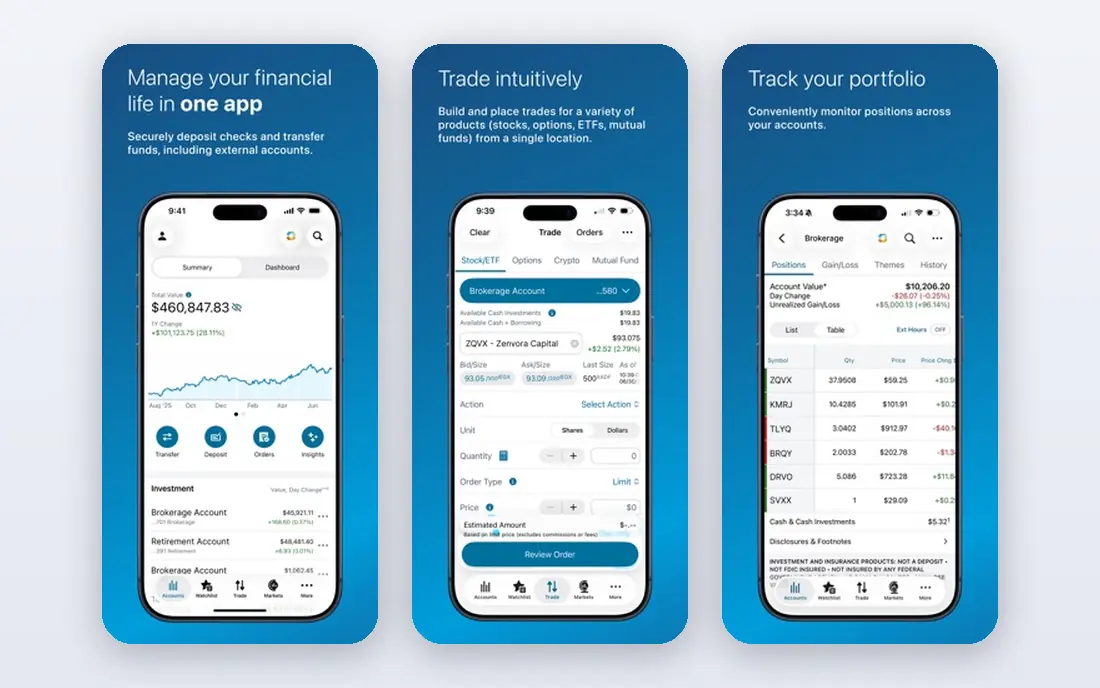
Schwab suits investors who want a full-service broker and a serious trading platform in one place. The main Schwab app covers everyday investing, while thinkorswim, inherited from TD Ameritrade, gives active traders multi-leg options tools, strong charting and paper trading. Fractional shares are available through Stock Slices, starting from small dollar amounts on eligible S and P 500 stocks.
The catch is cash. Uninvested cash left in the default sweep may earn very little, so check your cash settings and consider a money market fund if you hold a large idle balance. Schwab also charges 0.65 dollars per options contract. If you trade options often, that adds up next to a zero-contract-fee broker, but for stock investors who want research, branches and thinkorswim, Schwab is a strong pick.
- Zero-commission US stock and ETF trades
- Thinkorswim for advanced charting and options
- Stock Slices for fractional shares in S and P 500 stocks
- Options cost 0.65 dollars per contract
- Idle cash in the default sweep can earn a low rate

Robinhood remains the simplest way to buy a first stock. The app is clean, trades are commission-free, and fractional shares let you start with a small amount. Recurring investments and IRA accounts are available, and the optional Gold subscription, at 5 dollars per month or 50 dollars per year, adds features such as a higher IRA match and lower margin rates for eligible users.
The trade-off is depth. Research, screeners and desktop tools are lighter than at Fidelity or Schwab, so active traders may outgrow it. The 100-dollar outgoing transfer fee is also worth noting if you later move your account elsewhere. For beginners who want a low-friction start and a mobile-first routine, Robinhood is still a good choice, provided you understand that investing carries risk.
- Zero-commission US stock, ETF and options trades with no per-contract fee
- Simple app and fractional shares
- Recurring investments and IRA accounts
- Research tools are lighter than Fidelity or Schwab
- Outgoing brokerage transfers cost 100 dollars
Webull is the step up from Robinhood for traders who want tools without paying commissions. Charting is far stronger, with many technical indicators, multi-chart layouts and screeners, and paper trading lets you practise with real market data before risking money. Extended hours trading gives active traders more windows than many rivals offer.
The limits are clear. Webull does not support mutual funds, and its education content is thinner than Fidelity or Schwab. A paid Premium tier, at 3.99 dollars per month or 40 dollars per year, adds benefits such as a higher cash rate and IRA match perks, but the free tier already covers core stock and options trading. If charting and active trading matter more than advisory help, Webull is a strong pick.
- Zero-commission US stock, ETF and options trades
- Strong charting with many indicators
- Paper trading and extended hours trading
- No mutual funds
- Customer support can be slow at busy times
ETRADE, now part of Morgan Stanley, suits investors who want solid research and a capable options platform. Power ETRADE offers options chains, strategy tools and paper trading, while the main app covers stocks, ETFs and retirement accounts. Managed portfolios are available if you later want help with allocation.
The catch is options pricing for casual traders. At 0.65 dollars per contract, ETRADE is dearer than Robinhood or Webull, though active traders can qualify for 0.50 dollars per contract. Fractional shares are also more limited than at Fidelity or Robinhood. For stock investors who value research and a long-running broker, ETRADE remains a reliable choice.
- Zero-commission US stock and ETF trades
- Power E*TRADE for options analysis
- Morgan Stanley research and managed portfolio options
- Options cost 0.65 dollars per contract, or 0.50 dollars for active traders
- Main app can feel dated next to newer rivals
SoFi Invest fits people who want investing to sit next to their bank account. You can buy stocks and ETFs with no commission, invest fractional amounts, and set up recurring buys, all in an app that also handles banking and other SoFi products. That single-app routine suits beginners who do not want to juggle several providers.
Research is the limit. SoFi offers educational content and basic tools, but it does not match Fidelity or Schwab for deep stock research. The robo-investing option charges 0.25 percent per year, which is fair for automated help but is not free. If simplicity and a combined money app matter most, SoFi is a friendly starting point.
- Zero-commission US stock and ETF trades
- Fractional shares and recurring investing
- Banking, lending and investing in one app
- Research tools are lighter than at full-service brokers
- Robo-investing charges 0.25 percent per year
Public suits investors who learn by watching and discussing. The app combines zero-commission trading with community posts, company insights and educational content, which helps beginners understand why a stock moves. Fractional shares and recurring investing make it easy to start small and build a habit.
Premium is the catch to check. Public Premium costs 8 dollars per month, waived at a balance of 50,000 dollars or more, and it adds extra features rather than changing core commission terms. If you do not need Premium, the free tier already covers core trading. Public is a good pick for social learners, but serious researchers may still prefer Fidelity.
- Zero-commission US stock, ETF and options trades
- Fractional shares and recurring investing
- Community and education features
- Premium tier costs 8 dollars per month unless you hold 50,000 dollars or more
- Research depth is lighter than at Fidelity
Vanguard is built for patience. Its low-cost index funds and ETFs are a natural home for long-term savers, and the app now offers zero-commission US stock and ETF trades alongside mutual fund investing. IRA accounts are straightforward to open, and automatic investing into funds helps you stay consistent.
Active traders will find the app plain. Charting, options tools and fractional stock buying are more limited than at Webull or Schwab, and the experience is geared to holding rather than frequent trading. If your plan is to buy broad index funds, contribute regularly and leave the portfolio alone, Vanguard is one of the most cost-effective choices available.
- Zero-commission US stock and ETF trades
- Low-cost index funds and ETFs
- Simple IRA setup for long-term savers
- App and trading tools are simpler than at active-trading brokers
- Fractional stock trading is more limited than at Fidelity
Moomoo appeals to data-driven traders who want a modern app with strong tools at no commission. Charting, screeners and market data are central to the experience, and paper trading lets you test ideas before committing money. The app also covers options and crypto-related products in some regions, though availability varies.
The limit is breadth. Moomoo does not match Fidelity or Schwab for retirement account choice, banking services or advisory help. It is best as a trading app for self-directed investors who already know what they want to buy. If you want deep data and a low-cost active trading routine, Moomoo deserves a trial alongside Webull.
- Zero-commission US stock and ETF trades
- Strong charting, screeners and market data
- Paper trading for practice
- Fewer account types than full-service brokers
- Support and education vary by region
How we picked these
We compared official feature pages, pricing pages, app store listings and public reviews for stock apps that operate in October 2026 and offer real US stock trading. We gave weight to commission terms, fractional shares, recurring investing, retirement accounts, research tools and app quality. We did not claim hands-on testing of every trade, and we focused on published terms, because promotions and transfer fees change. Apps that only offered simulated trading, or that charged a subscription for basic stock trades, did not make the list.
Choosing the right stock app for you
Start with your investing style
Long-term index investors should prioritise low fund costs and IRA options, so Fidelity or Vanguard fit well. Active traders should prioritise charting, options costs and paper trading, so Webull, Schwab or Moomoo fit better. Beginners who want simplicity should start with Robinhood, SoFi or Public.
Check the costs beyond commission
Zero commission does not mean zero cost. Options contract fees, transfer-out fees, margin rates and fund expense ratios all matter. Check the fee schedule for the trades you will actually make, not just the headline stock commission.
Use fractional shares and recurring buys
Fractional shares let you start with a small amount and buy expensive stocks by dollar amount. Recurring investing builds a habit without timing the market each month. Both features are available at Fidelity, Robinhood, SoFi, Public and Webull, among others on this list.
Keep risk in view
This is not financial advice; trading carries risk, and stock prices can fall quickly. Avoid margin until you understand how interest and forced sales work, keep an emergency fund separate from invested money, and check your portfolio on a schedule rather than reacting to every price move.