Best Apps for Mindfulness in 2026: 9 Apps Compared
By ToolNimba Editorial Team October 28, 2026 12 min read

- Top pick
 Headspace
Beginners
Starting price$12.99 per monthCheck out HeadspaceRead our review - Runner-up
 Calm
Sleep
Starting price$14.99 per monthCheck out CalmRead our review - Also great
 Insight Timer
Free variety
Starting priceFreeCheck out Insight TimerRead our review
How we researched this
We compared official pricing and feature pages, app store listings, privacy policies and public user reviews. Prices change, so check the provider's site before you pay.
Key takeaways
- Headspace is our pick for beginners who want a clear course, while Insight Timer is the best free option because most of its library costs nothing.
- Calm leads for sleep, with Sleep Stories and soundscapes that other apps do not match in depth.
- Waking Up and Happier suit people who want deeper teaching, but they cost more and assume you already want to learn the ideas behind the practice.
- Meditation apps support a habit; they do not diagnose or treat a mental health condition, so seek professional help if anxiety, low mood, or sleep problems persist.
Quick comparison
| Name | Best for | Starting price | Free plan | |
|---|---|---|---|---|
| Headspace | Beginners | $12.99 per month | Free trial | Visit |
| Calm | Sleep | $14.99 per month | Yes | Visit |
| Insight Timer | Free variety | Free | Yes | Visit |
 Waking Up | Deep teaching | See website | Free trial | Visit |
 Happier | Practical teaching | $14.99 per month | Free trial | Visit |
 Balance | Personalised plans | $11.99 per month | Free trial | Visit |
 Aura | All-round wellbeing | $11.99 per month | Free trial | Visit |
 Medito | Fully free practice | Free | Yes | Visit |
 Smiling Mind | Families and schools | Free | Yes | Visit |
The best apps for mindfulness
These apps cover different routes into mindfulness: structured courses, sleep audio, a huge free library, and short daily practices. We compared official pricing, app store listings, content types, and public reviews to match each app to a real use case.
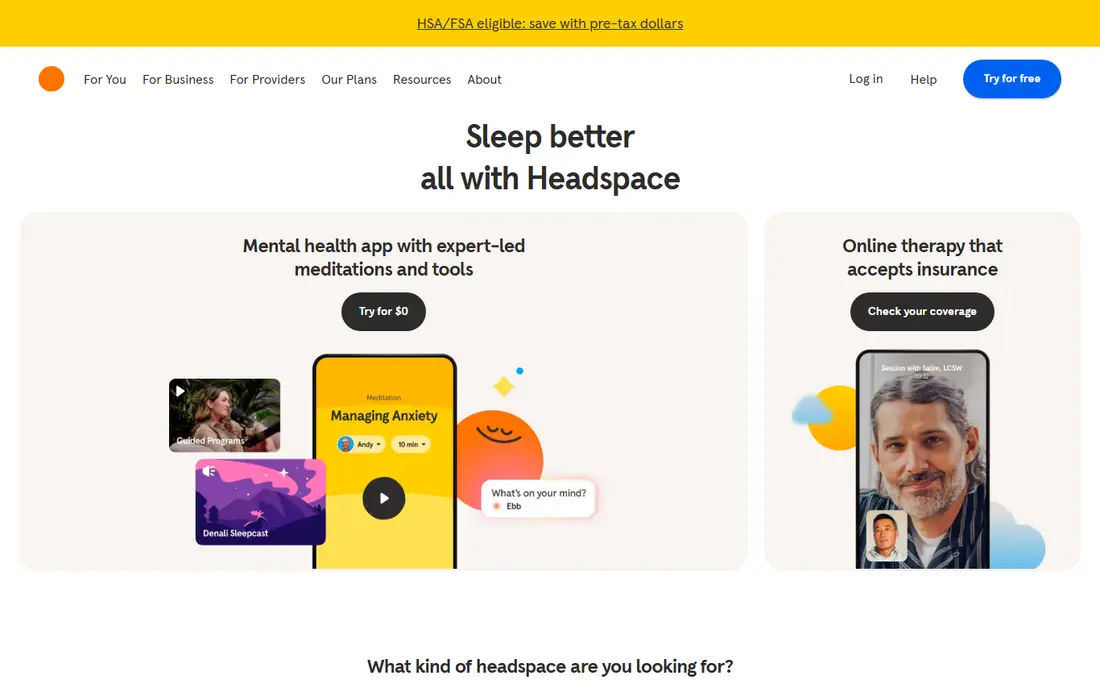
Headspace is the safest first app for someone who has never meditated and does not know where to start. Its courses teach one skill at a time, starting with short sessions and building up, and short animations explain ideas such as noticing a wandering mind without judgment. That structure removes the main beginner problem, which is opening an app full of sessions and having no idea which one to pick.
Beyond meditation, Headspace offers sleepcasts, soundscapes, breathing exercises, and short workouts that link movement to attention. The annual plan, at $69.99 per year based on current app store listings, is cheaper than paying monthly. The honest catch is that almost everything sits behind the subscription once the trial ends, so Headspace only makes sense if you plan to use it several times a week.
- Clear step-by-step courses
- Sleepcasts and focus tools
- Short sessions for busy days
- Little content remains free after the trial
- The structured style can feel restrictive for experienced meditators
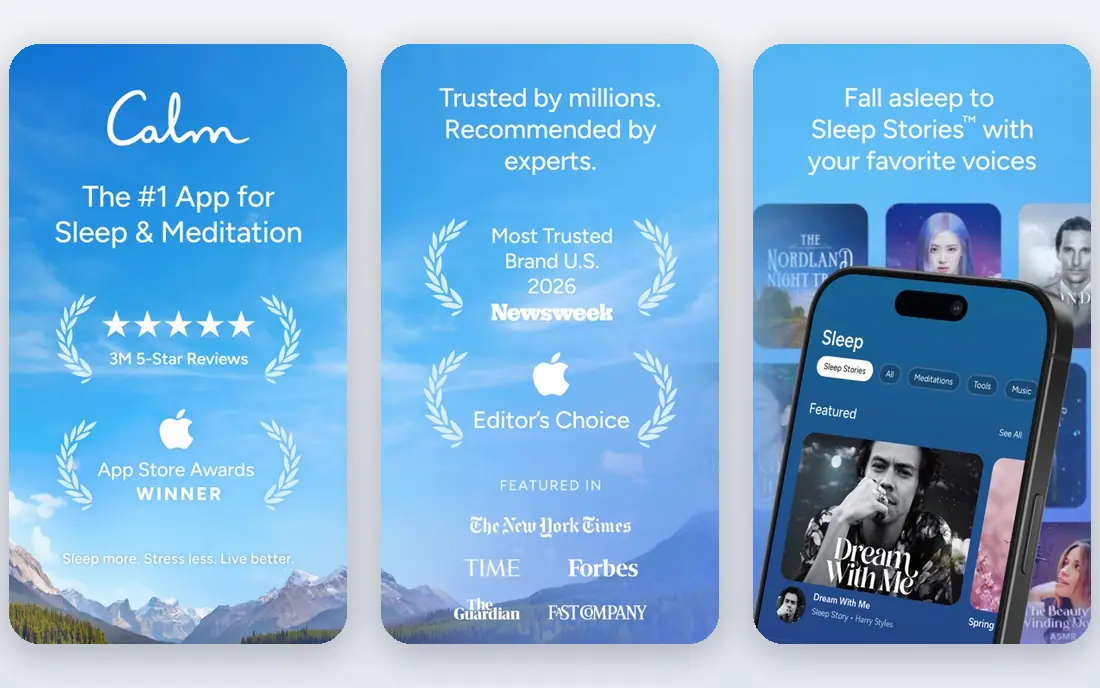
Calm is the app to pick if falling asleep is your main goal. Its Sleep Stories, read by familiar voices, plus sleep music and nature sounds, give you a clear bedtime routine, and the Daily Calm offers a short guided session each morning. Programs on stress, focus, and anxiety are also included, and the app is available on phones, tablets, and the web.
The trade-off is focus. Calm covers so much ground, from sleep to music to celebrity stories, that a person who mainly wants to learn meditation may find the meditation content harder to locate. Some programs are free, but most of the library needs a Premium subscription, listed at $14.99 per month or $69.99 per year in current listings, with a lifetime option also offered. If sleep is the problem you want solved, Calm earns its price. If it is not, Headspace or Insight Timer may fit better.
- Large Sleep Stories library
- Daily Calm sessions
- Music and nature sounds for winding down
- Meditation can be hard to find among sleep and music content
- Most of the library needs Premium
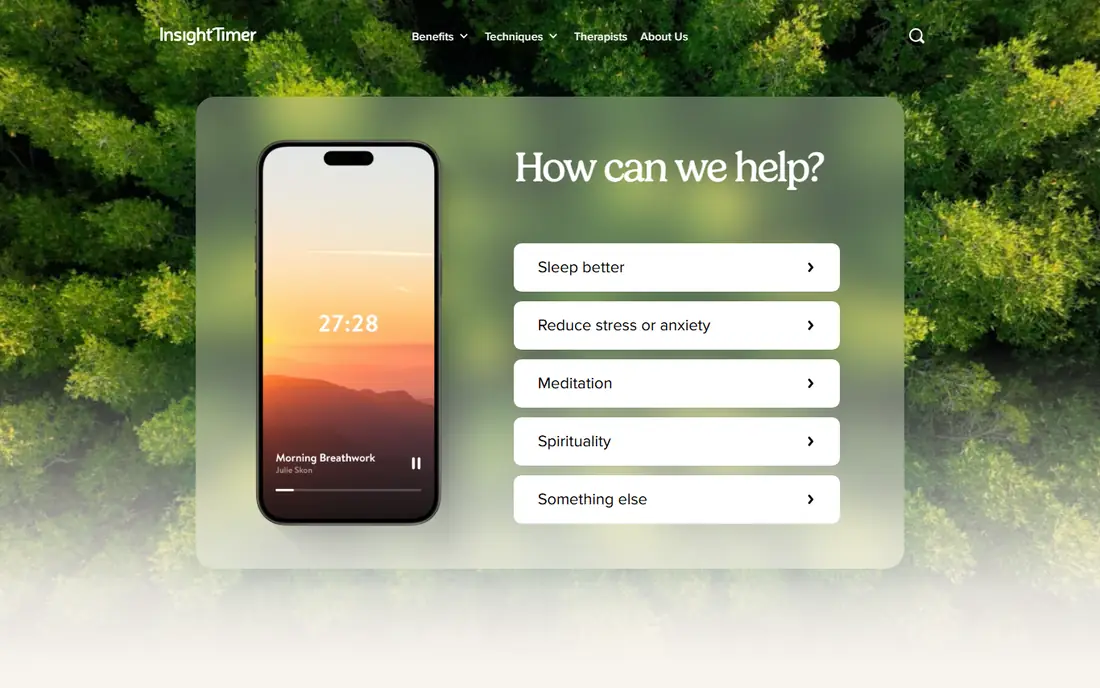
Insight Timer is the best value in this list by a wide margin. Most of its guided meditations, talks, sleep tracks, and timer features are free, with a paid Member Plus tier at $9.99 per month or $59.99 per year adding courses, offline listening, and higher-quality audio. Teachers from around the world contribute sessions on anxiety, sleep, grief, focus, and body scans, so you can find a voice and style that suits you.
The downside follows from that openness. Because many teachers publish on the platform, quality varies, and a beginner can spend a long time searching. Start with the Courses tab or a teacher you like, rather than browsing the full search results. If cost is the main barrier, or you already know what kind of practice you like, Insight Timer is hard to beat.
- Very large free library
- Timer for silent practice
- Live events and community groups
- Quality varies between teachers
- The size of the library can feel overwhelming
Waking Up, created by Sam Harris, takes a different approach from most meditation apps. It pairs daily guided meditations with short lessons that explain why a practice works, covering attention, awareness, and the nature of thought. That mix suits people who want to understand meditation, not just follow a voice for ten minutes. Guest teachers add variety, and the app offers a free year on request for anyone who cannot afford the subscription, with no questions asked according to its own policy.
The price is the main barrier, and published prices vary by source and offer, so check the official site before you subscribe. The style is also more intellectual than Headspace or Calm, and there is far less sleep content. Waking Up is our pick for a curious, committed meditator. It is not the best first app for someone who just wants a quick calm-down session.
- Strong introductory course on theory and practice
- Talks from respected teachers
- Free access on request for those who cannot afford it
- Higher price than most rivals
- Theory-heavy style does not suit everyone
Happier, formerly Ten Percent Happier, is built for people who are skeptical of meditation jargon. Its teachers explain practices in plain language, often with humor, and courses cover stress, anxiety, sleep, and focus without asking you to accept beliefs you do not hold. That tone makes it a good second choice for beginners who tried Headspace and found it too polished, or who want a more adult, conversational guide.
The app is priced at $14.99 per month or $99.99 per year in current listings, which is more than Headspace or Calm on an annual basis. A trial lets you test the style before you pay. Happier does not offer the sleep depth of Calm or the free library of Insight Timer, but for practical, teacher-led instruction, it is one of the strongest options here.
- Conversational, skeptic-friendly teaching
- Courses from well-known teachers
- Sessions for stress and sleep
- Annual plan at $99.99 per year is higher than Headspace or Calm
- Full library needs a subscription
Balance asks how you feel, how much time you have, and what you want to work on, then builds a daily meditation plan around those answers. That personal touch helps people who get bored with a fixed course, because the plan changes as your answers change. Sessions cover breathing, focus, sleep, and stress, and the app is easy to use in short daily slots.
The catch is that the personalisation only works if you answer the check-ins honestly and regularly. Skip them, and the plan becomes generic. Balance is listed at $11.99 per month or $69.99 per year, and it has often offered a free first year through promotions, though offers change, so check the current terms. Balance suits a person who wants a plan made for them, rather than a library to browse.
- Daily plans adapt to your mood and goals
- First-year offers are often generous
- Sleep and focus content included
- Personalisation depends on regular check-ins
- Long-term price is similar to other paid apps
Aura tries to be a single wellbeing app rather than a meditation-only app. It offers guided meditations, sleep stories, breathing exercises, and short talks on stress, relationships, and habits, plus optional coaching. Its search and filtering help you find a session for a specific mood or moment, which matters when you have five minutes and a clear need.
That breadth is also its weakness. If you want deep meditation teaching, Waking Up or Happier will take you further, and Aura's coaching features may cost extra depending on the plan. Aura is listed at $11.99 per month in current listings. It fits best as an everyday wellbeing companion for someone who wants meditation, sleep, and short motivational content in one place.
- Meditations, sleep stories, and life coaching in one app
- Strong search and filtering
- Personalised recommendations
- Coaching costs extra in some cases
- The breadth of content can dilute the meditation focus
Medito is the simplest recommendation for anyone who wants to meditate without paying or seeing ads. It is run by a nonprofit foundation, offers guided courses, breathing exercises, and sleep content, and does not lock features behind a subscription. The library is curated rather than huge, which actually helps beginners, because the path from a first session to a daily habit is clear.
The trade-off is scale. Medito does not have the thousands of teachers on Insight Timer, nor the polished sleep library on Calm. It also has less content for advanced practitioners. For a free, private, no-pressure start, Medito is excellent. You can always move to a paid app later if you want more variety or sleep stories.
- Completely free with no ads or paywall
- Curated courses for beginners
- Open-source project run by a nonprofit foundation
- Smaller library than Insight Timer
- Fewer sleep stories and celebrity voices
Smiling Mind is a free Australian nonprofit app designed for schools, families, and workplaces. Its programs are organised by age, from young children to adults, and by setting, such as classroom, workplace, or home. That makes it the best choice for a parent who wants to meditate with a child, or a teacher who needs a short classroom break that is appropriate for the age group.
For an adult who already meditates daily, Smiling Mind may feel basic compared with Waking Up or Headspace. Its strength is access and trust: it is free, it was developed with psychologists, and it does not push a subscription. If cost or age-appropriate content is the deciding factor, start here.
- Completely free
- Programs by age group, including children and teens
- Developed with psychologists
- Less content for advanced adult meditators
- Design is simpler than paid rivals
How we picked these
We compared official pricing pages, app store listings, content types, and public reviews for leading meditation and mindfulness apps. We looked for a clear beginner path, a usable free option or trial, sleep and stress content, and honest limits such as a small library or a high price. We gave weight to apps that explain what they offer without hiding the subscription behind a trial, and to free nonprofit options that genuinely cost nothing.
We did not claim hands-on testing, and we did not invent ratings or user counts. Our order reflects common reader needs: structured learning first, then sleep, then free variety, then deeper teaching and family options. Prices vary by platform and offer, so check the app store listing or official site before you subscribe.
How to choose the right mindfulness app
Start with your main goal, not the app with the most features. If you want to learn meditation from scratch, pick a structured course app such as Headspace or Happier. If you want to fall asleep, pick Calm or a sleep-focused app. If you want variety without paying, pick Insight Timer or Medito. A mismatch here is the most common reason people stop using an app after a week.
Next, test the voice and length before you pay. Use the free trial or free tier for at least a few sessions, and notice whether you look forward to opening the app or dread it. Short sessions of five to ten minutes, done most days, beat a long session you skip. Set a regular time, such as after waking or before bed, and keep the phone on silent during the session.
Finally, treat the app as a habit tool, not a treatment. Meditation can help with everyday stress and focus, but it is not a substitute for therapy, medical care, or sleep treatment. If you notice persistent anxiety, low mood, or sleep problems, talk to a clinician. You can also combine an app with a simple timer for silent practice once you know the basics, which is a good way to reduce dependence on any single subscription.
Sources
- https://www.headspace.com
- https://www.calm.com
- https://insighttimer.com
- https://www.wakingup.com
- https://www.happier.com
- https://www.balanceapp.com
- https://www.aurahealth.io
- https://medito.app
- https://www.smilingmind.com.au
- https://trywhitespace.com/blog/best-meditation-apps-2026.html
- https://www.choosingtherapy.com/meditation-apps/