Best Budgeting Apps in 2026: 9 Apps Compared
By ToolNimba Editorial Team October 28, 2026 12 min read

- Top pick
 YNAB
Strict zero-based budgeting
Starting price$14.99 per monthCheck out YNABRead our review - Runner-up
 Monarch Money
Couples and net worth
Starting price$14.99 per monthCheck out Monarch MoneyRead our review - Also great
 Rocket Money
Subscription tracking
Starting priceFreeCheck out Rocket MoneyRead our review
How we researched this
We compared official pricing and feature pages, app store listings, privacy policies and public user reviews. Prices change, so check the provider's site before you pay.
Key takeaways
- YNAB is our pick for hands-on budgeters who want a strict zero-based method that assigns every dollar a job.
- Monarch Money is the best all-around dashboard for couples and households, with budgeting, net worth, and investment tracking in one place.
- Rocket Money is the best free starting point if forgotten subscriptions and rising bills are your main problem.
- Quicken Simplifi offers strong value for automatic tracking at a lower annual cost than YNAB or Monarch.
- No budgeting app is financial advice, and the best app is the one you will open each week, not the one with the longest feature list.
Quick comparison
| Name | Best for | Starting price | Free plan | |
|---|---|---|---|---|
| YNAB | Strict zero-based budgeting | $14.99 per month | Free trial | Visit |
| Monarch Money | Couples and net worth | $14.99 per month | Free trial | Visit |
| Rocket Money | Subscription tracking | Free | Yes | Visit |
 Quicken Simplifi | Low-cost automatic tracking | $5.99 per month | Free trial | Visit |
 Copilot Money | Apple users who value design | $13.00 per month | Free trial | Visit |
 EveryDollar | Simple envelope budgeting | Free | Yes | Visit |
 Goodbudget | Envelope budgeting without bank links | Free | Yes | Visit |
 PocketGuard | Safe-to-spend number | $12.99 per month | Yes | Visit |
 Empower | Free net worth tracking | Free | Yes | Visit |
The best budgeting apps
Budgeting apps solve different problems. Some enforce a strict method, some track everything automatically, and some focus on cutting subscriptions. We compared official feature pages, pricing pages, app store listings, and public reviews to sort them by the job they do best.
This is not financial advice. Budgeting apps help you see and plan your spending, but they do not replace professional advice for debt, investing, or taxes. If you link bank accounts, use strong passwords, turn on two-factor authentication, and review connected accounts regularly.
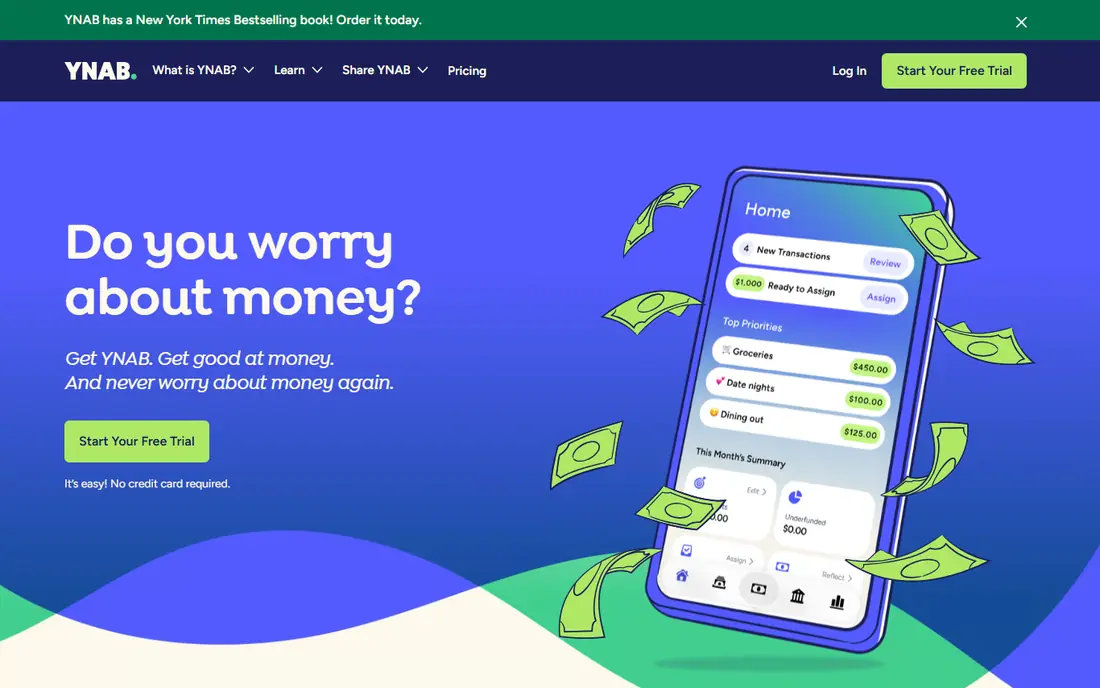
YNAB, short for You Need A Budget, is built around one rule: give every dollar a job before you spend it. You assign income to categories such as rent, groceries, and savings, then adjust as life happens. That hands-on method forces you to make choices in advance, which is why many users say it changes how they spend, not just how they record spending.
The cost is effort and price. There is no free plan, though the 34-day trial is long enough to learn the method, and the monthly rate is high unless you pay annually at $109 per year. The first weeks feel slow as you learn categories, goals, and how to handle credit cards. If you want a system that actively shapes spending and you are willing to check it weekly, YNAB is the strongest method-driven pick here.
- Clear zero-based method that changes spending habits
- Goal tracking and debt payoff tools
- One subscription covers up to six people
- No free plan, only a 34-day trial
- Real learning curve in the first weeks
- Requires regular attention to work well
Monarch Money is the closest thing to a complete household money dashboard on this list. It syncs bank, credit card, loan, and investment accounts, lets you set flexible budgets by category, and shows net worth and cash flow in one view. Partners can share access without extra cost on the Core plan, which makes it practical for couples managing joint and separate money together.
The downside is that there is no free tier, only a short 7-day trial, so you must decide quickly or pay for a month to test syncing with your banks. The Core plan at $99.99 per year covers most households, while the Plus tier adds forecasting tools most people will not need. If you want one polished place for budgets, accounts, and investments, Monarch is our pick.
- Flexible budgeting plus net worth and investment tracking
- Shared access for partners
- Clean dashboard across web and mobile
- No free plan, only a 7-day trial
- Annual Core plan is $99.99 per year
- Plus tier at $199 per year suits power users more than most households
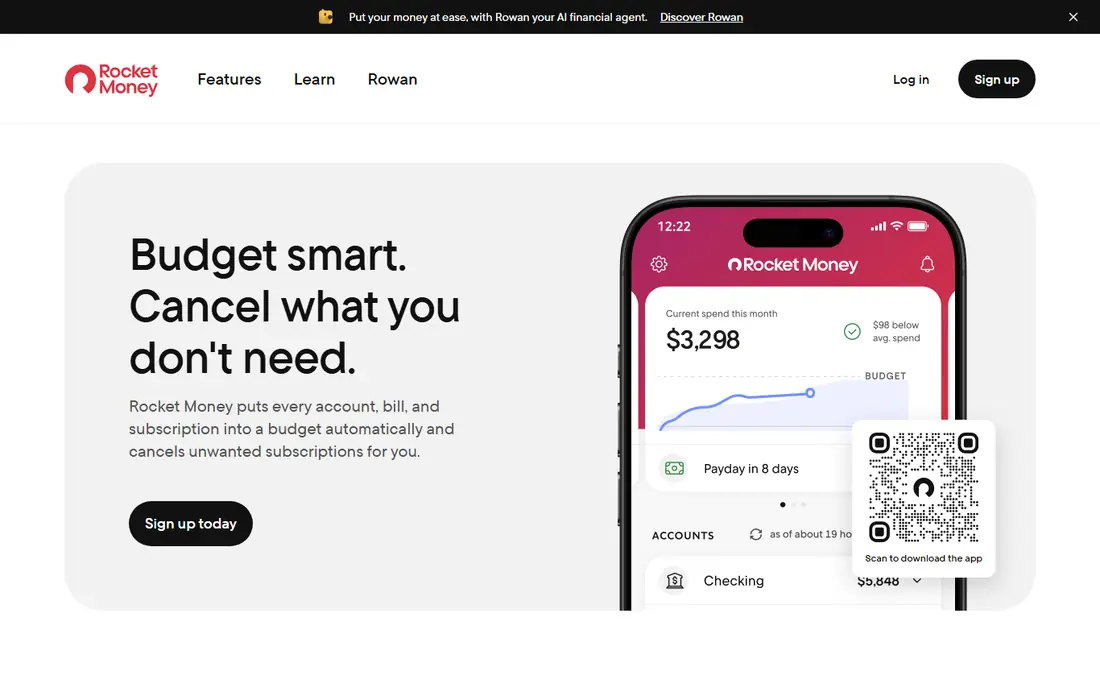
Rocket Money, formerly Truebill, is best at finding money you are already losing. Connect your accounts and it lists recurring charges, flags price increases, and helps you cancel subscriptions you no longer use. That single job saves many users more than the cost of any budgeting app, and the free tier covers basic tracking and subscription detection.
Full budgeting, custom categories, and web access require Premium, which uses a sliding scale typically reported at $7 to $14 per month. Bill negotiation is a separate service, and Rocket Money takes a percentage of the first-year savings when it succeeds, so read those terms before you use it. If subscriptions and bills are your main leak, start free here, even if you later pair it with YNAB or Monarch for stricter budgeting.
- Free tier finds subscriptions and tracks spending
- Bill negotiation service can lower some bills
- Easy to cancel unwanted subscriptions
- Best budgeting tools sit behind Premium
- Premium price varies on a sliding scale
- Bill negotiation takes a share of savings
Quicken Simplifi is a solid middle ground between a free tracker and a strict budgeting system. It syncs accounts, categorizes spending, and builds a spending plan that shows how much you have left after bills and savings goals. Bill reminders and cash flow forecasts help you see upcoming tight weeks before they arrive, which is useful for variable incomes.
Simplifi does not enforce zero-based budgeting, so hands-on budgeters may find it too loose. Pricing also varies: first-year promotions are common, with a standard rate reported around $5.99 per month billed annually, so check the renewal price at checkout. For people who want automatic tracking, a clear left-to-spend number, and a lower annual cost, Simplifi is strong value.
- Automatic account syncing and categorization
- Spending plan shows what is left to spend
- Cash flow forecasts and bill reminders
- Not a strict envelope or zero-based system
- Pricing varies with promotions and renewal rates
- Less household sharing depth than Monarch
Copilot Money is the design-led option, built for iPhone, iPad, Mac, and the web. Transactions are categorized automatically, budgets are easy to adjust, and the interface makes reviewing spending feel less like a chore. It also tracks net worth and investments, so it can replace a separate dashboard for many Apple users.
The limits are platform and price. There is no Android app, so Android households should look at Monarch or Simplifi instead. At $13 per month or $95 per year, Copilot costs more than Simplifi without offering a strict budgeting method like YNAB. If you live in the Apple ecosystem and you will actually open an app because it looks and feels good, that design advantage is worth weighing.
- Clean, fast design on Apple devices
- Automatic categorization with smart review tools
- Budgeting, net worth, and investment tracking in one app
- No Android app
- Web version is still catching up to mobile
- $95 per year cost is high for a tracker without a strict method
EveryDollar keeps budgeting simple on purpose. You create a monthly budget, assign income to categories, and track spending against those targets. The free version uses manual entry, which suits people who prefer to type in spending or who do not want to link bank accounts at all. Its structure follows the zero-based approach popularized by Ramsey Solutions, with an emphasis on debt payoff steps.
Automatic bank syncing sits behind Premium, which costs $17.99 per month or $79.99 per year, and the app is less flexible than YNAB for irregular income or detailed goals. Reporting is also basic compared with Monarch. If you want a simple, free, manual budget and you like a clear monthly plan, EveryDollar is a good start. If you want automation, pay for Premium or choose Simplifi.
- Simple zero-based budgeting with a clear layout
- Free manual version works without bank links
- Ties into a popular debt payoff approach
- Bank syncing requires Premium at $17.99 per month or $79.99 per year
- Less flexible than YNAB for complex budgets
- Reporting tools are basic
Goodbudget brings the old cash-envelope method to your phone. You divide money into virtual envelopes for groceries, rent, transport, and fun, then spend from each envelope until it is empty. That visual limit is powerful for people who overspend in one category while other bills wait, and it works without linking a bank account if you prefer manual control.
The free plan includes a limited number of envelopes and one account, while Plus at $10 per month or $80 per year adds unlimited envelopes, more accounts, and bank syncing features. Manual entry is the main cost in time, though many users say that friction is what makes the method work. Goodbudget is ideal for couples or families who want shared envelopes and a simple system they can explain in a minute.
- Digital envelope method is easy to understand
- Free plan works without linking bank accounts
- Shared budgets suit couples and families
- Free plan limits envelopes and accounts
- Bank syncing requires a paid plan
- Manual entry takes time each week
PocketGuard answers one question well: after bills, savings, and goals, how much can I safely spend today. It syncs accounts, categorizes transactions, and shows that number prominently, which helps people who overspend not because they lack a budget, but because they lack a clear daily limit. Bill tracking adds a useful overview of upcoming charges.
Planning depth is thinner than YNAB or Monarch, with fewer tools for long-term goals or complex household budgets. The free plan limits how many accounts you can link, and Plus at $12.99 per month or $74.99 per year opens the full set. If you want a simple guardrail against overspending rather than a full financial dashboard, PocketGuard fits.
- Single safe-to-spend figure after bills and goals
- Automatic categorization
- Bill tracking and subscription overview
- Less planning depth than YNAB or Monarch
- Free plan limits linked accounts
- Plus at $74.99 per year is needed for full features
Empower, formerly Personal Capital, offers a free dashboard that tracks accounts, investments, and net worth in one place. Its retirement planner and investment checkup tools give a longer-term view than most budgeting apps, which focus on this month only. For people who mainly want to see the whole picture without paying a subscription, Empower is the best free option here.
Monthly budgeting is lighter than in YNAB, Monarch, or Simplifi, with fewer envelope or zero-based tools. Empower also offers paid wealth management, which carries advisory fees, though the core dashboard remains free. Use Empower for net worth and investment oversight, and pair it with a budgeting app if you need strict monthly control.
- Free personal dashboard with account syncing
- Net worth, investment, and retirement planning tools
- No subscription for core tracking
- Not a strict monthly budgeting app
- Wealth management services carry advisory fees
- Budgeting features are lighter than YNAB or Monarch
How we picked these
We compared official feature pages, pricing pages, app store listings, and public reviews, and we kept apps that are active in the US in 2026, support account syncing or a clear manual method, and state their pricing or trial terms. We included zero-based, envelope, automatic tracking, and net worth tools, plus free and paid options, so different budgets and habits are covered. We did not claim hands-on testing, and we note where prices vary with promotions, plan length, or renewal rates.
How to choose the best budgeting app for you
Start with the problem you actually have. If you overspend and need discipline, choose a method-driven app such as YNAB or Goodbudget. If you want a full household view, choose Monarch. If subscriptions are draining your account, start free with Rocket Money. If you want automatic tracking at a lower cost, try Quicken Simplifi, and if you only need a free overview, Empower covers net worth well.
Test syncing before you commit
Bank syncing is the feature most likely to disappoint, because support varies by bank and account type. Use the trial period to link your main checking, savings, and credit card accounts, and check whether transactions categorize correctly. If syncing fails for a key account, switch apps early rather than paying for a year of manual fixes.
Make the weekly check a habit
A budgeting app only works if you open it. Set a weekly 15-minute check to review spending, adjust categories, and move money to savings before the weekend. Automate bills and savings where you can, keep the number of categories small at first, and review subscriptions monthly. The best system is the one you still use in three months, not the one with the most charts on day one.
Sources
- https://www.ynab.com
- https://www.monarch.com
- https://www.rocketmoney.com
- https://www.quicken.com
- https://copilot.money
- https://www.everydollar.com
- https://goodbudget.com
- https://pocketguard.com
- https://www.empower.com
- https://www.supermoney.com/reviews/money-management
- https://financefeeds.com/the-best-budgeting-apps-of-2026/
- https://www.thepennyhoarder.com/budgeting/best-expense-tracking-app/