Best Investment Apps for Beginners in 2026: 9 Apps Compared
By ToolNimba Editorial Team October 28, 2026 10 min read

- Top pick
 Fidelity
All-round beginner investing
Starting priceFreeCheck out FidelityRead our review - Runner-up
 Charles Schwab
Education and human support
Starting priceFreeCheck out Charles SchwabRead our review - Also great
 Robinhood
Simple mobile investing
Starting priceFreeCheck out RobinhoodRead our review
How we researched this
We compared official pricing and feature pages, app store listings, privacy policies and public user reviews. Prices change, so check the provider's site before you pay.
Key takeaways
- Fidelity is our pick for most beginners because it pairs zero-commission stock and ETF trades with strong education and retirement accounts.
- Charles Schwab is the best alternative if you want branch access and human support alongside a simple app.
- Robinhood suits mobile-first beginners who want the simplest interface, while Webull suits beginners who want free paper trading first.
- SoFi Invest and Acorns suit hands-off beginners, with automated investing and small starting amounts.
- This is not financial advice. Investing carries risk, including loss of money, and past returns do not predict future results.
Quick comparison
| Name | Best for | Starting price | Free plan | |
|---|---|---|---|---|
| Fidelity | All-round beginner investing | Free | Yes | Visit |
| Charles Schwab | Education and human support | Free | Yes | Visit |
| Robinhood | Simple mobile investing | Free | Yes | Visit |
 Webull | Paper trading and active learning | Free | Yes | Visit |
 SoFi Invest | Active and automated in one app | Free | Yes | Visit |
 Vanguard | Low-cost index investing | Free | Yes | Visit |
 M1 Finance | Automated portfolio building | Free | Yes | Visit |
 Acorns | Passive micro-investing | $3 per month | No | Visit |
 Betterment | Fully managed portfolios | $5 per month | No | Visit |
The best investment apps for beginners
Most major brokers now charge zero commission on online US stock and ETF trades, so the real differences for beginners are education, account types, fractional shares, and how easily the app nudges you toward a steady plan. The apps below cover self-directed trading, automated portfolios, and micro-investing, so you can match the app to how much control you want.

Fidelity is the strongest all-round starting point for a US beginner. You get zero-commission online stock and ETF trades, no account minimum on core accounts, fractional shares from $1, and retirement accounts including IRAs in the same app. Education is a genuine strength, with guides and calculators that explain index funds, diversification, and retirement planning in plain terms.
The app packs a lot in, so new users may feel overwhelmed on first open. That density is the price of depth, and most beginners settle in after a week of regular use. If you want one broker that can grow from a first $10 investment to a full retirement plan, Fidelity is our first pick.
- Zero-commission US stock and ETF trades
- Fractional shares from $1
- Strong education and retirement accounts
- App can feel dense at first
- Advanced tools take time to learn

Charles Schwab matches Fidelity on core cost, with zero-commission online stock and ETF trades and no minimum to open a brokerage account. Where it stands out is support. Phone help and US branch access give beginners a human fallback when an app screen is unclear, which matters for a first IRA or a rollover question.
The range of accounts and tools can feel complex at first, and the app is less minimalist than Robinhood. That is a fair trade for support depth. If you want a full-service broker at DIY prices, and you value being able to talk to a person, Schwab is the best alternative to Fidelity.
- Zero-commission US stock and ETF trades
- Strong support including branches
- Good research and education
- Product range can feel complex
- App navigation takes learning
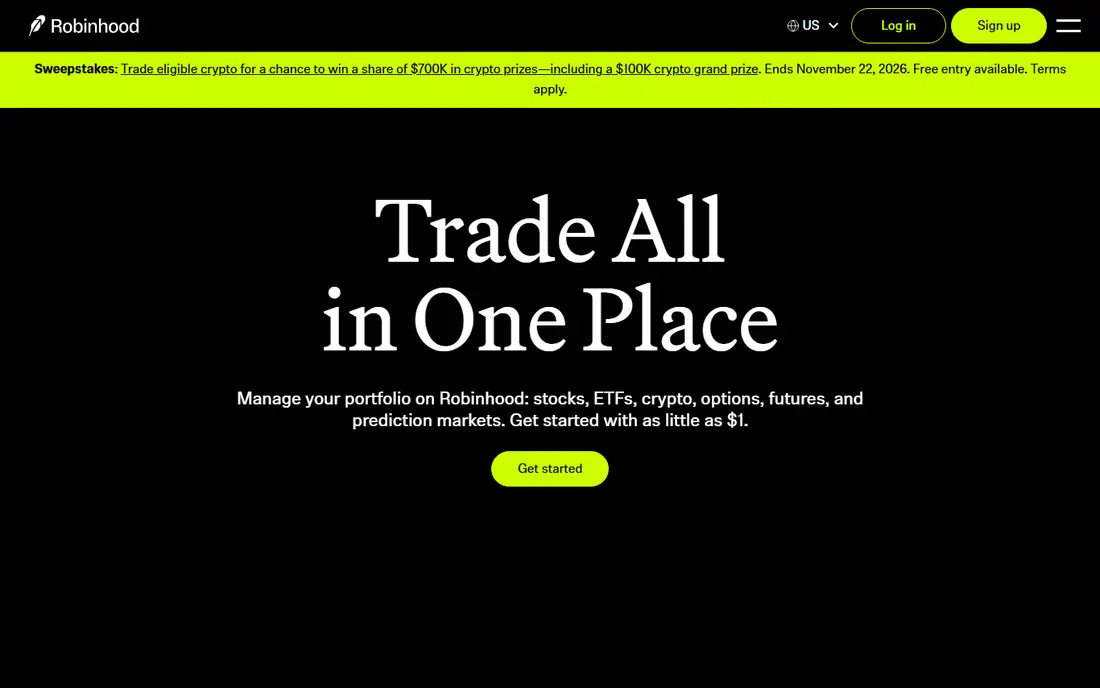
Robinhood remains the simplest mobile investing experience. The app is clean, trades take a few taps, fractional shares start at $1, and recurring investments help beginners automate a plan. Gold, at $5 per month, adds research and higher cash interest for users who want it, but the free tier covers core trading.
Education is lighter than Fidelity or Schwab, and the simple design can nudge some users toward frequent trading, which rarely helps long-term returns. If you want maximum simplicity and you already know you will favor broad ETFs over stock picking, Robinhood is a good, low-friction start.
- Cleanest mobile interface
- Zero-commission stock and ETF trades
- Fractional shares from $1
- Lighter education than Fidelity or Schwab
- Interface can encourage frequent trading
Webull is the best pick for beginners who want to practice before risking real money. Paper trading uses real market prices, so you can test ideas, learn order types, and build confidence without loss. Real trading is also zero-commission on US stocks and ETFs, with strong charts and data included free.
The app leans toward active trading, which can distract from a simple long-term plan. It is less focused on guided retirement planning than Fidelity or Schwab. Use Webull to learn actively, then pair that learning with a steady ETF plan rather than chasing every chart signal.
- Free paper trading with real prices
- Zero-commission stock and ETF trades
- Strong charts for learners
- Less suited to simple retirement planning
- Interface leans toward active trading
SoFi Invest suits beginners who are unsure whether they want to pick investments or automate them. Active investing starts from $5 with fractional shares, and automated investing starts from $50 with a diversified portfolio built for your goal. Having both in one app lets you start automated and try active trading later without switching brokers.
Research and charting are lighter than Fidelity, Schwab, or Webull, so active traders may outgrow it. SoFi also promotes its banking and loan products inside the app, which some users find distracting. For a clean, low-cost start that covers both paths, SoFi is a strong, friendly choice.
- Zero-commission stock and ETF trades
- Active investing from $5
- Automated investing from $50
- Research tools are lighter than specialist brokers
- Banking upsell can distract
Vanguard is the purist pick for index fund investors. It offers zero-commission trades on most US stocks and ETFs, a deep range of low-cost index funds, and a straightforward IRA setup for retirement savers. If your plan is to buy broad index funds regularly and hold them for years, Vanguard's cost structure fits that plan well.
The app and website feel dated next to Robinhood or Fidelity, and active trading tools are basic. That matters little if you invest monthly and rarely trade. For long-term, low-cost index investing with minimal fuss, Vanguard remains a trusted, sensible choice.
- Zero-commission on most US stocks and ETFs
- Low-cost index funds
- Simple IRA setup
- App feels dated
- Trading tools are basic compared with rivals
M1 Finance, now part of a larger platform group, lets you build a portfolio as a pie of stocks and ETFs, set target percentages, and let deposits and rebalancing follow that pie automatically. Self-directed accounts carry no commissions, and fractional shares make a diversified pie possible with small amounts.
Trades run in set windows rather than instantly all day, so it does not suit intraday traders. Some premium features, such as extra trading windows, cost $3 per month. If you want a DIY portfolio that mostly runs itself, M1 gives you more control than a managed app without the daily trading temptation.
- No commissions on self-directed accounts
- Pie-based portfolios automate rebalancing
- Fractional shares
- Trading windows limit intraday control
- Premium features cost $3 per month
Acorns is built for people who struggle to start. Round-ups invest spare change from card purchases into a diversified portfolio, and recurring deposits add to it over time. The app is simple, the portfolios are managed for you, and retirement and family account options extend the same habit to longer goals.
The monthly fee, from $3 per month, matters when a balance is still small, since it eats a larger share of returns early on. You also get limited control over individual stocks, since Acorns favors diversified portfolios. If a tiny automatic habit is what gets you investing at all, Acorns earns its fee by making starting effortless.
- Round-ups invest spare change automatically
- Simple portfolios
- Retirement and family accounts available
- Monthly fee matters on small balances
- Limited control over individual holdings
Betterment suits beginners who want investing fully handled. You set a goal, answer risk questions, and Betterment builds and manages a diversified portfolio, rebalances it, and reinvests dividends. The digital plan starts at $5 per month, or 0.25 percent annually with a qualifying balance or deposits, depending on the plan you choose.
You give up stock-picking control, and the fee, while modest, is a real cost compared with a free self-directed ETF account. That cost buys time, discipline, and planning tools many beginners lack. If you want to set a plan and stop worrying about daily choices, Betterment is a calm, well-built option.
- Fully managed diversified portfolios
- Goal-based planning
- Automatic rebalancing and tax tools
- Management fee applies
- Less control than self-directed brokers
How we picked these
We compared official commission pages, account terms, and app listings for brokers and apps that are live in 2026 and truly fit US beginners. We favored zero-commission stock and ETF trading, fractional shares, retirement accounts, and education, since those features shape a beginner's first year more than advanced charting. Prices shown are starting plan prices from recent vendor listings, and fund expense ratios still apply inside ETFs and mutual funds. We did not claim hands-on investing we did not do, and we treated all return claims with caution.
What to check before you open an account
Start with the goal, not the stock. A retirement account, such as a Roth IRA, a general investing account, and a short-term savings goal each point to different choices. Check whether the app offers the account type you need, whether fractional shares let you start small, and whether recurring investments can automate your plan. A good beginner app makes a monthly ETF purchase as easy as a single stock trade.
Costs hide in the details. Commissions may be zero, but fund expense ratios, options contract fees, margin interest, and account transfer fees still matter. Read the fee schedule, check whether cash interest and payment for order flow affect your fills, and avoid margin borrowing as a beginner. Margin can multiply losses, and it is not needed for a first diversified portfolio.
A simple beginner plan
Many beginners do well with a broad, low-cost ETF portfolio, regular deposits, and a long holding period. Diversification across many stocks reduces single-company risk, and regular investing smooths out market ups and downs over time. Keep an emergency fund in cash outside investing, avoid putting rent money into stocks, and review your plan yearly rather than reacting to daily headlines.
A plain risk note
This article is not financial advice. Investing involves risk, including possible loss of principal, and market values can fall. Consider your goals, time horizon, and risk tolerance, and speak to a qualified financial adviser if you are unsure. Past performance does not guarantee future results.
Sources
- https://www.fidelity.com
- https://www.schwab.com
- https://www.robinhood.com
- https://www.webull.com
- https://www.sofi.com
- https://www.vanguard.com
- https://www.m1.com
- https://www.acorns.com
- https://www.betterment.com
- https://rankite.com/blog/best-software-for-investing
- https://www.selfemployed.com/6-popular-free-investment-apps-for-self-employed-beginners-in-2026/