Best Investment Companies in 2026: 8 Firms Compared
By ToolNimba Editorial Team October 28, 2026 9 min read

- Top pick
 Fidelity Investments
Best all-round broker
Starting priceFreeCheck out Fidelity InvestmentsRead our review - Runner-up
 Charles Schwab
Retirement savers and traders
Starting priceFreeCheck out Charles SchwabRead our review - Also great
 Vanguard
Long-term index investors
Starting priceFreeCheck out VanguardRead our review
How we researched this
We compared official pricing and feature pages, app store listings, privacy policies and public user reviews. Prices change, so check the provider's site before you pay.
Key takeaways
- Fidelity, Charles Schwab, and Vanguard remain the strongest all-round picks, with $0 commissions on online stock and ETF trades and no account minimum to open.
- Robinhood, SoFi Invest, and E*TRADE suit mobile-first investors who want a simple app and fractional shares from small amounts.
- Interactive Brokers suits active and international investors, while Betterment suits people who want a managed portfolio without picking stocks.
- This is not financial advice; investing carries risk, and fund fees, options fees, and transfer fees still vary even when stock trades are free.
Quick comparison
| Name | Best for | Starting price | Free plan | |
|---|---|---|---|---|
| Fidelity Investments | Best all-round broker | Free | Yes | Visit |
| Charles Schwab | Retirement savers and traders | Free | Yes | Visit |
| Vanguard | Long-term index investors | Free | Yes | Visit |
 Robinhood | Mobile-first beginners | Free | Yes | Visit |
 E*TRADE | Research and active trading | Free | Yes | Visit |
 Interactive Brokers | Active and global traders | Free | Yes | Visit |
 SoFi Invest | Investing plus banking in one app | Free | Yes | Visit |
 Betterment | Hands-off managed portfolios | $5 per month | No | Visit |
The best investment companies
We compared official fee schedules, account pages, app store listings, and public reviews for firms that serve US investors in October 2026. This is not financial advice; investing carries risk, and past results do not predict future returns. The list mixes low-cost brokers, a mobile-first app, a global broker, and a managed portfolio service, so you can match the firm to how involved you want to be.
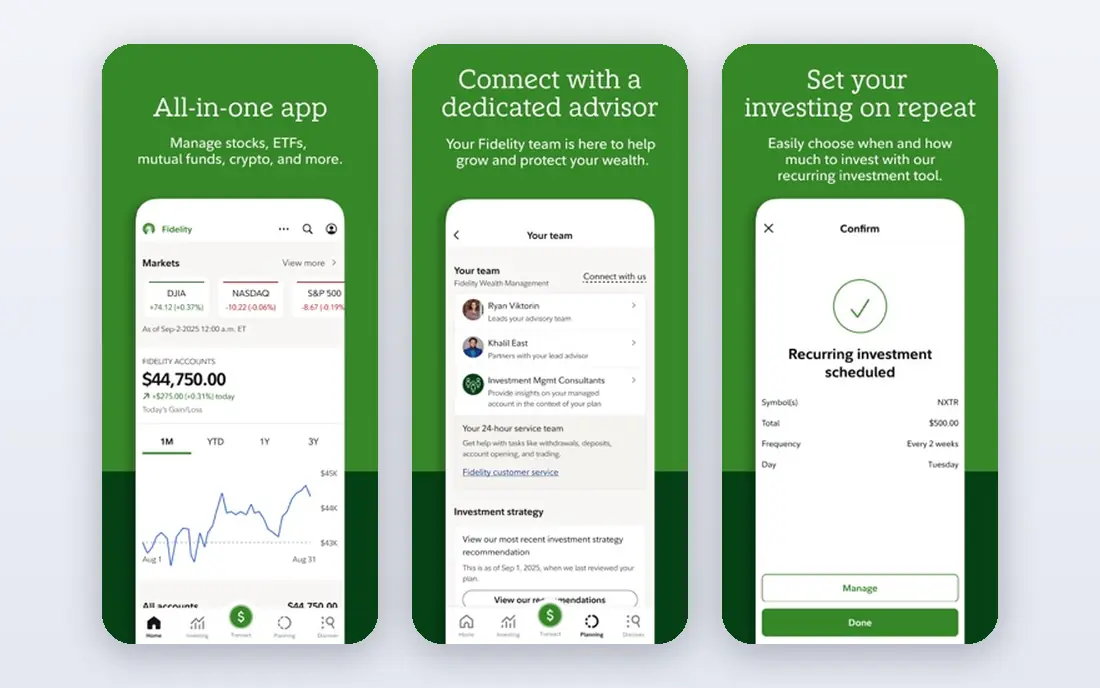
Fidelity is our pick for most investors because it covers nearly every need in one account. You can trade stocks and ETFs online at $0 commission, buy fractional shares from $1, and use its zero-expense index funds for a low-cost core portfolio. Retirement accounts, health savings accounts, and cash management sit in the same login, which helps as your finances grow.
The main downside is choice overload. The website and app pack in research, screeners, and planning tools that a beginner may not need at first. Some non-Fidelity mutual funds also carry a transaction fee. If you want one firm that can grow from a first Roth IRA to a full portfolio, Fidelity is the easiest default.
- $0 stock and ETF commissions
- Zero-expense index funds
- Strong research and support
- Platform can feel busy for beginners
- Some mutual funds carry transaction fees
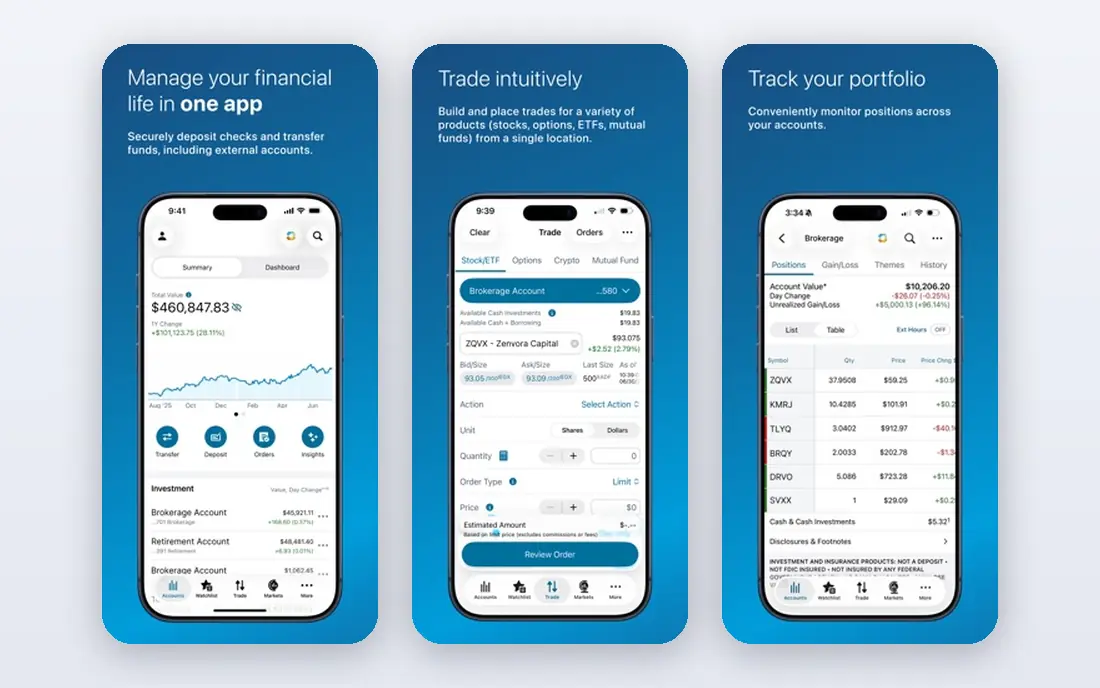
Charles Schwab pairs a full-service broker with DIY prices. Online stock and ETF trades cost $0, fractional shares start from $1, and the thinkorswim platform gives active traders charts, screeners, and options tools. With hundreds of branches and round-the-clock phone support, Schwab also suits investors who want help in person.
Watch the cash sweep. Uninvested cash in a Schwab brokerage account may sit in a bank sweep with a lower yield than a money market fund at another broker, so check where idle cash goes. Schwab also charges $0.65 per options contract. For retirement savers and traders who value service and tools, Schwab is a close rival to Fidelity.
- $0 stock and ETF commissions
- Thinkorswim trading platform
- Large branch network
- Default cash sweep yields can be low
- Some fund fees still apply

Vanguard built its name on low-cost index investing, and it still suits buy-and-hold investors best. Its ETFs trade online at $0 commission with no minimum, and its mutual funds remain a popular core holding for retirement accounts. The firm structure, owned by its funds, keeps its focus on keeping fund costs low.
The trade-offs are practical. Vanguard charges a $25 annual account fee that is waived with electronic delivery or a qualifying balance, and many mutual funds still require $1,000 to $3,000 to start. Options cost $1 per contract, higher than Fidelity or Schwab. Pick Vanguard if you plan to hold its funds for years and you prefer ETFs or larger mutual fund purchases.
- Low-cost index funds and ETFs
- Strong long-term focus
- No minimum for ETFs
- $25 annual account fee unless waived
- Mutual fund minimums can be high
Robinhood is the simplest way to start investing from a phone. Stocks, ETFs, and options trade at $0 commission, fractional shares start from $1, and recurring investments help beginners build a habit. The app also offers IRAs and crypto trading, which appeals to younger investors who want several asset types in one place.
Depth is the limit. Robinhood offers fewer research tools than Fidelity or Schwab, and it does not offer mutual funds. A full account transfer out costs $100, so check exit fees before moving a large account. Pick Robinhood for a simple start, and consider a fuller broker later if you need bonds, funds, or deeper research.
- $0 stock, ETF, and options commissions
- Fractional shares from $1
- Simple mobile app
- Fewer research tools
- No mutual funds
- Transfer-out fee applies
E*TRADE, now part of Morgan Stanley, suits investors who want research depth without paying commissions on stock and ETF trades. Its platforms offer screeners, charts, and analyst research, and its mobile app covers most trading needs. Fractional share orders are available on a select list of stocks and ETFs, with a $5 minimum on those orders.
Options trades cost $0.65 per contract, and transfer fees apply for full or partial moves out. The range of platforms can also feel complex for a first-time investor. Pick E*TRADE if you trade more often, value research, and want a broker backed by a large bank group.
- $0 stock and ETF commissions
- Strong research and screeners
- Fractional shares on select stocks
- Options cost $0.65 per contract
- Transfer fees apply
- Platform can feel complex
Interactive Brokers is the pick for serious traders and investors who want global reach. IBKR Lite offers $0 commissions on US stock and ETF trades, while IBKR Pro adds per-share pricing and tools for active traders. The platform covers stocks, options, futures, forex, and markets far beyond the United States.
That breadth makes it a poor first broker for many beginners. The interface assumes trading knowledge, and Pro fees vary by product and market. Pick Interactive Brokers when you trade often, invest abroad, or need tools that simpler apps do not offer, and start on Lite if you want the simpler price plan.
- $0 US trades on IBKR Lite
- Access to many global markets
- Low margin rates for pros
- Complex platform for beginners
- Pro pricing varies by product
SoFi Invest suits people who already bank, borrow, or save with SoFi and want investing in the same app. Active investing starts from $5, automated investing from $50, and stock and ETF trades cost $0 online. The simple interface and financial planning tools make it approachable for a first portfolio.
SoFi Invest is thinner than Fidelity or Schwab for advanced traders, and it does not list mutual funds in the same way. It also lacks some of the research depth that active traders expect. Pick SoFi Invest if you value one app for banking and investing and you plan to stick to stocks, ETFs, and automated portfolios.
- $0 stock and ETF commissions
- Active investing from $5
- Automated investing from $50
- No mutual funds listed
- Fewer advanced trading tools
Betterment is for investors who do not want to pick stocks at all. You answer questions about goals and risk, and Betterment builds and manages a diversified portfolio, rebalances it, and reinvests dividends. That hands-off approach suits busy savers and retirement investors who prefer a plan over daily decisions.
The cost is a management fee, starting at $5 per month on some plans or 0.25 percent per year on qualifying balances. You also give up direct control over individual holdings. This is not financial advice; investing carries risk, and a managed portfolio can still fall in value. Pick Betterment when you want professional management without hiring an adviser.
- Managed portfolios with automatic rebalancing
- Goal-based planning
- Tax-loss harvesting on higher tiers
- Management fee applies
- Less control over individual holdings
How we picked these
We compared official fee schedules, account and pricing pages, app store listings, and public reviews for investment firms that serve US investors in October 2026. We kept firms with a clear official homepage and current $0 or low-cost pricing, and we favored a mix of full-service brokers, mobile apps, a global broker, and a managed service. We noted options fees, account fees, and transfer fees, since those costs still vary when stock trades are free.
How to choose an investment company
Start with how involved you want to be
A self-directed broker suits you if you want to pick funds and stocks yourself, while Betterment suits you if you want a managed portfolio. Active traders should weigh platform tools and options fees, while long-term savers should weigh fund expense ratios and cash sweep yields. The right firm is the one that fits your habits, not just the lowest headline fee.
Check the fees beyond free trades
Stock and ETF trades may be free, but options contracts, mutual fund transactions, account fees, and transfer fees still vary. Vanguard charges a $25 annual fee unless waived, Schwab charges $50 for a full transfer out, and Robinhood charges $100. Read the fee schedule for the account type you will actually open, and check fund expense ratios too.
Match accounts to your goals
Check that the firm offers the accounts you need, such as a Roth IRA, traditional IRA, taxable brokerage account, or 401(k) rollover. Fractional shares from $1 help small savers start, while automatic investing helps you stay consistent. This is not financial advice; investing carries risk, so only invest money you can afford to leave invested for your time horizon.
Sources
- https://www.fidelity.com
- https://www.schwab.com
- https://www.vanguard.com
- https://www.robinhood.com
- https://www.etrade.com
- https://www.interactivebrokers.com
- https://www.sofi.com
- https://www.betterment.com
- https://www.schwab.com/compare-us
- https://www.brokerage-review.com/discount-broker/compare-brokerage-commissions.aspx