Best Landlord App in 2026: 9 Apps Compared
By ToolNimba Editorial Team November 13, 2026 10 min read

- Top pick
 TurboTenant
Free start for DIY landlords
Starting priceFreeCheck out TurboTenantRead our review - Runner-up
 Avail
Listings and tenant placement
Starting priceFreeCheck out AvailRead our review - Also great
 RentRedi
Flat pricing, unlimited units
Starting price$12 per monthCheck out RentRediRead our review
How we researched this
We compared official pricing and feature pages, app store listings, privacy policies and public user reviews. Prices change, so check the provider's site before you pay.
Key takeaways
- TurboTenant and Avail are the best free starting points for landlords with a handful of units.
- RentRedi stands out for flat pricing, since one monthly fee covers unlimited units instead of charging per door.
- Stessa is the pick for landlords who mainly need clean books and tax-ready reports.
- Buildium and Hemlane suit larger or remote portfolios, but their cost only makes sense once the unit count grows.
Quick comparison
| Name | Best for | Starting price | Free plan | |
|---|---|---|---|---|
| TurboTenant | Free start for DIY landlords | Free | Yes | Visit |
| Avail | Listings and tenant placement | Free | Yes | Visit |
| RentRedi | Flat pricing, unlimited units | $12 per month | No | Visit |
 Innago | Fully free management | Free | Yes | Visit |
 Stessa | Bookkeeping and tax reports | Free | Yes | Visit |
 TenantCloud | Budget accounting depth | $15 per month | Free trial | Visit |
 Landlord Studio | Small portfolios and expenses | Free | Yes | Visit |
 Buildium | Growing portfolios | $62 per month | Free trial | Visit |
 Hemlane | Remote and out-of-state owners | $30 per month | Yes | Visit |
The best landlord apps
A good landlord app replaces scattered spreadsheets, paper leases, and bank-transfer rent chasing with one place for listings, applications, payments, and records. We compared official pricing and feature pages to find apps that fit landlords from a single rental up to a growing portfolio.

TurboTenant is the easiest recommendation for a landlord managing their first rentals. The free plan covers the core workflow: list a property, collect applications, screen tenants, and collect rent online. Listings can reach major rental sites, which helps a single vacancy get seen without paying for separate ads on each site.
The limits appear as a portfolio grows. Deeper accounting and some automation features sit on paid plans, and screening and payment fees can add up depending on who pays them. Still, for one to ten units, the free tier does the job that most new landlords actually need, and you can upgrade only when the extra features start saving real time.
- Free plan covers listings, applications, and rent collection
- Wide listing syndication
- Screening add-ons
- Full accounting sits on paid plans
- Some features cost extra per use
Avail, now part of the Realtor.com network, guides landlords through finding and placing tenants step by step. Listings, applications, screening, and leases live in one flow, and the lease templates are tailored by state, which reduces the guesswork for landlords who do not have a lawyer on call for every vacancy. Rent collection and maintenance requests round out the basics.
The free Unlimited plan covers a lot, but the paid Unlimited Plus plan is priced per unit, so a landlord with twenty doors will feel the difference. Accounting is serviceable rather than deep, so owners who want full books may pair Avail with a separate accounting tool. For placement-focused landlords, though, the guided workflow is genuinely helpful.
- Guided leasing workflow
- State-specific lease templates
- Online rent collection
- Paid plan charges per unit, so costs rise with growth
- Accounting is lighter than dedicated tools
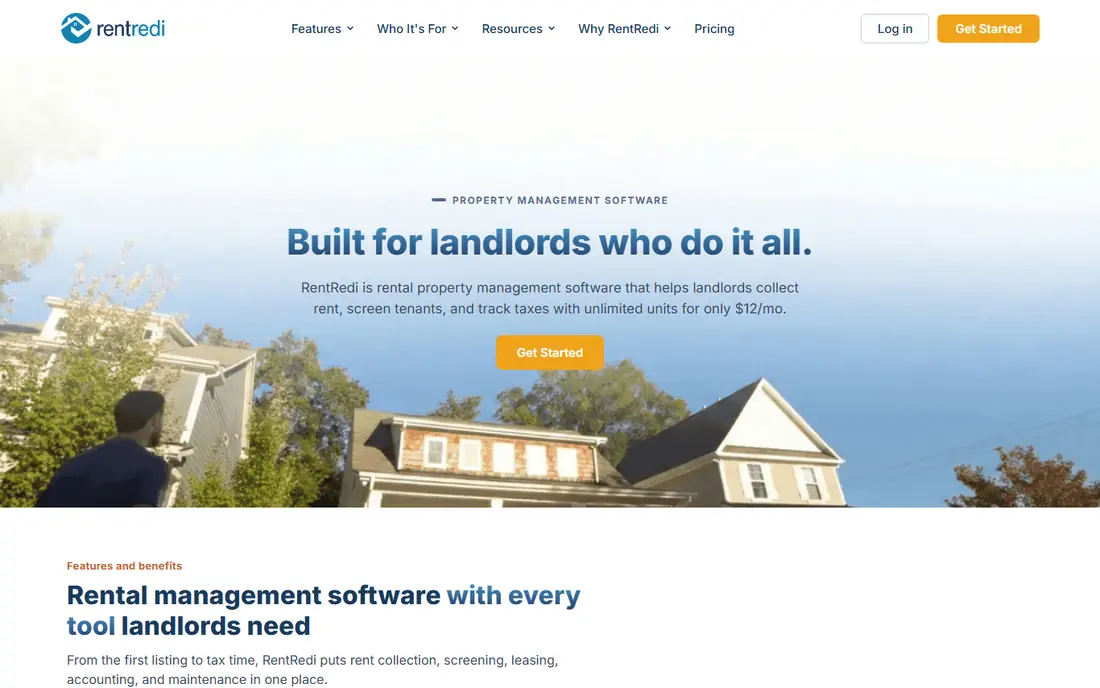
RentRedi wins on pricing logic. Instead of charging per unit, it charges one flat monthly fee for unlimited units, which makes costs predictable as you add doors. The mobile apps are strong, which matters for landlords who handle maintenance requests and rent reminders from a phone rather than a desk.
There is no free tier, so it is a paid decision from day one, though the annual price works out lower than the month-to-month rate. Accounting covers the essentials but is not as deep as a full property management platform. For self-managing landlords who want one price no matter how many units they add, RentRedi is hard to beat.
- One flat fee for unlimited units
- Strong mobile apps
- Listings, screening, and rent collection included
- No free plan
- Some advanced accounting features are lighter than Buildium
Innago is free for landlords, which makes it an obvious trial for anyone on a tight budget. It covers listings, applications, screening, leases, rent collection, and maintenance tracking without a monthly subscription. The interface is plain and easy to learn, which suits landlords who do not want to spend a weekend learning software.
The trade-off is depth and funding. Advanced reporting is thinner than on Stessa or Buildium, and some costs are covered by fees tenants pay, so check what applicants and renters are charged before you commit. If your portfolio is small and your needs are basic, Innago does the core job for nothing, and that is a strong offer.
- Free for landlords
- Listings, screening, leases, and rent collection
- Simple interface
- Fewer advanced accounting features
- Revenue comes partly from tenant-paid fees
Stessa is best thought of as an accounting tool for landlords rather than a full management suite. Connect a bank account and it pulls in transactions, sorts them into rental categories, and builds reports your tax preparer can actually use. The free Essentials tier covers unlimited properties, which is generous for a bookkeeping tool.
It does not try to be a leasing platform, so listings and screening are not the focus. Many landlords use Stessa alongside TurboTenant or Avail: one tool finds and places tenants, Stessa keeps the books straight. If tax time is your pain point, start here before you pay for a bigger platform.
- Free bookkeeping with bank feeds
- Tax-ready reports
- Unlimited properties on the free tier
- Not a full leasing platform
- Rent collection is not its main strength
TenantCloud gives small landlords accounting depth at a low flat price. The Starter plan covers online payments, leases, maintenance requests, and accounting, with portals for tenants and owners. For landlords who want more ledger detail than the free tools offer but do not want Buildium pricing, it sits in a useful middle ground.
The interface packs a lot onto each screen, and new users may need a few sessions to find their way around. A short free trial means you should test it with a real property, not just a demo, before paying. On value, though, TenantCloud is one of the cheapest ways to get proper rental accounting.
- Low flat starting price
- Accounting, leases, and maintenance in one place
- Tenant and owner portals
- Interface can feel busy
- Free trial is short for a full evaluation
Landlord Studio is built for landlords who think in terms of income and expenses first. The free Go tier covers up to three units, with rent tracking, expense logging, and receipt capture from a phone camera. That makes it a good fit for someone with a duplex or a single rental who mainly wants tidy records.
Growth is where the price appears. Beyond three units, the Pro plan adds a per-unit charge on top of the base fee, so costs climb with the portfolio. It also lacks the leasing depth of TurboTenant or Avail. For a very small landlord who wants clean books without a subscription, Landlord Studio is a neat, focused choice.
- Free tier for up to three units
- Expense tracking with receipt capture
- Rent reminders
- Free tier unit cap
- Larger portfolios need the paid Pro plan
Buildium is the step up when a portfolio stops being a side project. It covers the full cycle from listing and leasing to accounting, owner statements, maintenance, and resident portals, with trust accounting for managers who hold client funds. That depth is why property managers and landlords with dozens of units choose it over simpler apps.
The price reflects that scope. Starting around $62 per month, it is hard to justify for two or three units, and setup takes real time. A free trial helps, but budget a week to configure it properly. If you plan to grow past twenty units or hire help, Buildium is the platform to grow into rather than out of.
- Full accounting and trust accounting
- Owner and resident portals
- Maintenance workflows
- Pricey for a handful of units
- Setup takes longer than simpler apps
Hemlane is designed for landlords who do not live near their rentals. Alongside standard leasing, rent collection, and maintenance tools, it offers access to local agents who can show a property, meet a repair worker, or check on a unit. For an out-of-state owner, that local help is the feature that matters most.
Coverage varies by city, so check that your market is well served before relying on the agent network. Pricing starts with a free Starter tier and paid plans from around $30 per month, with per-unit elements on some plans. If distance is your main problem, Hemlane solves a problem the other apps on this list do not touch.
- Local agent network for showings and repairs
- Good for out-of-state owners
- Leasing and management tools
- Service coverage varies by market
- Per-unit costs can add up
How we picked these
We compared official pricing pages, feature pages, and app listings for landlord software, and we kept tools that cover at least two of the core jobs: listings, screening, rent collection, leases, maintenance, or accounting. We favored tools with a clear free tier or published starting price, and we included both free tools for small landlords and paid platforms for growing portfolios. Short-term rental tools were left out, since this list is for long-term landlords.
What to look for in a landlord app
Start with your unit count and your biggest headache. A landlord with two units who struggles with late rent needs different software from a landlord with forty units who struggles with owner statements. Pick the tool that fixes your current problem, not the one with the longest feature list.
Count the total cost, not just the subscription
Free plans often pass screening or card payment fees to tenants, and per-unit plans grow with your portfolio. Add up subscription fees, screening costs, and payment fees for your actual unit count before you compare headline prices. A flat-fee tool can be cheaper at twenty units even if it looks pricier at two.
Check leases and screening for your state
Lease templates and screening rules vary by state and city. Confirm that the templates match your location and that screening reports comply with local rules. Software helps with paperwork, but it does not replace legal advice for an eviction or a disputed deposit.
Test the mobile app before you commit
Most landlord work happens on a phone: a maintenance photo, a rent reminder, a lease signature. Open the mobile app during a trial, not just the desktop site, and make sure the tasks you do weekly are easy there. An app you avoid using will not save you time, however good its desktop version looks.
Sources
Frequently asked questions
What is the best landlord app for small landlords?
TurboTenant and Avail are the best free starting points for small landlords, since both cover listings, applications, screening, and rent collection without a subscription. Add Stessa for bookkeeping if tax reports are your weak spot.
What is the best free landlord app?
Innago is free for landlords and covers listings, screening, leases, rent collection, and maintenance. TurboTenant and Avail also offer genuinely useful free tiers, so the best free pick depends on whether you value placement help or a simpler interface more.
What is the best software for landlords with many units?
Buildium is the strongest pick for growing portfolios because it adds full accounting, owner portals, and maintenance workflows that free tools lack. RentRedi is a cheaper alternative if you mainly need flat pricing for unlimited units.
Do landlord apps collect rent online?
Yes, most landlord apps on this list collect rent online by bank transfer or card. Bank transfers are usually cheaper, while card payments carry processing fees, so check who pays those fees before you turn card payments on.
Can a landlord app replace a property manager?
It can replace much of the paperwork, rent collection, and record keeping, but it cannot show a property, meet a contractor, or handle a difficult tenant in person. Hemlane comes closest for remote owners by offering local agent help, but hands-on work still needs a person.