Best Running App in 2026: 9 Apps Compared
By ToolNimba Editorial Team October 28, 2026 12 min read

- Top pick
 Nike Run Club
Free guided coaching
Starting priceFreeCheck out Nike Run ClubRead our review - Runner-up
 Strava
Social running and segments
Starting priceFreeCheck out StravaRead our review - Also great
 ASICS Runkeeper
Structured plans at low cost
Starting priceFreeCheck out ASICS RunkeeperRead our review
How we researched this
We compared official pricing and feature pages, app store listings, privacy policies and public user reviews. Prices change, so check the provider's site before you pay.
Key takeaways
- Nike Run Club is our pick for most beginners, since guided runs and training plans are free, with no subscription needed for core features.
- Strava is the best choice for social motivation, with segments, clubs, and leaderboards that keep many runners consistent.
- Runkeeper offers the cheapest paid annual plan among the main trackers, at $39.99 per year for Go, with structured plans and privacy-friendly tracking.
- Garmin Connect gives the deepest free analysis, but it works best with a Garmin watch, while phone-only runners will get more from Strava, Nike, or Runkeeper.
- Start free, run for three weeks, and pay only for the coaching, analysis, or social features you actually open after each run.
Quick comparison
| Name | Best for | Starting price | Free plan | |
|---|---|---|---|---|
| Nike Run Club | Free guided coaching | Free | Yes | Visit |
| Strava | Social running and segments | Free | Yes | Visit |
| ASICS Runkeeper | Structured plans at low cost | Free | Yes | Visit |
 adidas Running | Multi-sport tracking | Free | Yes | Visit |
 MapMyRun | Route mapping and history | Free | Yes | Visit |
 Garmin Connect | Deep free analysis with a watch | Free | Yes | Visit |
 Couch to 5K | Absolute beginners | $4.99 | No | Visit |
 Zombies, Run | Story-driven motivation | Free | Yes | Visit |
 Zwift | Indoor running and racing | $19.99 per month | Free trial | Visit |
The best running app
A running app should do three things well: record distance and pace accurately, help you follow a plan, and keep you coming back. We compared official feature pages, app store listings, pricing pages, and public reviews for the main running apps available in the United States in October 2026. Prices below are starting figures, and some premium prices are sold only inside the app, so check the store listing before you subscribe.
Nike Run Club is hard to beat on value, because its best features cost nothing. Guided runs talk you through speed, recovery, and long runs, training plans cover distances from 5K to marathon, and achievements mark milestones without a paywall. The app also tracks pace, distance, heart rate with a connected watch or sensor, and run history in a clean feed. The trade-off is depth. Serious runners who want detailed power, cadence, or segment analysis will find Strava or Garmin Connect more useful, and the social side is quieter than Strava. For beginners and intermediate runners who want coaching in their ears and a plan to follow, Nike Run Club is the first app to install, and it stays useful even after you add a second tracker.
- Free guided runs and training plans
- Audio coaching from Nike coaches and athletes
- Challenges and achievement tracking
- Social features are thinner than Strava
- Data analysis is simpler than paid rivals
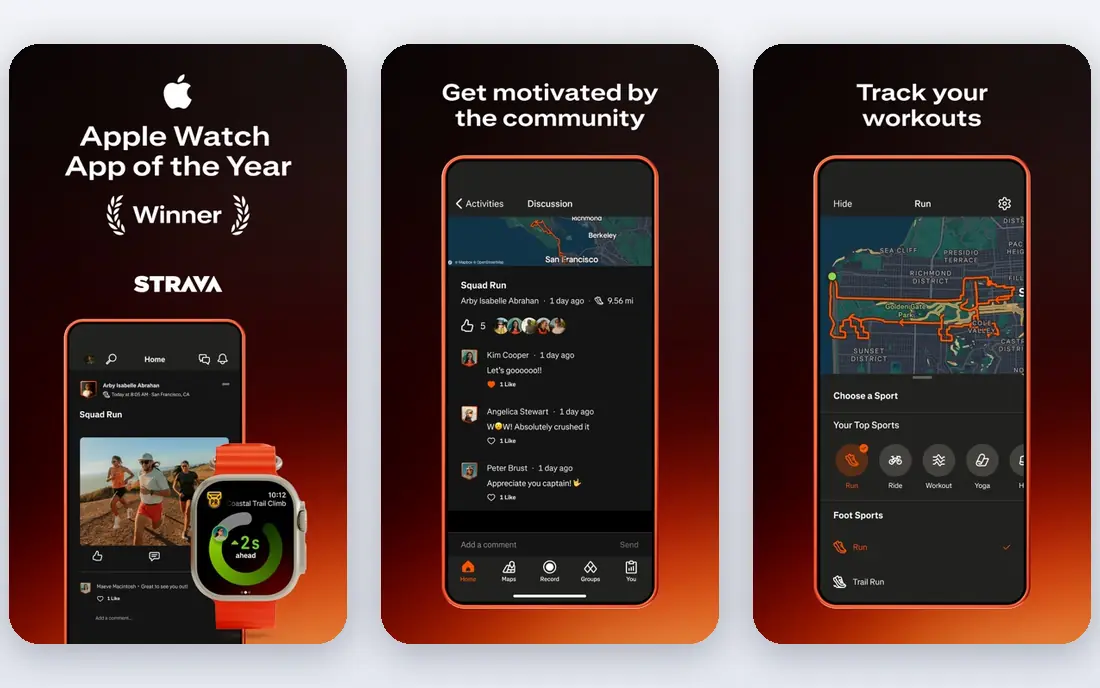
Strava works because running stops feeling solitary. Segments turn local roads and trails into leaderboards, clubs give group challenges a home, and kudos from friends add a small reward after a hard run. The route builder and global heatmaps also help you find popular, safe routes in a new city, and the app syncs with Garmin, Apple Watch, Coros, and many other devices. The free tier covers tracking and social features well, but deeper analysis, route planning extras, and training insights require a subscription. That paywall frustrates runners who only want their own data in detail. If motivation is your main problem, Strava is still the best answer, since the social layer is the feature other apps cannot copy easily.
- Segments, clubs, and leaderboards for motivation
- Route builder and heatmaps
- Syncs with almost every watch and app
- Most detailed analysis sits behind a subscription at $11.99 per month or $79.99 per year
- Feed can feel competitive
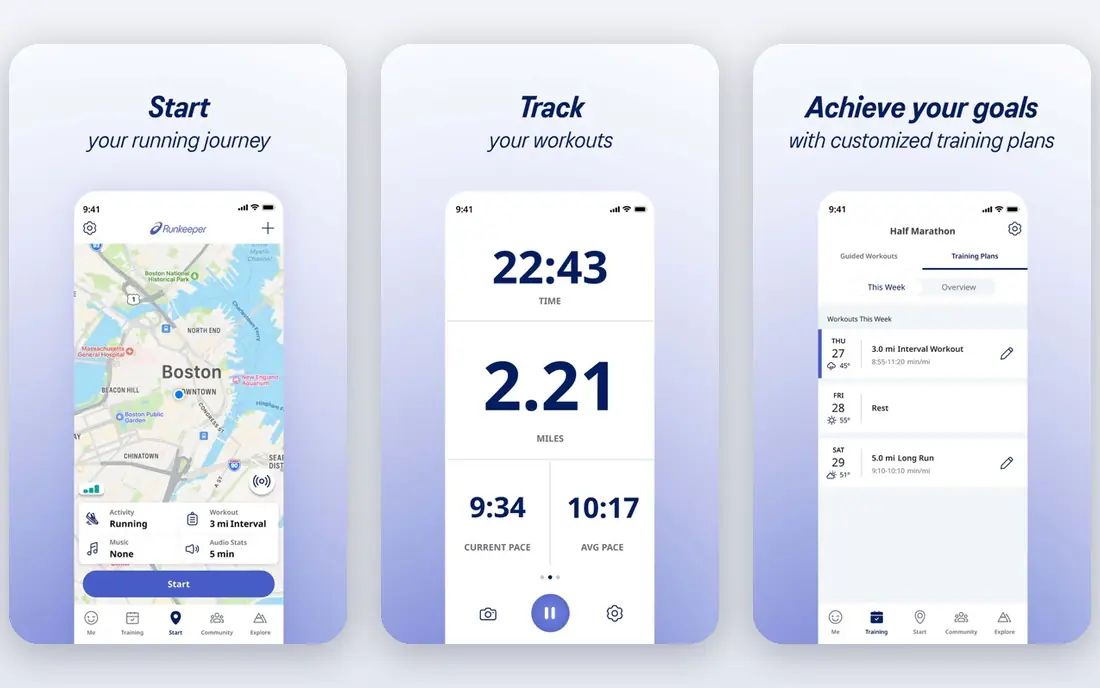
Runkeeper has been tracking runs since 2008, and it remains a calm, reliable choice. The free version records GPS runs, manual activities, distance, pace, and calories, and keeps your full history without pushing a social feed at you. That quiet design suits runners who want to train without leaderboards or public posts. Runkeeper Go adds personalized training plans, deeper insights, and progress tracking for $9.99 per month or $39.99 per year, which is the cheapest annual paid plan among the main trackers here. The community is smaller than Strava, so you will not find as many friends on it, and the plans are less charismatic than Nike audio coaching. For goal-focused runners who value privacy and low cost, Runkeeper is an easy pick.
- Free GPS tracking and full history
- Go plans at $9.99 per month or $39.99 per year
- Audio cues for pace and distance
- Smaller community than Strava or Nike
- Training plans are solid but less polished than Nike guided runs
adidas Running, long known as Runtastic, is a good all-round tracker for people who run plus do other sports. The free version covers GPS tracking, route maps, basic stats, and challenges, and the interface stays simple even when you switch between running, cycling, and walking. Live tracking, voice coaching, and training plans sit in the Premium tier for runners who want more guidance. The awkward part is pricing. adidas now sells Premium only inside the app, so you must check the current rate in the store before you commit, rather than comparing a web price. That lack of transparency is a mark against it, but the free tracker itself is strong. Choose adidas Running if you want one app for several sports and you are happy to test Premium inside the app first.
- Tracks running, cycling, walking, and many other sports
- Clean interface and challenges
- Voice coach and live tracking on Premium
- Premium is sold only inside the app, so no public web price to compare
- Some features vary by region
MapMyRun earns its place for runners who plan routes carefully. You can build a route on the map, search courses other runners have shared, and track distance, pace, elevation, and splits with audio feedback during the run. That mapping strength helps for trail runs, race courses, and new neighborhoods, where a simple GPS trace is not enough. The free version handles core tracking well, while MVP at $5.99 per month adds advanced analysis, training plans, and live tracking. Ads in the free tier and a less social feed than Strava are the main drawbacks. If you love planning routes and studying courses, MapMyRun is a strong second app, and it pairs well with a watch for heart rate data.
- Strong route mapping and course search
- Long activity history
- Syncs with Under Armour gear and many devices
- Most advanced analysis and coaching sit behind MVP at $5.99 per month
- Interface includes ads on the free tier
Garmin Connect gives away analysis that other apps charge for, including training load, recovery time, sleep scores, and race time predictions, all free with a Garmin device. That depth suits serious runners who train by heart rate, load, and recovery rather than by distance alone. An optional Connect+ tier at $6.99 per month or $69.99 per year adds AI insights and expanded live tracking, but the core app stayed free. The catch is hardware. Phone-only tracking exists, but it is not where Garmin Connect shines, and the app packs a large amount of data into dense screens. If you already own a Garmin watch, this is the app to use, full stop. If you do not, start with Nike or Strava, and consider Garmin only when you are ready to buy a watch for training.
- Free training load, recovery, sleep, and race predictions
- No subscription for core analysis
- Excellent device sync
- Works best with a Garmin watch
- App interface is dense for new users
Couch to 5K is the best app for someone who has never run regularly. The official app from Active Network lays out a 9-week program that alternates walking and running, with audio cues telling you when to switch, so you never have to watch the screen. It costs $4.99 as a one-time purchase, with no subscription, which makes the total cost easy to understand. The narrow focus is also the limit. Once you finish the program, you will want a full tracker such as Nike Run Club or Strava for longer distances and plans. That is fine, since Couch to 5K does one job well: getting a beginner from the couch to a continuous 5K. If starting is your hardest step, this focused, paid app beats a free tracker with no structure.
- Clear 9-week walk-to-run program
- Simple audio cues
- No subscription or in-app purchases in the official app
- Paid app with no free tier
- Narrow focus once you can run 5K
Zombies, Run turns a run into an audio drama in which you gather supplies and outrun zombies, with your pace and distance driving the story. That format helps runners who find music and metrics boring, and it includes interval sessions, a 5K training program, and hundreds of missions for long-term use. The free tier covers a sample of missions, while membership opens the full library. Not every runner wants a story in their ears, and the app is less useful as a pure data tracker than Strava or Garmin Connect. For runners who struggle to start, though, a mission can be a stronger pull than a leaderboard. Try the free missions first, and pay only if you finish them and want the next chapter.
- Audio story with missions that make runs feel purposeful
- Interval training and base building options
- Large mission library
- Story format is not for every runner
- Full membership costs $6.99 per month or $49.99 per year
Zwift is the pick for runners who train indoors, whether for winter, heat, or a busy schedule. You run on a treadmill while your avatar moves through virtual worlds, joins group runs, and races other runners in real time. Structured workouts and training plans add purpose to treadmill sessions that can otherwise feel dull. The setup is the barrier. You need a treadmill, and a foot pod or compatible treadmill gives the best speed accuracy, plus a screen to run the app. At $19.99 per month or $199.99 per year, it is also the priciest app here for casual use. For dedicated indoor runners, racers, and people who train through harsh weather, Zwift turns the treadmill into a social sport rather than a chore.
- Virtual worlds, group runs, and races for treadmill running
- Structured workouts
- Strong community events
- Needs a treadmill setup and usually a foot pod or smart treadmill
- Monthly cost is high for occasional use
How we picked these
We compared official feature pages, pricing pages, and app store listings for each app, along with public reviews updated in 2026. We kept apps that are widely available in the United States, that track runs by GPS or treadmill, and that state a price, free plan, or trial clearly, with adidas Running noted as an in-app exception. We favored a mix of free coaching, social tracking, structured beginner plans, watch analysis, and indoor training, so runners at different levels can find a fit without paying for features they will not use. Prices vary by store and billing period, so check the live listing before you subscribe.
How to choose the right running app
Match the app to your biggest obstacle
If starting is hard, pick Couch to 5K or Zombies, Run. If staying consistent is hard, pick Strava for social pressure or Nike Run Club for guided coaching. If training seriously is hard, pick Garmin Connect with a watch or Runkeeper Go for plans. The best app is the one that fixes your actual obstacle, not the one with the longest feature list.
Check GPS, watch, and export options
Before you commit months of runs to one app, check that it syncs with your watch, that it records heart rate if you care about effort, and that you can export GPX files for your history. A running log becomes valuable over years, and an app that locks your data in makes switching painful later.
Try free for three weeks before you pay
Run with a free tier for at least three weeks, including a long run, a speed session, and a rainy or busy week. You will learn whether you open the analysis, join the social features, or follow the plans. Pay only for the paid feature you actually used, and cancel quickly if the subscription does not change your training.
Sources
- https://www.nike.com/nrc
- https://www.strava.com
- https://runkeeper.com
- https://www.adidas.com/us/apps
- https://www.mapmyrun.com
- https://connect.garmin.com
- https://www.active.com
- https://www.zombiesrungame.com
- https://www.zwift.com
- https://www.vimafitness.com/blog/best-running-apps-2026/
- https://www.vimafitness.com/blog/strava-vs-nike-run-club-vs-runkeeper/