Best Supply Chain Planning Software in 2026: 9 Tools Compared
By ToolNimba Editorial Team November 12, 2026 9 min read

- Top pick
 Kinaxis
Concurrent enterprise planning
Starting priceSee websiteCheck out KinaxisRead our review - Runner-up
 o9 Solutions
Integrated business planning
Starting priceSee websiteCheck out o9 SolutionsRead our review - Also great
 Blue Yonder
Plan to execution scale
Starting priceSee websiteCheck out Blue YonderRead our review
How we researched this
We compared official pricing and feature pages, app store listings, privacy policies and public user reviews. Prices change, so check the provider's site before you pay.
Key takeaways
- Kinaxis, o9 Solutions, and Blue Yonder lead for enterprise planning, with strong forecasting and scenario tools.
- Most enterprise planning tools are quote-only, with annual deals often running into five or six figures.
- Oracle and SAP suit firms already running those ERPs, while best-of-breed tools suit firms that want planning depth.
- Data cleanup and ERP links drive success more than any single feature, so staff that work early.
Quick comparison
| Name | Best for | Starting price | Free plan | |
|---|---|---|---|---|
| Kinaxis | Concurrent enterprise planning | See website | No | Visit |
| o9 Solutions | Integrated business planning | See website | No | Visit |
| Blue Yonder | Plan to execution scale | See website | No | Visit |
 Oracle Supply Chain Management Cloud | Oracle ERP firms | See website | No | Visit |
 SAP Integrated Business Planning | SAP ERP firms | See website | No | Visit |
 E2open | Networked supply chains | See website | No | Visit |
 Infor Supply Chain Planning | Manufacturing and distribution firms | See website | No | Visit |
 Manhattan Associates | Execution-led planning | See website | No | Visit |
 Coupa Supply Chain Planning | Scenario and network design | See website | No | Visit |
The best supply chain planning software
Supply chain planning decides what to make, where to hold stock, and how to respond when demand shifts. We compared nine enterprise tools on forecasting, scenario modeling, ERP links, and scale, with a warning that most are quote-only and need serious implementation work.
Kinaxis suits firms that need planners, suppliers, and operations to work from one live plan. Its concurrent planning model helps teams see the impact of a demand change across supply, inventory, and production in one view, rather than waiting for batch updates.
The main catch is worth weighing before you buy. It also helps to trial the tool with real data and real users, since demos rarely show permission, reporting, or support limits. Check the current pricing page before you sign, since enterprise and usage-based prices change often, and confirm that the integrations and data controls your team needs are included in the tier you plan to buy.
- Concurrent planning across demand and supply
- Fast scenario modeling
- Strong user community
- Quote-only pricing
- Implementation needs expert help

o9 Solutions suits firms that want supply, sales, and finance plans in one connected model. Its Enterprise Knowledge Graph helps leaders test what-if cases, such as a supplier failure or demand spike, and see financial impact alongside operational impact.
The main catch is worth weighing before you buy. It also helps to trial the tool with real data and real users, since demos rarely show permission, reporting, or support limits. Check the current pricing page before you sign, since enterprise and usage-based prices change often, and confirm that the integrations and data controls your team needs are included in the tier you plan to buy.
- Digital Brain links supply, commercial, and financial plans
- AI learning from plan versus actual
- Strong scenarios
- Quote-only pricing
- Enterprise implementation can be long
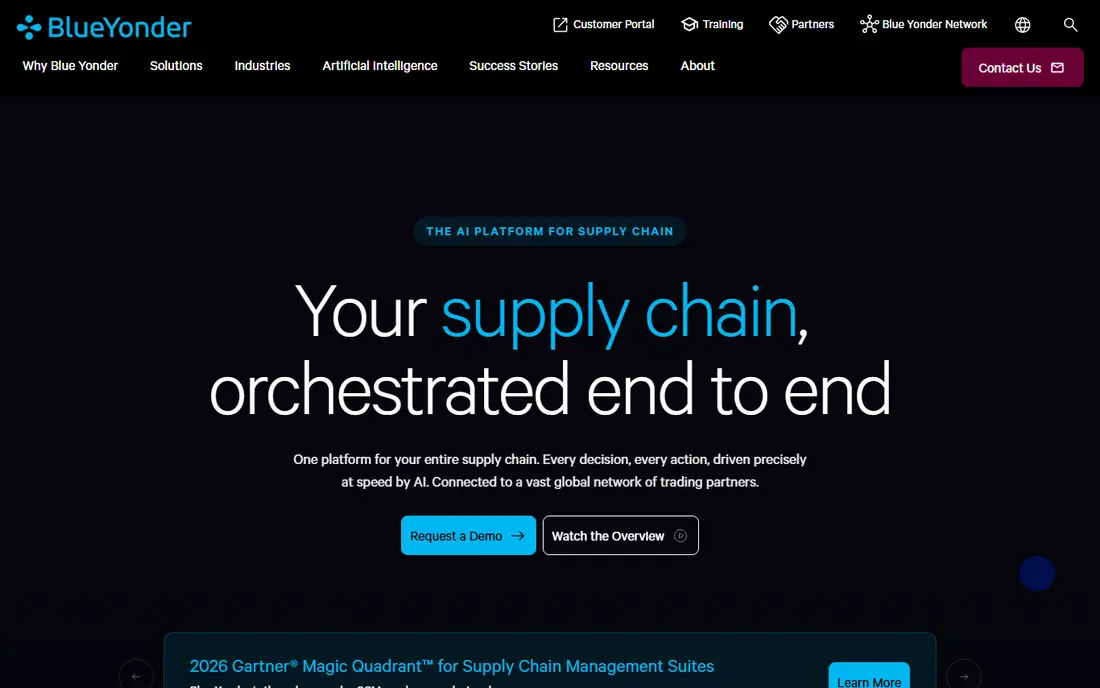
Blue Yonder suits large firms that want planning and execution in one vendor relationship. Its breadth helps firms move from forecast to warehouse and transport without stitching many vendors together, though that breadth adds implementation work.
The main catch is worth weighing before you buy. It also helps to trial the tool with real data and real users, since demos rarely show permission, reporting, or support limits. Check the current pricing page before you sign, since enterprise and usage-based prices change often, and confirm that the integrations and data controls your team needs are included in the tier you plan to buy.
- Covers planning through warehouse and transport
- AI agents for execution
- Broad suite depth
- Quote-only pricing
- Implementation is often long and needs vendor support
Oracle Supply Chain Management Cloud
Best for: Oracle ERP firms
Oracle Supply Chain Management Cloud suits firms already running Oracle ERP and finance. Its planning modules share data with orders, inventory, and finance, which cuts reconciliation work for Oracle shops.
The main catch is worth weighing before you buy. It also helps to trial the tool with real data and real users, since demos rarely show permission, reporting, or support limits. Check the current pricing page before you sign, since enterprise and usage-based prices change often, and confirm that the integrations and data controls your team needs are included in the tier you plan to buy.
- Deep link to Oracle ERP and finance
- Broad planning and execution modules
- Global scale
- Quote-only pricing
- Best value needs Oracle stack use
SAP Integrated Business Planning suits firms already running SAP, where planning data should flow from the same ERP. Its modules cover demand, supply, inventory, and sales and operations planning, though firms outside SAP may find best-of-breed tools simpler to deploy.
The main catch is worth weighing before you buy. It also helps to trial the tool with real data and real users, since demos rarely show permission, reporting, or support limits. Check the current pricing page before you sign, since enterprise and usage-based prices change often, and confirm that the integrations and data controls your team needs are included in the tier you plan to buy.
- Strong link to SAP ERP
- Demand, supply, and inventory planning
- Global enterprise scale
- Quote-only pricing
- Implementation needs SAP expertise
E2open suits firms that need visibility across suppliers, partners, and logistics providers. Its network approach helps firms track orders and shipments across many partners, and its entry tier gives smaller firms a lower-cost starting point than most enterprise rivals.
The main catch is worth weighing before you buy. It also helps to trial the tool with real data and real users, since demos rarely show permission, reporting, or support limits. Check the current pricing page before you sign, since enterprise and usage-based prices change often, and confirm that the integrations and data controls your team needs are included in the tier you plan to buy.
- Large partner network
- Planning plus execution visibility
- Published entry tier in some reports
- Enterprise pricing varies widely
- Network onboarding takes time
Infor Supply Chain Planning
Best for: Manufacturing and distribution firms
Infor Supply Chain Planning suits manufacturers and distributors already using Infor tools. Its industry-specific planning helps firms handle production schedules, inventory, and distribution with tools built for their sector.
The main catch is worth weighing before you buy. It also helps to trial the tool with real data and real users, since demos rarely show permission, reporting, or support limits. Check the current pricing page before you sign, since enterprise and usage-based prices change often, and confirm that the integrations and data controls your team needs are included in the tier you plan to buy.
- Strong manufacturing and distribution planning
- Link to Infor ERP
- Industry depth
- Quote-only pricing
- Best fit needs Infor ecosystem use
Manhattan Associates suits firms where warehouse and order execution matter as much as the plan. Its execution strength helps firms promise accurate delivery dates and run warehouses efficiently, with planning tools that feed those operations.
The main catch is worth weighing before you buy. It also helps to trial the tool with real data and real users, since demos rarely show permission, reporting, or support limits. Check the current pricing page before you sign, since enterprise and usage-based prices change often, and confirm that the integrations and data controls your team needs are included in the tier you plan to buy.
- Leads in warehouse and execution
- Strong order management
- Planning links to execution
- Quote-only pricing
- Planning depth is narrower than pure planning leaders
Coupa Supply Chain Planning
Best for: Scenario and network design
Coupa suits firms that want to model network changes and test scenarios before committing capital. Its digital twin tools help planners ask what happens if a supplier fails, demand jumps, or a site closes, and see cost and service impact quickly.
The main catch is worth weighing before you buy. It also helps to trial the tool with real data and real users, since demos rarely show permission, reporting, or support limits. Check the current pricing page before you sign, since enterprise and usage-based prices change often, and confirm that the integrations and data controls your team needs are included in the tier you plan to buy.
- Digital twin scenarios
- Network design and optimization
- Link to Coupa spend tools
- Quote-only pricing
- Newer planning brand for some buyers
How we picked these
We compared official feature pages, pricing pages, app store listings, and public documentation for each product, and we kept only products that are available now and truly fit the topic. We did not claim hands-on testing we did not do, and where a vendor does not publish a price we say so rather than guessing. Prices below reflect vendor pages and recent pricing summaries checked in October 2026, so confirm the current figure before you buy.
How to choose planning software
Start with the planning problem you must fix: forecast accuracy, inventory targets, production schedules, or network design. Then check ERP links, data quality, and who will staff the project, since data cleanup often takes longer than software setup. Run a pilot on one product family or region, measure forecast error and inventory change, and get implementation, training, and renewal costs in writing. Enterprise rollouts often take 12 to 18 months, so plan for phased go-lives.
Sources
Frequently asked questions
What is the best supply chain planning software?
Kinaxis, o9 Solutions, and Blue Yonder lead for enterprise planning depth. Oracle and SAP suit firms already on those ERPs, while Manhattan suits execution-led firms and Coupa suits scenario and network design.
What is the difference between supply chain planning and execution?
Planning decides what should happen, including forecasts, inventory targets, and production schedules. Execution makes it happen, including warehouse work, transport, and order fulfillment.
How much does supply chain planning software cost?
Most enterprise tools are quote-only, with annual deals often running from tens of thousands into six or seven figures, plus implementation that can match or exceed the first-year license. Always budget implementation separately.
Do I need planning software if I already have an ERP?
ERPs handle transactions well but plan poorly. If planners live in spreadsheets beside the ERP, planning software fills that gap with forecasting, scenario modeling, and optimization.
What is a digital twin in supply chain planning?
It is a live virtual model of suppliers, plants, inventory, lanes, and demand that you can run scenarios against. Tools from o9, Coupa, and Kinaxis use it to answer disruption questions in minutes instead of weeks.