Cloudflare Alternatives in 2026: 9 Services Compared
By ToolNimba Editorial Team November 13, 2026 10 min read

- Top pick
 Fastly
Programmable edge for developers
Starting priceSee websiteCheck out FastlyRead our review - Runner-up
 Akamai
Enterprise global delivery
Starting priceSee websiteCheck out AkamaiRead our review - Also great
 Amazon CloudFront
AWS-based delivery
Starting price$0.085 per GBCheck out Amazon CloudFrontRead our review
How we researched this
We compared official pricing and feature pages, app store listings, privacy policies and public user reviews. Prices change, so check the provider's site before you pay.
Key takeaways
- Fastly suits developer teams that want programmable edge logic and instant cache purging.
- Akamai and Imperva suit large enterprises where security and support matter more than a low entry price.
- Amazon CloudFront is the natural pick for teams already running on AWS, with pay-as-you-go pricing.
- Bunny.net and KeyCDN offer the lowest published per-gigabyte prices for straightforward content delivery.
- Sucuri suits small WordPress sites that need a firewall and malware cleanup in one package.
Quick comparison
| Name | Best for | Starting price | Free plan | |
|---|---|---|---|---|
| Fastly | Programmable edge for developers | See website | Yes | Visit |
| Akamai | Enterprise global delivery | See website | No | Visit |
| Amazon CloudFront | AWS-based delivery | $0.085 per GB | Yes | Visit |
 Sucuri | WordPress security and CDN | $229 per year | No | Visit |
 Bunny.net | Low-cost global delivery | $0.01 per GB | Free trial | Visit |
 KeyCDN | Simple pay-as-you-go CDN | $0.04 per GB | Free trial | Visit |
 Gcore | Global delivery with free tier | Free | Yes | Visit |
 Imperva | Enterprise WAF and DDoS cover | See website | No | Visit |
 Google Cloud CDN | Google Cloud delivery | $0.08 per GB | Yes | Visit |
The best cloudflare alternatives
Cloudflare bundles a CDN, DNS, DDoS protection and a web application firewall in one platform, so no single rival replaces it exactly. The services below each cover part of that bundle, and the right pick depends on whether you need speed, security, developer control or a low bill. We compared official pricing pages and independent CDN comparisons from 2026, and we focused on pricing model, security features and fit.
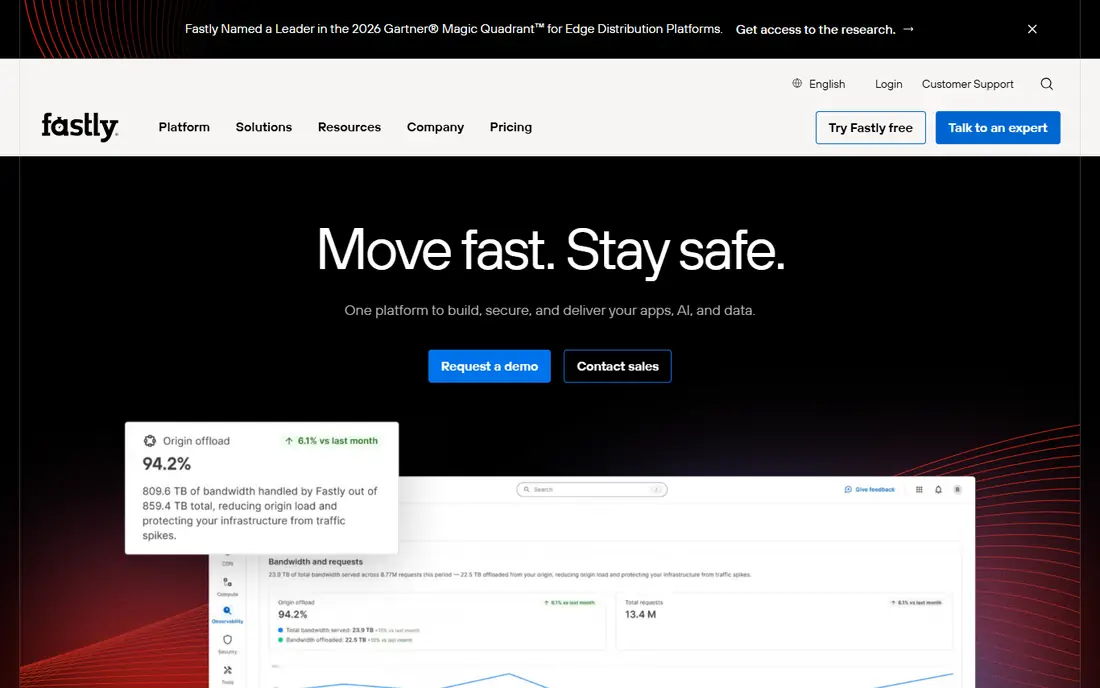
Fastly is the developer pick in this list. Its edge platform lets teams run custom logic close to users, purge cached content instantly, and watch traffic in real time. That control suits SaaS products, APIs and sites where content changes often and stale caches cause real problems. A limited developer account is available to start.
The trade-off is cost structure. Delivery is metered, and published comparisons list rates around $0.12 per GB, with a separate charge for the Next-Gen WAF. Small sites may pay little, but high-traffic sites should model the bill before switching. If your team writes code at the edge, Fastly is worth the complexity. If you want a simple set-and-forget CDN, a cheaper specialist will do.
- Programmable edge with instant purge
- Strong developer tooling and real-time stats
- Good fit for APIs and dynamic apps
- Pricing is usage-based and can surprise at scale
- WAF features cost extra on top of delivery
Akamai runs one of the largest delivery networks in the world, and it is the default pick for large enterprises with global audiences. Its platform combines delivery with edge security, bot management and DDoS protection, backed by enterprise support and service agreements. For media companies, banks and global retailers, that scale and support matter.
Small sites should look elsewhere. Akamai does not publish a simple self-serve price, and contracts are built for volume. If your traffic is modest, Bunny.net or KeyCDN will deliver pages for far less. If your traffic is global and your uptime requirements are strict, Akamai belongs on the shortlist.
- One of the largest global networks
- Strong enterprise security and DDoS cover
- Deep controls for large traffic volumes
- Pricing is by contract, not published self-serve rates
- Overkill and costly for small sites
Amazon CloudFront is the natural CDN for teams already on AWS. It integrates with S3, EC2, load balancers and AWS Shield and WAF, and billing sits on the same AWS invoice. Pricing starts around $0.085 per GB in the US, with a free tier of 1 TB per month for the first 12 months. Request charges apply on top of transfer.
The catch is that metered pricing punishes high-volume, low-margin delivery. At very large volumes, flat-rate specialists can cost far less than CloudFront pay-as-you-go rates. For AWS-native apps with moderate traffic, CloudFront is convenient and well integrated. For pure bulk delivery, compare Bunny.net before committing.
- Deep integration with AWS origins and services
- Pay-as-you-go pricing
- Free tier covers 1 TB per month for the first year
- Metered transfer gets expensive outside AWS bundles
- Setup is more complex than a flat-rate CDN
Sucuri leads with security rather than raw delivery speed. Its platform plans, listed from $229 per year for the basic tier in recent comparisons, bundle a CDN with a website firewall, malware scanning and cleanup, and an incident response team. That combination suits WordPress site owners and small businesses that worry about hacks more than edge logic.
The delivery side is solid but not the fastest in this list, and the network is smaller than Akamai or Fastly. If your main risk is malware and attacks on a CMS site, Sucuri is a strong pick. If your main need is cheap global delivery of large files, a pure CDN will cost less.
- Website firewall plus malware scanning and cleanup
- Strong fit for WordPress and small business sites
- Incident response team
- Delivery network is smaller than pure CDNs
- Platform plans cost more than the basic firewall tier
Bunny.net is the budget pick for straightforward delivery. Pricing starts at $0.01 per GB on some networks, with a $1 per month minimum, and a 14-day trial lets you test performance before paying. It supports storage, video delivery and image optimization, and setup is quick for WordPress and static sites.
Security is the limit. Bunny.net offers DDoS protection and basic controls, but it is not a full WAF platform like Imperva or Sucuri. Sites that face frequent attacks should pair it with a firewall or pick a security-first service. Sites that mainly need fast, cheap delivery will find Bunny.net hard to beat.
- Very low per-gigabyte pricing from $0.01 per GB
- Volume network option cuts costs further
- Simple setup with a 14-day trial
- Security features are thinner than WAF-first rivals
- No permanent free plan
KeyCDN suits developers and site owners who want a simple CDN without a contract. Pricing starts at $0.04 per GB for the first 10 TB per month in North America and Europe, with higher regional rates elsewhere, a $4 per month minimum, and a free 14-day trial. It includes DDoS protection, bot blocking, secure tokens and free TLS.
The pricing model is honest but regional. Traffic to Asia, Oceania, Africa and Latin America costs more, so sites with a global audience should check the regional table before estimating a bill. For North American and European audiences, KeyCDN is a clean, low-friction pick.
- Simple pay-as-you-go pricing from $0.04 per GB in North America and Europe
- Free TLS and HTTP/2 support
- Easy WordPress integration
- Minimum $4 per month
- Asian and African traffic costs more per gigabyte
Gcore offers a free tier of 1 TB per month, which makes it one of the few CDNs in this list you can run at no cost for a small site. Paid delivery starts around 0.01 euros per GB after the free allowance in recent comparisons. The network covers Europe well and extends globally, and Gcore also sells security, streaming and edge services.
Paid list prices are higher than Bunny.net at large volumes, so heavy users should compare volume rates. For a small or mid-size site that wants a free start and room to grow, Gcore is a practical option. For bulk delivery at the lowest price, Bunny.net remains cheaper.
- Free tier includes 1 TB per month
- Global network with strong European coverage
- CDN plus security and streaming options
- List prices above the free tier are higher than budget CDNs
- Enterprise features need a sales conversation
Imperva, formerly Incapsula, is a security platform first and a CDN second. Its strengths are an advanced web application firewall, bot protection, API security and DDoS mitigation, which suit finance, healthcare and other high-risk sectors. Delivery is included, but buyers choose Imperva for protection, not for the cheapest gigabyte.
Pricing is enterprise-grade and largely by quote, so small sites will find it expensive. Recent comparisons list enterprise WAF pricing in the thousands per month for large deployments. If security compliance drives your choice, Imperva belongs on the shortlist. If price drives it, look at Sucuri or Bunny.net instead.
- Advanced WAF, bot protection and API security
- Strong DDoS mitigation
- Suited to regulated and high-risk industries
- Enterprise pricing with no simple self-serve tier
- CDN is secondary to the security platform
Google Cloud CDN is the natural pick for teams running on Google Cloud. It plugs into Cloud Load Balancing and Cloud Storage, uses a global anycast network, and charges from around $0.08 per GB in recent comparisons, with a free tier for new accounts. It also pairs with Google Cloud Armor for WAF and DDoS rules.
Outside Google Cloud, the integration advantage disappears, and a standalone CDN may be simpler. For Google Cloud apps, though, keeping delivery, security rules and billing in one console is a real advantage. Model request and egress charges together, since the per-gigabyte rate is only part of the bill.
- Native integration with Google Cloud load balancing and storage
- Anycast network
- Free tier and pay-as-you-go pricing
- Best value only inside Google Cloud
- Setup assumes cloud experience
How we picked these
We compared official pricing pages and independent CDN comparisons from 2026, and we favored services with a current product, published or widely reported pricing, and a clear fit for either delivery or security. We left Cloudflare itself out, since the topic is alternatives, and we left out discontinued services such as StackPath. Prices for metered CDNs depend on region and volume, so treat every per-gigabyte figure as a starting point and confirm the rate for your traffic mix.
What to check before you switch
Delivery versus security
A cheap CDN may not include a strong WAF, and a strong WAF may not be the cheapest delivery. Decide which risk matters more for your site, then check whether you need two services or one platform that covers both.
Pricing model
Flat monthly plans suit predictable traffic, while per-gigabyte pricing suits variable traffic but can spike. Compare your last three months of transfer, requests and regions before choosing a model, not just the headline rate.
Origin and integration
A CDN that plugs into your existing cloud, CMS or origin will save setup time and support calls. Check WordPress plugins, S3 or storage links, and cache purge tools before you migrate.
Trial and purge
Use the free trial or free tier to test cache purge speed, time to first byte from your main regions, and behavior during a traffic spike. A CDN that is slow to purge will cause stale content problems that no low price can fix.
Sources
Frequently asked questions
What is the best Cloudflare alternative for most websites?
For most small sites, Bunny.net or KeyCDN offer cheap, simple delivery, while Sucuri suits WordPress sites that need security too. Large enterprises should compare Akamai and Imperva, and AWS or Google Cloud users should start with their own cloud CDN.
Is there a free Cloudflare alternative?
Gcore offers a free tier of 1 TB per month, and Fastly offers a limited developer account. Amazon CloudFront and Google Cloud CDN offer free tiers for new accounts, usually time-limited. No free tier here matches the full Cloudflare free plan, so check what each tier actually includes.
Which Cloudflare alternative is cheapest for video and large files?
Bunny.net is usually cheapest for bulk delivery, with rates from $0.01 per GB and a volume network option. KeyCDN is also low cost for North American and European traffic. Compare regional rates, since the cheapest rate in one region may not hold worldwide.
Do I need a WAF if I switch from Cloudflare?
If your site faces attacks, bots or login abuse, yes. Sucuri and Imperva include strong WAF features, while pure CDNs such as Bunny.net and KeyCDN offer only basic protection. You can also pair a cheap CDN with a separate WAF if that combination costs less.
Can I use a CDN without changing my DNS provider?
Most CDNs work with your existing DNS by pointing a hostname at the CDN, though some security features work better when the CDN handles DNS too. Check the setup guide for your chosen service before migration, and keep your DNS records backed up.